Louise H. Westling - Böcker
Visar alla böcker från författaren Louise H. Westling. Handla med fri frakt och snabb leverans.
4 produkter
4 produkter
489 kr
Skickas inom 5-8 vardagar
In searching American literary landscapes for what they can reveal about our attitudes toward nature and gender, The Green Breast of the New World considers symbolic landscapes in twentieth-century American fiction, the characters who inhabit those landscapes, and the gendered traditions that can influence the figuration of both of these fictional elements. In this century, says Louise H. Westling, American literary responses to landscape and nature have been characterized by a puzzling mix of eroticism and misogyny, celebration and mourning, and reverence and disregard. Focusing on problems of gender conflict and imperialist nostalgia, The Green Breast of the New World addresses this ambivalence. Westling begins with a "deep history" of literary landscapes, looking back to the archaic Mediterranean/Mesopotamian traditions that frame European and American symbolic figurations of humans in the land. Drawing on sources as ancient as the Sumerian Hymns to Innana and the Epic of Gilgamesh, she reveals a tradition of male heroic identity grounded in an antagonistic attitude toward the feminized earth and nature. This identity recently has been used to mask a violent destruction of wilderness and indigenous peoples in the fictions of progress that have shaped our culture. Examining the midwestern landscapes of Willa Cather's Jim Burden and Ernest Hemingway's Nick Adams, and the Mississippi Delta of William Faulkner's Thomas Sutpen and Isaac McCaslin and Eudora Welty's plantation families and small-town dwellers, Westling shows that these characters all participate in a cultural habit of gendering the landscape as female and then excusing their mistreatment of it by retreating into a nostalgia that erases their real motives, displaces responsibility, and takes refuge in attitudes of self-pitying adoration.
Sacred Groves and Ravaged Gardens
The Fiction of Eudora Welty, Carson McCullers, and Flannery O'Connor
Häftad, Engelska, 2008
507 kr
Skickas inom 5-8 vardagar
In Sacred Groves and Ravaged Gardens, Louise Westling explores how the complex, difficult roles of women in southern culture shaped the literary worlds of Eudora Welty, Carson McCullers, and Flannery O'Connor. Tracing the cultural heritage of the South, Westling shows how southern women reacted to the violent, false world created by their men—a world in which women came to be shrouded as icons of purity in atonement for the sins of men. Exposing the actual conditions of women's lives, creating assertive protagonists who resist or revise conventional roles, and exploring rich matriarchal traditions and connections to symbolic landscapes Welty, McCullers, and O'Connor created a body of fiction that enriches and complements the patriarchal version of southern life presented in the works of William Faulkner, John Crowe Ransom, Allen Tate, and William Styron.
353 kr
Skickas inom 5-8 vardagar
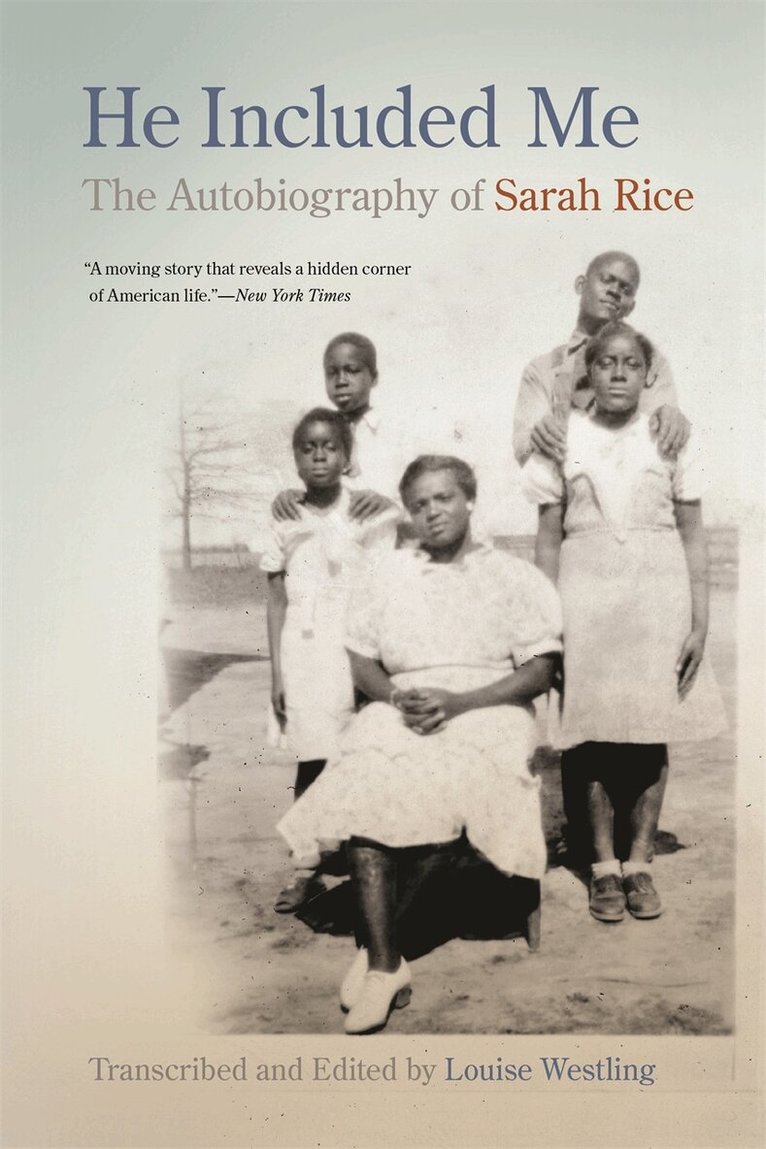
A rare first-person account of life in the twentieth-century South, He Included Me weaves together the story of a black family—eight children reared in rural Alabama, their mother a schoolteacher, their father a minister—and the emerging self-portrait of a woman determined, like her parents, to look ahead.Sarah Rice recalls her mother's hymn of thanks—"He Included Me"—when God showed her a way to feed her family, and hears again her mother's quiet words, "It's no disgrace to work. It's an honor to make an honest dollar," spoken when her children were embarrassed that she took in white people's laundry. Rice speaks, finally, of the determination, faith, and pride that carried her through life.In a document that spans more than three-quarters of the twentieth century, He Included Me presents the voice of a single woman whose life was rich in complexity, deep in suffering and joy; yet it also speaks for the many black women who have worked and struggled in the rural South and always looked ahead.
1 469 kr
Skickas inom 5-8 vardagar
In searching American literary landscapes for what they can reveal about our attitudes toward nature and gender, The Green Breast of the New World considers symbolic landscapes in twentieth-century American fiction, the characters who inhabit those landscapes, and the gendered traditions that can influence the figuration of both of these fictional elements. In this century, says Louise H. Westling, American literary responses to landscape and nature have been characterized by a puzzling mix of eroticism and misogyny, celebration and mourning, and reverence and disregard. Focusing on problems of gender conflict and imperialist nostalgia, The Green Breast of the New World addresses this ambivalence. Westling begins with a "deep history" of literary landscapes, looking back to the archaic Mediterranean/Mesopotamian traditions that frame European and American symbolic figurations of humans in the land. Drawing on sources as ancient as the Sumerian Hymns to Innana and the Epic of Gilgamesh, she reveals a tradition of male heroic identity grounded in an antagonistic attitude toward the feminized earth and nature. This identity recently has been used to mask a violent destruction of wilderness and indigenous peoples in the fictions of progress that have shaped our culture. Examining the midwestern landscapes of Willa Cather's Jim Burden and Ernest Hemingway's Nick Adams, and the Mississippi Delta of William Faulkner's Thomas Sutpen and Isaac McCaslin and Eudora Welty's plantation families and small-town dwellers, Westling shows that these characters all participate in a cultural habit of gendering the landscape as female and then excusing their mistreatment of it by retreating into a nostalgia that erases their real motives, displaces responsibility, and takes refuge in attitudes of self-pitying adoration.