Lowell D. Holmes - Böcker
Visar alla böcker från författaren Lowell D. Holmes. Handla med fri frakt och snabb leverans.
4 produkter
4 produkter
2 304 kr
Skickas inom 3-6 vardagar
Holmes and Holmes have revised their 1983 book, and it remains a good supplement for an undergraduate gerontology course or anthropology course. It is written at a readable level, each chapter has a clear summary. . . . It provides an excellent summary of secondary sources, avoiding extensive review of primary research, complicated theory, and methodological issues. --Clinical Gerontologist Hailed as "extremely well organized, balanced, and impartial" in its first edition by The Gerontologist, Other Cultures, Elder Years is once again available in a fully revamped second edition. This new edition provides a comprehensive, comparative viewpoint on our knowledge about worldwide patterns of aging. It addresses everything from demographic patterns to family relations, from perceptions of the life cycle to the impact of modernization on the aged. Replete with summaries of crucial studies from various parts of the world, Other Cultures, Elder Years also offers three extended case descriptions of Inuit, Samoan, and white American aged as well as an examination of aging patterns among major American ethnic groups. Among the other subjects the text addresses are cultural perspectives in health care, the future of aging in America, and creativity and the life cycle. Other Cultures, Elder Years is the key text available for use by anyone teaching courses on aging and culture. "I found the current [book] a significant improvement over the first edition. . . . It remains to be the only usable text in the anthropology of aging available. I see the audiences for the book as instructors for the following courses: Anthropology of Aging, Sociology of Aging, and general social gerontology courses. I have used this book in past Anthropology of Aging courses and would do so again." --Jay Sokolovsky, University of Maryland, Baltimore County "This book does a truly artful job of organizing and presenting the complex diversity of human experience related to aging and cultural influence. . . . This book offers an implicit biocultural laboratory to the reader: the biologic universal of human aging is shaped by the prism of cultural influence. The reader is guided through the evolutionary history of aging among anthropoid primates, to hominids, to Homo sapiens sapiens, who are then examined from cultural perspectives found around the globe. The effect is one of inquiry, search, synthesis, and, ultimately, a confrontation with our inner selves as we negotiate the inexorable march toward our ultimate destiny." --J. Neil Henderson, Suncoast Gerontology Center, University of South Florida
1 009 kr
Skickas inom 10-15 vardagar
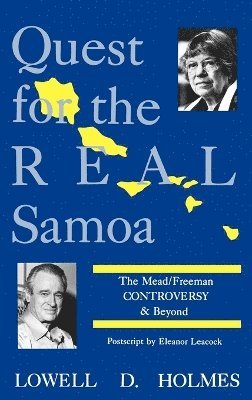
Since the controversy began, Homes's restudy has been criticized by Freeman. Now Holmes has published his dissertation findings along with more recent observations on the controversy. Because he conducted the only explicit restudy of the Manu'a group, and because of his own extensive research in the islands over three decades, Holmes's Quest for the Real Samoa is worth reading. While the book will not resolve the controversy, it does provide an interesting perspective, some new data, and useful insights into the controversy. . . . Holmes concludes that Mead's work will endure, not because it was flawless or because it is a model for contemporary research, but precisely because it was pioneering and controversial. He sees the tragedy of the controversy in Freeman's almost exclusive focus on Mead, which could obscure Freeman's potential contribution to Samoan ethnography. This is where Freeman and Holmes differe fundamentally. For Freeman, the ultimate issue is the refutation of Mead's ideas on Samoan adolescence. For Holmes, it is a deeper appreciation of the possibilities of Samoan ethnography. To get beyond the Mead/Freeman controversy, it is this latter path that should be explored. American Anthropologist Holmes has a special claim to be heard, for in 1954 he did a restudy of Tau, the same village Mead had worked in 29 years before. While Mr. Holmes disagrees with her on various points, he does not find the `truth' to be midway between Mead and Mr. Freeman. His work showed the quality of Mead's Samoan research to be `remarkably high,' while Mr. Freeman's refuation was, in Mr. Holmes's opinion, both methodologically shoddy and uncorroborated by the evidence. New York Times Book Review
368 kr
Skickas inom 10-15 vardagar
Mr. Holmes' study is . . . the basic stuff of competent ethnography, that combination of science and art in which the details of daily life are systematically observed, analyzed and constructed into a cultural account. . . He concludes that Margaret Mead was essentially correct in her depiction of coming of age in Samoa in 1925, concerned as she was to compare it with adolescence in the United States at that time. New York Times Book Review Thanks to Holmes' compelling review of the `great debate,' we see [all these things] more clearly because he is acting as more than just an informed guide to the facts and the issues; he is providing an insightful exposition on the nature of anthropological inquiry. Science Book & Films
376 kr
Tillfälligt slut
An account of Robert Louis Stevenson's desperate search for health, and the fulfilment of his life-long ambition to cross broad oceans in tall ships and gain an understanding of the world beyond the frontiers of 'civilised' society. It is the story of a literary giant and his supportive and somewhat eccentric family and the ships-the Casco, the Equator and the Janet Nicoll-that transported them to high adventure in the South Pacific between the years 1888 and 1890. Like many sailors before and since, the South Sea islands haunted and inspired legendary author Robert Louis Stevenson. Lowell D. Holmes' account of Stevenson's Pacific wanderings is an enchanting mix of high seas adventure and a fresh view of the fragile writer and his eccentric but devoted family. Holmes an anthropologist and a sailor, senses a kindred spirit as he describes Stevenson's fascination and respect for the island cultures.