Luc Bauwens – författare
Visar alla böcker från författaren Luc Bauwens. Handla med fri frakt och snabb leverans.
7 produkter
7 produkter
Inbunden, Engelska, 2000
2 849 kr
Skickas inom 5-8 vardagar
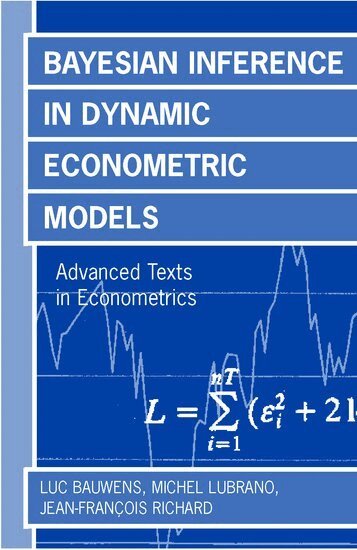
This book contains an up-to-date coverage of the last twenty years advances in Bayesian inference in econometrics, with an emphasis on dynamic models. It shows how to treat Bayesian inference in non linear models, by integrating the useful developments of numerical integration techniques based on simulations (such as Markov Chain Monte Carlo methods), and the long available analytical results of Bayesian inference for linear regression models. It thus covers a broad range of rather recent models for economic time series, such as non linear models, autoregressive conditional heteroskedastic regressions, and cointegrated vector autoregressive models. It contains also an extensive chapter on unit root inference from the Bayesian viewpoint. Several examples illustrate the methods.
Häftad, Engelska, 2000
985 kr
Skickas inom 5-8 vardagar
This book contains an up-to-date coverage of the last twenty years advances in Bayesian inference in econometrics, with an emphasis on dynamic models. It shows how to treat Bayesian inference in non linear models, by integrating the useful developments of numerical integration techniques based on simulations (such as Markov Chain Monte Carlo methods), and the long available analytical results of Bayesian inference for linear regression models. It thus covers a broad range of rather recent models for economic time series, such as non linear models, autoregressive conditional heteroskedastic regressions, and cointegrated vector autoregressive models. It contains also an extensive chapter on unit root inference from the Bayesian viewpoint. Several examples illustrate the methods.
Del 3 - Wiley Handbooks in Financial Engineering and Econometrics
Handbook of Volatility Models and Their Applications
Inbunden, Engelska, 2012
2 038 kr
Skickas inom 5-8 vardagar
A complete guide to the theory and practice of volatility models in financial engineering Volatility has become a hot topic in this era of instant communications, spawning a great deal of research in empirical finance and time series econometrics. Providing an overview of the most recent advances, Handbook of Volatility Models and Their Applications explores key concepts and topics essential for modeling the volatility of financial time series, both univariate and multivariate, parametric and non-parametric, high-frequency and low-frequency.Featuring contributions from international experts in the field, the book features numerous examples and applications from real-world projects and cutting-edge research, showing step by step how to use various methods accurately and efficiently when assessing volatility rates. Following a comprehensive introduction to the topic, readers are provided with three distinct sections that unify the statistical and practical aspects of volatility: Autoregressive Conditional Heteroskedasticity and Stochastic Volatility presents ARCH and stochastic volatility models, with a focus on recent research topics including mean, volatility, and skewness spillovers in equity markets Other Models and Methods presents alternative approaches, such as multiplicative error models, nonparametric and semi-parametric models, and copula-based models of (co)volatilities Realized Volatility explores issues of the measurement of volatility by realized variances and covariances, guiding readers on how to successfully model and forecast these measures Handbook of Volatility Models and Their Applications is an essential reference for academics and practitioners in finance, business, and econometrics who work with volatility models in their everyday work. The book also serves as a supplement for courses on risk management and volatility at the upper-undergraduate and graduate levels.
Inbunden, Engelska, 2001
1 114 kr
Skickas inom 10-15 vardagar
Over the past 25 years, applied econometrics has undergone tremen dous changes, with active developments in fields of research such as time series, labor econometrics, financial econometrics and simulation based methods. Time series analysis has been an active field of research since the seminal work by Box and Jenkins (1976), who introduced a gen eral framework in which time series can be analyzed. In the world of financial econometrics and the application of time series techniques, the ARCH model of Engle (1982) has shifted the focus from the modelling of the process in itself to the modelling of the volatility of the process. In less than 15 years, it has become one of the most successful fields of 1 applied econometric research with hundreds of published papers. As an alternative to the ARCH modelling of the volatility, Taylor (1986) intro duced the stochastic volatility model, whose features are quite similar to the ARCH specification but which involves an unobserved or latent component for the volatility. While being more difficult to estimate than usual GARCH models, stochastic volatility models have found numerous applications in the modelling of volatility and more particularly in the econometric part of option pricing formulas. Although modelling volatil ity is one of the best known examples of applied financial econometrics, other topics (factor models, present value relationships, term structure 2 models) were also successfully tackled.
Del 38 - Advanced Studies in Theoretical and Applied Econometrics
Econometric Modelling of Stock Market Intraday Activity
Häftad, Engelska, 2010
1 105 kr
Skickas inom 10-15 vardagar
Over the past 25 years, applied econometrics has undergone tremen dous changes, with active developments in fields of research such as time series, labor econometrics, financial econometrics and simulation based methods. Time series analysis has been an active field of research since the seminal work by Box and Jenkins (1976), who introduced a gen eral framework in which time series can be analyzed. In the world of financial econometrics and the application of time series techniques, the ARCH model of Engle (1982) has shifted the focus from the modelling of the process in itself to the modelling of the volatility of the process. In less than 15 years, it has become one of the most successful fields of 1 applied econometric research with hundreds of published papers. As an alternative to the ARCH modelling of the volatility, Taylor (1986) intro duced the stochastic volatility model, whose features are quite similar to the ARCH specification but which involves an unobserved or latent component for the volatility. While being more difficult to estimate than usual GARCH models, stochastic volatility models have found numerous applications in the modelling of volatility and more particularly in the econometric part of option pricing formulas. Although modelling volatil ity is one of the best known examples of applied financial econometrics, other topics (factor models, present value relationships, term structure 2 models) were also successfully tackled.
Inbunden, Engelska, 2007
1 105 kr
Skickas inom 10-15 vardagar
In this paper, we propose a new econometric approach to jointly model the time series dynamics of the trading process and the revisions of ask and bid prices. Namely, we test whether ask and bid quotes respond symmetrically to trade-related shocks, and whether buyer-initiated trades and seller-initiated trades are equally informative.
Häftad, Engelska, 2010
1 073 kr
Skickas inom 10-15 vardagar
In this paper, we propose a new econometric approach to jointly model the time series dynamics of the trading process and the revisions of ask and bid prices. Namely, we test whether ask and bid quotes respond symmetrically to trade-related shocks, and whether buyer-initiated trades and seller-initiated trades are equally informative.