Lucia Reisch - Böcker
Visar alla böcker från författaren Lucia Reisch. Handla med fri frakt och snabb leverans.
2 produkter
2 produkter
3 436 kr
Skickas inom 7-10 vardagar
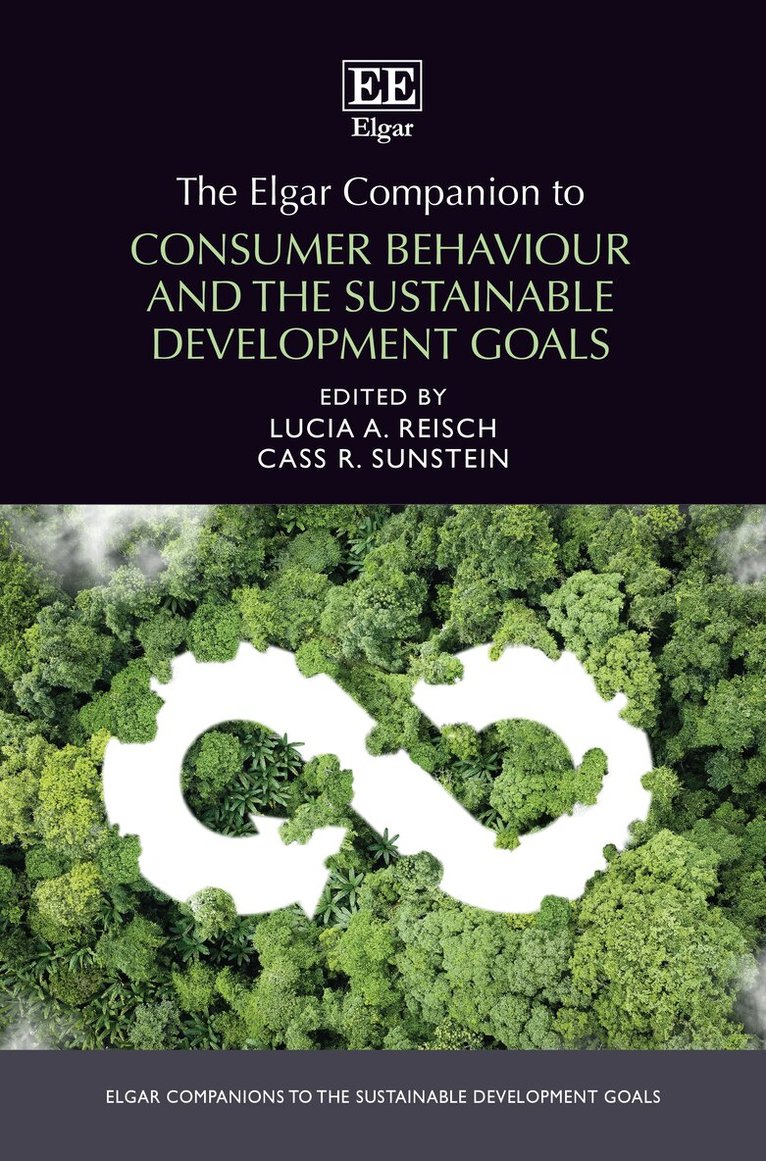
In light of the re-evaluation of the UN Sustainable Development Goals (SDGs), this timely Companion adopts an interdisciplinary approach to provide key insights on important topics, including sustainable food consumption and the mitigation of food waste.Bringing together a diverse array of prominent scholars in the field, the book combines theoretical discussion with practical applications, considering how consumer behaviour shapes our world, especially when trying to achieve the SDGs. The book highlights that, as our global community faces urgent challenges such as climate change, poverty and inequality, understanding how people make choices and their impact is crucial.The Elgar Companion to Consumer Behaviour and the Sustainable Development Goals is a fundamental resource for scholars, researchers and students of business management, organisational behaviour, development studies, management and sustainability, social psychology, and behavioural and experimental economics. Practitioners and policymakers in the fields of sustainable consumption and production, food policy, and sustainable development policy will also find the book’s practical insights to be of benefit.
19 417 kr
Skickas inom 10-15 vardagar
Proponents of ‘nudge theory’ argue that, because of our human susceptibility to an array of biases, we often make subprime choices and decisions that make us poorer, less healthy, and more miserable than we might otherwise be. However, using behavioural economics—and insights from other disciplines—they suggest that apparently small and subtle solutions (or ‘nudges’) can lead to disproportionately beneficial outcomes without unduly restricting our freedom of choice. Indeed, the apparently virtuous—and cost-effective—possibilities of nudge theory has led to its enthusiastic adoption by adherents in the highest echelons of government and business, and ‘nudge units’ (such as the Behavioural Insights Team in the British Cabinet Office) have been established in the UK, the United States, and Australia.While far from uncontroversial (some critics have questioned its ethical implications and dismissed many of its practical applications as short-term, politically motivated initiatives based on flimsy evidence), in recent years there has been an astonishing growth in scholarly output about and around the economics of nudge. And now, while the hybrid field continues to flourish, Routledge announces a new four-volume collection to provide users with a much-needed compendium of foundational and the very best cutting-edge scholarship.The collection is co-edited by Cass R. Sunstein (Robert Walmsley University Professor at Harvard), the co-author (with Richard Thaler) of the pioneering Nudge: Improving Decisions About Health, Wealth, and Happiness (2008), and Lucia Reisch of the Copenhagen Business School. The Economics of Nudge is fully indexed and has a comprehensive introduction, newly written by the editors, which places the collected material in its historical and intellectual context. It is an essential work of reference and is destined to be valued by scholars, students, and policymakers as a vital resource.