• Fri frakt över 249 kr
  • •
  • Snabba leveranser
  • •
  • Billiga böcker
Kundservice

Du är på sajten för privatpersoner.

Företag, bibliotek eller offentlig verksamhet?

Du handlar på classic.bokus.com, där alla dina funktioner finns intakta.
Till classic.bokus.com
Bokus logotyp. Gå till startsidan.
  • Erbjudanden
  • Nyheter
  • Student
  • Topplistor
  • Barn & ungdom
  • Bokus Play
  • E-böcker
  • Pocketböcker
  • Spel & pussel

Må bättre, för mindre! Upp till 50% rabatt på hälsoböcker

Sidfot

Mina sidor

    Hjälp

    • Kundservice
    • Vanliga frågor och svar
    • Frakt och leverans
    • Retur vid ångerrätt
    • Reklamera vara
    • Betalning
    • Köpvillkor
    • Allmänna villkor
    • Information om webbplatsens tillgänglighet

    Om Bokus

    • Om oss
    • Pressrum
    • För studenter
    • För företag
    • För bibliotek och offentlig verksamhet
    • För leverantörer
    • Hållbarhet

    Populärt

    • Aktuella erbjudanden
    • Presentkort
    • Studentlitteratur
    • Nya böcker
    • Topplistor
    • Signerade böcker
    • Engelska böcker

    Inspiration

    • Boktips
    • BookTok
    • Populära bokserier
    • Barnbokskaraktärer
    • Populära författare
    Logotyp för Bokus
    Följ oss på Facebook (extern länk)Följ oss på Instagram (extern länk)Följ oss på YouTube (extern länk)Följ oss på TikTok (extern länk)
    bokus @ CookiesAnpassa cookiesIntegritetspolicyKöpvillkor
    Till Citymail hemsida (extern länk)Till Budbee hemsida (extern länk)Till Postnord hemsida (extern länk)Till Schenker hemsida (extern länk)Till Early Bird hemsida (extern länk)Till Walleys hemsida (extern länk)
    1. Ekonomi och Ledarskap
    2. Nationalekonomi

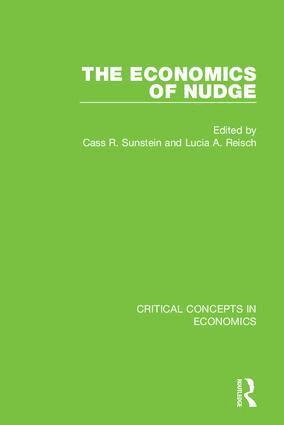
    Economics of Nudge

    AvCass Sunstein,Lucia Reisch

    Taylor & Francis Ltd

    2016

    Del i serien Critical Concepts in Economics

    20 800 kr

    Beställningsvara. Skickas inom 10-15 vardagar. Fri frakt över 249 kr.

    Beskrivning

    Proponents of ‘nudge theory’ argue that, because of our human susceptibility to an array of biases, we often make subprime choices and decisions that make us poorer, less healthy, and more miserable than we might otherwise be. However, using behavioural economics—and insights from other disciplines—they suggest that apparently small and subtle solutions (or ‘nudges’) can lead to disproportionately beneficial outcomes without unduly restricting our freedom of choice. Indeed, the apparently virtuous—and cost-effective—possibilities of nudge theory has led to its enthusiastic adoption by adherents in the highest echelons of government and business, and ‘nudge units’ (such as the Behavioural Insights Team in the British Cabinet Office) have been established in the UK, the United States, and Australia.While far from uncontroversial (some critics have questioned its ethical implications and dismissed many of its practical applications as short-term, politically motivated initiatives based on flimsy evidence), in recent years there has been an astonishing growth in scholarly output about and around the economics of nudge. And now, while the hybrid field continues to flourish, Routledge announces a new four-volume collection to provide users with a much-needed compendium of foundational and the very best cutting-edge scholarship.The collection is co-edited by Cass R. Sunstein (Robert Walmsley University Professor at Harvard), the co-author (with Richard Thaler) of the pioneering Nudge: Improving Decisions About Health, Wealth, and Happiness (2008), and Lucia Reisch of the Copenhagen Business School. The Economics of Nudge is fully indexed and has a comprehensive introduction, newly written by the editors, which places the collected material in its historical and intellectual context. It is an essential work of reference and is destined to be valued by scholars, students, and policymakers as a vital resource.

    Produktinformation

    • Märke:Taylor & Francis Ltd
    • Utgivningsdatum:2016-10-10
    • Höjd:156 x 234 x 157 mm
    • Vikt:3 120 g
    • Språk:Engelska
    • Serie:Critical Concepts in Economics
    • Antal sidor:1 556
    • Förlag:Taylor & Francis Ltd
    • EAN:9781138938533

    Utforska kategorier

    • Nationalekonomi inom Ekonomi och Ledarskap

    Innehållsförteckning

    • VOLUME 1. THE BASICSPart 1. Fundamentals 1. Tversky, A. & Kahneman, D. ‘Judgment under Uncertainty: Heuristics and Biases’, Science, 185, 4157, 1974, pp. 1124-1131. 2. Tversky, A., & Kahneman, D., ‘The Framing of Decisions and the Psychology of Choice’, Science, 211, 4481, 1981, pp. 453-458. 3. Camerer, C., Issacharoff, S., Loewenstein, G., O’Donoghue, T., & Rabin, M. ‘Regulation for Conservatives: Behavioral Economics and the Case for "Asymmetric Paternalism"’, University of Pennsylvania Law Review, 151, 3, 2003, pp. 1211-1254. 4. Sunstein, C. & Thaler, R. ‘Libertarian Paternalism Is Not an Oxymoron’, University of Chicago Law Review, 70, 4, 2003, pp. 1159-1202.5. Thaler, R., Sunstein, C., & Balz, J., ‘Choice Architecture’, in E. Shafir, ed., The Behavioral Foundations of Public Policy (Princeton: Princeton University Press, 2012), pp. 428-439. 6. Smith, C., Goldstein, D., & Johnson, E., ‘Choice without awareness: Ethical and policy implications of defaults’, Journal of Public Policy and Marketing, 32, 2, 2013, pp. 159-172. 7. Camerer, C., & Fehr, E., ‘When Does ‘Economic Man’ Dominate Social Behavior?’, Science, 311, 2006, pp. 47-52. Part 2. Counterarguments8. Glaeser, E., ‘Paternalism and Psychology’, University of Chicago Law Review, 73, 2006, pp. 133-156. 9. Gigerenzer, G.,‘On the Supposed Evidence for Libertarian Paternalism’, Review of Philosophy and Psychology, 6, 3, 2015, pp. 361-383. 10. Bubb, R., & Pildes, R., ‘How Behavioral Economics Trims Its Sails and Why’, Harvard Law Review, 127, 2014, pp. 1593-1678. 11. Cornell, N., ‘A Third Theory of Paternalism’, Michigan Law Review, 113, 2015, 1295-1336. VOLUME II. FINANCIAL MATTERSPart 3. Savings and retirement 12. Madrian, B. & Shea, D., ‘The Power of Suggestion: Inertia in 401(k) Participation and Savings Behavior’, Quarterly Journal of Economics, 116, 4, 2001, pp. 1149-1187. 13. Thaler, R. & Benartzi, S., ‘Save More Tomorrow™: Using Behavioral Economics to Increase Employee Saving’, Journal of Political Economy, 112, 1, 2004, pp. S164-S187.14. Carroll, G., Choi, J., Laibson, D., Madrian, B., & Metrick, A., ‘Optimal Defaults and Active Decisions’, Quarterly Journal of Economics, 124, 4, 2009, pp. 1639-1674.15. Hershfield, H., Goldstein, D., Sharpe, W., Fox, J., Yeykelis, L., Carstensen, L., & Bailenson, J., ‘Increasing Saving Behavior Through Age-Progressed Renderings of the Future Self’, Journal of Marketing Research, 48, 2011, pp. S23-S37. 16. Benartzi, S. & Thaler, R., ‘Behavioral Economics and the Retirement Savings Crisis’, Science, 339, 6124, 2013, pp. 1152-1153. 17. Beshears, J., Choi, J., Laibson, D., & Madrian, B., ‘Simplification and Saving’, Journal of Economic Behavior and Organization, 95, 2013, pp. 130-145. 18. Chetty, R., Friedman, J., Leth-Petersen, S., Nielsen, T., Olsen, T., ‘Active vs. Passive Decisions and Crowd-Out in Retirement Savings Accounts: Evidence from Denmark’, Quarterly Journal of Economics, 129, 3, 2014, pp. 1141-1219. Part 4. Consumers and credit markets 19. Bar-Gill, O., ‘Seduction by Plastic’, Northwestern University Law Review, 98, 4, 2004, pp. 1373-1434. 20. Gabaix, X. & Laibson, D., ‘Shrouded Attributes, Consumer Myopia, and Information Suppression in Competitive Markets’, Quarterly Journal of Economics, 121, 2, 2006, 505-540. 21. Schwartz, A., ‘Regulating for Rationality’, Stanford Law Review, 67, 2015, pp. 1373-1410. VOLUME III. ENVIRONMENT AND HEALTH BEHAVIOR Part 5. Environment and sustainability 22. Michael D. Grubb, 'Overconfident Consumers in the Marketplace', Journal of Economic Perspectives, 29, 4, 2015, 9-36. (American Economic Association).23. Goldstein, N., Cialdini, R., & Griskevicius, V., ‘A Room with a Viewpoint: Using Social Norms to Motivate Environmental Conservation in Hotels’, Journal of Consumer Research, 35, 3, 2008, pp. 472-482. 24. Allcott, H. ‘Social Norms and Energy Conservation’, Journal of Public Economics, 95, 2011, pp. 1082-1095. 25. Costa, D. & Kahn, M. ‘Energy Conservation "Nudges" and Environmentalist Ideology: Evidence from a Randomized Residential Electricity Field Experiment’, Journal of the European Economic Association, 11, 3, 2013, pp. 680-702. 26. Pichert, D., & Katsikopoulos, K., ‘Green Defaults: Information Presentation and Pro-environmental Behavior’, Journal of Environmental Psychology, 28, 2008, pp. 63-71 27. Sunstein, C., & Reisch, L., ‘Automatically Green: Behavioral Economics and Environmental Protection’, Harvard Environmental Law Review, 38, 2014, pp. 127-158 (33 pages)28. Momsen, K. & Stoerk, T., ‘From Intention to Action: Can Nudges Help Consumers to Choose Renewable Energy?’, Energy Policy, 74, 2014, pp. 376-382. 29. Asensio, O. & Delmas, M., ‘Nonprice Incentives and Energy Conservation’, Proceedings of the National Academy of Sciences, 112, 6, 2015, pp. E510-E515. 30. Newell, R. & Siikamaaki, J., ‘Nudging Energy Efficiency Behavior: The Role of Information Labels,’ Journal of the Association of Environmental and Resource Economists, 1, 4, 2014, pp. 555-598. Part 6. Health behavior31. Wansink, B., Just, D., & Payne, C., ‘Mindless Eating and Healthy Heuristics for the Irrational,’ American Economic Review, 99, 2, 2009, pp. 165-169. 32. Gine, X., Karlan, D., & Zinman, J., ‘Put Your Money Where Your Butt Is: A Commitment Contract for Smoking Cessation’, American Economic Journal: Applied Economics, 2, 2010, pp. 213-235. 33. Kling, J., Mullainathan, S., Shafir, E., Vermeulen, L., & Wrobel, M. (2012). Comparison Friction: Experimental Evidence from Medicare Drug Plans’, The Quarterly Journal of Economics, 127, 1, 2012, pp. 199-235. 34. Keller, P., Harlam, B., Loewenstein, G., & Volpp, K., ‘Enhanced Active Choice: A New Method to Motivate Behavior Change’, Journal of Consumer Psychology, 21, 2011, pp. 376-383. 35. Dai, H., Milkman, K., & Riis, J., ‘The Fresh Start Effect: Temporal Landmarks Motivate Aspirational Behavior’, Management Science, 60, 10, 2015, pp. 2563-2582. 36. Milkman, K., Minson, J., & Volpp, K., ‘Holding the Hunger Games Hostage at the Gym: An Evaluation of Temptation Bundling’, Management Science, 60, 2, 2014, pp. 283-299. VOLUME IV. DEVELOPMENT AND EDUCATIONPart 7. Poverty and development policy 37. Bertrand, M., Mullainathan, S., & Shafir, E., ‘A Behavioral-Economics View of Poverty’, American Economic Review, 94, 2, 2004, pp. 419-423. 38. Shah, A., Mullainathan, S., & Shafir, E., ‘Some Consequences of Having Too Little’, Science, 338, 2012, pp. 682-685. 39. Mani, A., Mullainathan, S., Shafir, E., & Zhao, J., ‘Poverty Impedes Cognitive Function’, Science, 341, 2013, pp. 976-980. 40. Karlan, D., McConnell, M., Mullainathan, S., & Zinman, J., ‘Getting to the Top of Mind: How Reminders Increase Saving’, National Bureau of Economic Research Working Paper 16205, 2010. 41. Dupas, P., ‘Health Behavior in Developing Countries’, Annual Review of Economics, 3, 2011, pp. 425-449. 42. Duflo, E., Kremer, M., & Robinson, J., ‘Nudging Farmers to Use Fertilizer: Theory and Experimental Evidence from Kenya’, American Economic Review, 101, 2011, pp. 2350-2390. Part 8. Education 43. Bettinger, E., Long, B., Oreopoulos, P. & Sanbonmatsu, L., ‘The Role of Application Assistance and Information in College Decisions: Results from the H&R Block FAFSA Experiment’, Quarterly Journal of Economics, 127, 3, 2012, pp. 1205-1242. 44. Castleman, B. & Page, L., ‘Summer Nudging: Can Personalized Text Messages and Peer Mentor Outreach Increase College Going Among Low-income High School Graduates?’, Journal of Economic Behavior and Organization, 115, 2015, pp. 144-160. 45. Kraft, M. & Rogers, T., ‘The Underutilized Potential of Teacher to Parent Communication: Evidence from a Field Experiment’, Economics of Education Review, 47, 2015: 49-63. Part 9. Future directions 46. Kuran, T., & Sunstein, C., ‘Availability Cascades and Risk Regulation’, Stanford Law Review, 51, 4, 1999, pp. 683-768. 47. Breman, A., ‘Give More Tomorrow: Two Field Experiments on Altruism and Intertemporal Choice’, Journal of Public Economics, 95, 11-12, 2011, 1349-1357. 48. Bhargava, S. & Loewenstein, G., ‘Behavioral Economics and Public Policy 102: Beyond Nudging’, American Economic Review: Papers and Proceedings, 2015, 105, 5, 2015, pp. 396-401. 49. Goldin, J., ‘Which Way to Nudge? Uncovering Preferences in the Behavioral Age’, Yale Law Journal, 125, 1, 2015, pp. 226-270, 50. Chetty, R., ‘Behavioral Economics and Public Policy: A Pragmatic Perspective’, American Economic Review, 2015, 105, 5, pp. 1-33.