Lucrecia Santibañez - Böcker
Visar alla böcker från författaren Lucrecia Santibañez. Handla med fri frakt och snabb leverans.
4 produkter
4 produkter
446 kr
Skickas inom 10-15 vardagar
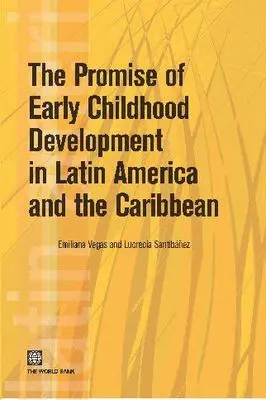
Early childhood development (ECD) outcomes affect one's income-earning capacity and productivity, longevity, health, and cognitive ability. The deleterious effects of poor ECD outcomes can be long-lasting, affecting school attainment, employment, wages, criminality, and social integration of adults. The authors first take stock of ECD indicators in the region and explore access to ECD services for children of different backgrounds. They review recent evidence on the impact of ECD interventions in the region and investigate more deeply a selection of ECD programs in Latin America and the Caribbean to distill lessons related to their design, implementation and institutionalization processes. The book concludes with a discussion of the challenges of scaling up and presents policy options to develop national ECD policies and programs that may be effective and sustained over time.
295 kr
Skickas inom 10-15 vardagar
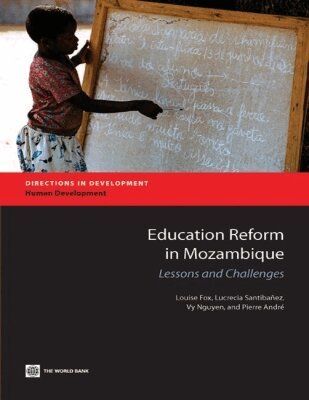
Coming out of civil war, Mozambique had an enormous education deficit. In 199, five years after the peace treaty, 80 percent of the labor force reported to have no education at all, and school enrollment outside the large cities was miserable. Since then, Mozambique has come a long way in improving access to lower and upper primary through sustained investments in education infrastructure and introduction of important reforms. The primary education reform programs implemented in 2004, combined with a continuing program of school construction and teacher training, resulted in a 70% increase in enrollment in EP1 over 4 years with the highest gains for the poorest and most vulnerable children. Yet there was only a slight increase in student/teacher ratios. How did Mozambique do this, and what are the lessons going foward? The most important part of the reform appears to be the removal of the national school fee for primary level and the provision of free textbooks. These reforms provided the boost that poorer households needed to get their children in school. Continued investments in school construction helped as well. However, despite these efforts, there is still an education deficit. In 2008, over 1 million children who should be attending primary school were not. Over half of the children who began grade 1 in 2000 did not complete grade 7 by 2008. One reason is that school costs remain high, especially for grades 6 and above (EP2+). And quality is still not adequate in many schools. As a result, the transformation of the labor force is slow, as over half of the females who entered the labor force in the decade since 1997 did not even complete EP1. Analysis of employment and livelihood opportunities indicates that the transition out of subsistence agriculture requires primary education. This means that to achieve inclusive growth, the key strategic objective of the education system needs to be ensuring that as many children as possible start and finish primary school with competency in the basic subjects, as well as the skills to allow them to find productive economic activities and make these activities pay This book is aimed at policy makers in the education field. .
Who is Leading Our Schools?
An Overview of School Administrators and Their Careers
Häftad, Engelska, 2003
287 kr
Tillfälligt slut
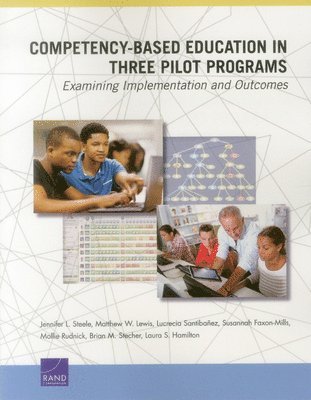
Competency-Based Education in Three Pilot Programs
Examining Implementation and Outcomes
Häftad, Engelska, 2014
339 kr
Tillfälligt slut