Luna B. Leopold - Böcker
Visar alla böcker från författaren Luna B. Leopold. Handla med fri frakt och snabb leverans.
3 produkter
3 produkter
232 kr
Skickas inom 5-8 vardagar
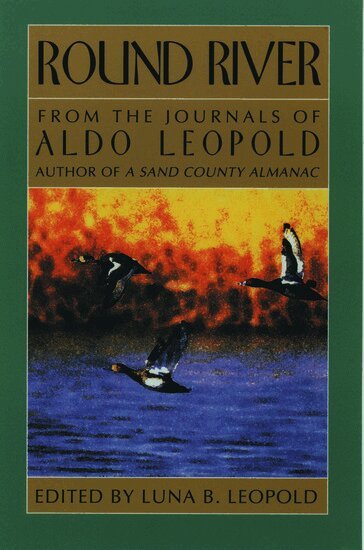
To those who know the charm of Aldo Leopold's writing in A Sand County Almanac, this collection from his journals and essays will be a new delight. The journal entries included here were written in camp during his many field trips--hunting, fishing, and exploring--and they indicate the source of ideas on land ethics found in his longer essays. They reflect as well two long canoe trips in Canada and a sojourn in Mexico, where Leopold hunted deer with bowand arrow. The essays presented here are culled from the more contemplative notes which were still in manuscript form at the time of Leopold's death in 1948, fighting a brush fire on a neighbor'sfarm. Round River has been edited by Leopold's son, Luna, a geologist well-known in the field of conservation. It is also charmingly illustrated with line drawings by Charles W. Schwartz. All admirers of Leopold's work--indeed, all lovers of nature--will find this book richly rewarding.
276 kr
Skickas inom 7-10 vardagar
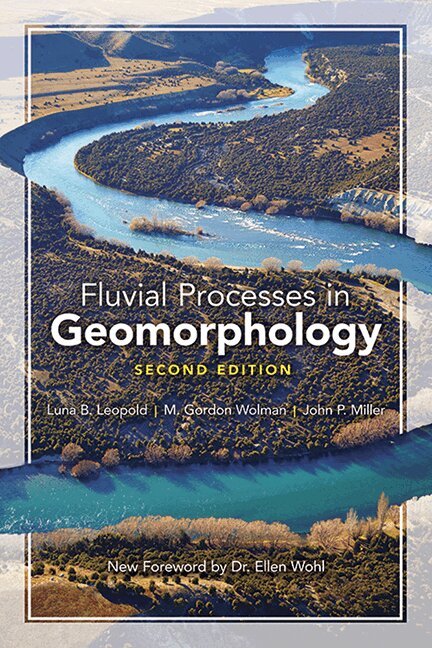
This excellent text is a pioneering work in the study of landform development under processes associated with running water. Its primary emphasis is on subjects that were the focus of the authors' studies in both field and laboratory. Part I deals with the process of change in the evolving landscape. Part II explores process and form, and Part III, the effects of time. In Part I, the relation of geomorphology to field problems is analyzed in studies of a mountain block in a semiarid climate, a meandering river cut into bedrock, and benches along a sea coast. Part Two contains studies of weathering, climate, and such denudational processes as flooding and erosion. Here, too, are examinations of the drainage basin as a geomorphic unit, water and sediment in channels, channel form and process, and hillslope characteristics and processes. In Part III, the authors cover geochronology, drainage pattern evolution, channel changes with time, and the evolution of hillslopes. A new Foreword by Dr. Ellen Wohl situates the text within the evolution of the science along with its continuing relevance today as a primary resource. Plus, two appendixes will help readers convert units and equivalents, and identify symbols and nomenclature.
343 kr
Skickas inom 10-15 vardagar
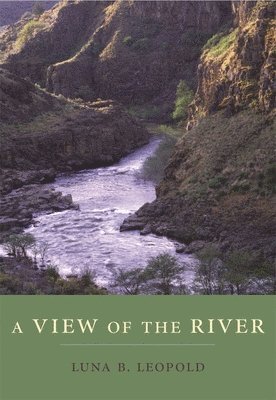
With the Midwest under water, America had a chance to see how effectively it had “improved” its rivers. We’ve straightened and dredged them, revetted and rerouted them, made massive efforts to control them, yet our actions have been less than successful. Too often, physical changes made to a river conflict with natural processes, resulting in damage rather than alleviating it. Applying available knowledge on how rivers form and act could prevent such problems. Luna B. Leopold seeks to organize such knowledge. Widely regarded as the most creative scholar in the field of river morphology, Leopold presents a coherent description of the river, its shape, size, organization, and action, along with a consistent theory that explains much of the observed character of channels.The laws of physics that govern rivers allow for variations, many of them dictated by random chance. Thus, a river’s adaptation, as Leopold describes it, tends toward the most probable form, the one with the least variance among hydraulic parameters. We see how this probabilistic tendency plays out as Leopold views the river as a whole from headwater to mouth, in the drainage net, in the behavior of meanders, and in aspects of sediment transport.Grounded in hydraulics, geomorphology, and surveying, as well as in extensive fieldwork on rivers in the eastern and Rocky Mountain states, Leopold’s view of a river is at once technical and personal, providing both a firm foundation for understanding the behavior of rivers—including instructions for getting started in backyard hydrology—and a wealth of firsthand observations by a thoughtful and experienced scientist. It will be of immediate interest and great use as we seek to develop, preserve, and appreciate our most fluid natural resource.