
Lutz Prechelt - Böcker
Visar alla böcker från författaren Lutz Prechelt. Handla med fri frakt och snabb leverans.
6 produkter
6 produkter
549 kr
Skickas inom 10-15 vardagar
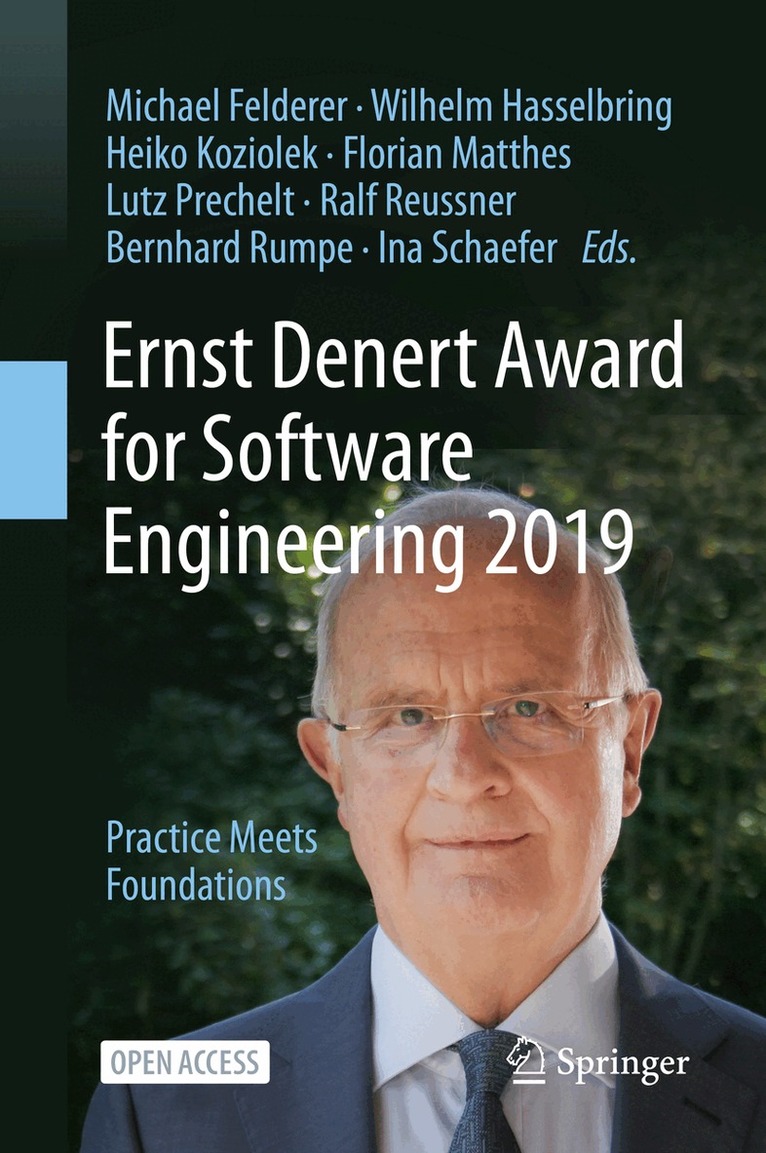
This open access book provides an overview of the dissertations of the five nominees for the Ernst Denert Award for Software Engineering in 2019. The prize, kindly sponsored by the Gerlind & Ernst Denert Stiftung, is awarded for excellent work within the discipline of Software Engineering, which includes methods, tools and procedures for better and efficient development of high quality software. An essential requirement for the nominated work is its applicability and usability in industrial practice.The book contains five papers describing the works by Sebastian Baltes (U Trier) on Software Developers’Work Habits and Expertise, Timo Greifenberg’s thesis on Artefaktbasierte Analyse modellgetriebener Softwareentwicklungsprojekte, Marco Konersmann’s (U Duisburg-Essen) work on Explicitly Integrated Architecture, Marija Selakovic’s (TU Darmstadt) research about Actionable Program Analyses for Improving Software Performance, and Johannes Späth’s (Paderborn U)thesis on Synchronized Pushdown Systems for Pointer and Data-Flow Analysis – which actually won the award.The chapters describe key findings of the respective works, show their relevance and applicability to practice and industrial software engineering projects, and provide additional information and findings that have only been discovered afterwards, e.g. when applying the results in industry. This way, the book is not only interesting to other researchers, but also to industrial software professionals who would like to learn about the application of state-of-the-art methods in their daily work.
549 kr
Skickas inom 10-15 vardagar
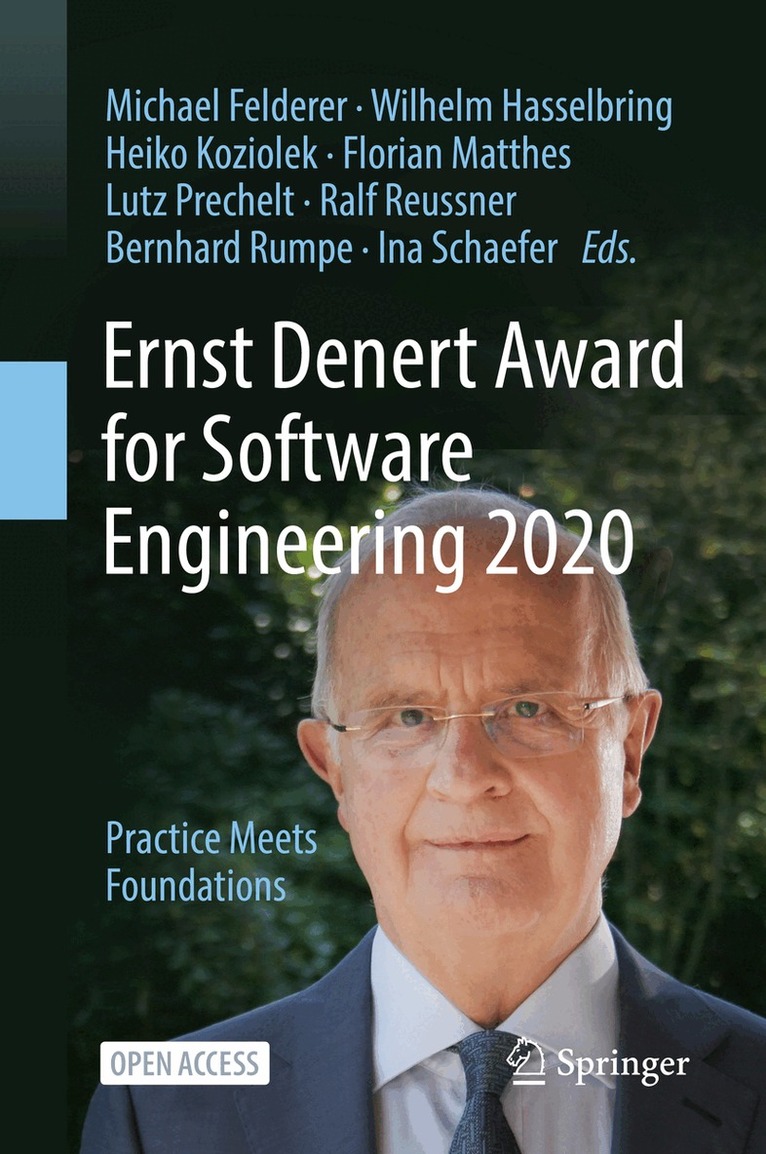
This open access book provides an overview of the dissertations of the eleven nominees for the Ernst Denert Award for Software Engineering in 2020. The prize, kindly sponsored by the Gerlind & Ernst Denert Stiftung, is awarded for excellent work within the discipline of Software Engineering, which includes methods, tools and procedures for better and efficient development of high quality software. An essential requirement for the nominated work is its applicability and usability in industrial practice.The book contains eleven papers that describe the works by Jonathan Brachthäuser (EPFL Lausanne) entitled What You See Is What You Get: Practical Effect Handlers in Capability-Passing Style, Mojdeh Golagha’s (Fortiss, Munich) thesis How to Effectively Reduce Failure Analysis Time?, Nikolay Harutyunyan’s (FAU Erlangen-Nürnberg) work on Open Source Software Governance, Dominic Henze’s (TU Munich) research about Dynamically Scalable Fog Architectures, Anne Hess’s (Fraunhofer IESE, Kaiserslautern) work on Crossing Disciplinary Borders to Improve Requirements Communication, Istvan Koren’s (RWTH Aachen U) thesis DevOpsUse: A Community-Oriented Methodology for Societal Software Engineering, Yannic Noller’s (NU Singapore) work on Hybrid Differential Software Testing, Dominic Steinhofel’s (TU Darmstadt) thesis entitled Ever Change a Running System: Structured Software Reengineering Using Automatically Proven-Correct Transformation Rules, Peter Wägemann’s (FAU Erlangen-Nürnberg) work Static Worst-Case Analyses and Their Validation Techniques for Safety-Critical Systems, Michael von Wenckstern’s (RWTH Aachen U) research on Improving the Model-Based Systems Engineering Process, and Franz Zieris’s (FU Berlin) thesis on Understanding How Pair Programming Actually Works in Industry: Mechanisms, Patterns, and Dynamics – which actually won the award.The chapters describe key findings of the respective works, show their relevance and applicability to practice and industrial software engineering projects, and provide additional information and findings that have only been discovered afterwards, e.g. when applying the results in industry. This way, the book is not only interesting to other researchers, but also to industrial software professionals who would like to learn about the application of state-of-the-art methods in their daily work.
441 kr
Skickas inom 10-15 vardagar
This open access book provides an overview of the dissertations of the eleven nominees for the Ernst Denert Award for Software Engineering in 2020. The prize, kindly sponsored by the Gerlind & Ernst Denert Stiftung, is awarded for excellent work within the discipline of Software Engineering, which includes methods, tools and procedures for better and efficient development of high quality software. An essential requirement for the nominated work is its applicability and usability in industrial practice.The book contains eleven papers that describe the works by Jonathan Brachthäuser (EPFL Lausanne) entitled What You See Is What You Get: Practical Effect Handlers in Capability-Passing Style, Mojdeh Golagha’s (Fortiss, Munich) thesis How to Effectively Reduce Failure Analysis Time?, Nikolay Harutyunyan’s (FAU Erlangen-Nürnberg) work on Open Source Software Governance, Dominic Henze’s (TU Munich) research about Dynamically Scalable Fog Architectures, Anne Hess’s (Fraunhofer IESE, Kaiserslautern) work on Crossing Disciplinary Borders to Improve Requirements Communication, Istvan Koren’s (RWTH Aachen U) thesis DevOpsUse: A Community-Oriented Methodology for Societal Software Engineering, Yannic Noller’s (NU Singapore) work on Hybrid Differential Software Testing, Dominic Steinhofel’s (TU Darmstadt) thesis entitled Ever Change a Running System: Structured Software Reengineering Using Automatically Proven-Correct Transformation Rules, Peter Wägemann’s (FAU Erlangen-Nürnberg) work Static Worst-Case Analyses and Their Validation Techniques for Safety-Critical Systems, Michael von Wenckstern’s (RWTH Aachen U) research on Improving the Model-Based Systems Engineering Process, and Franz Zieris’s (FU Berlin) thesis on Understanding How Pair Programming Actually Works in Industry: Mechanisms, Patterns, and Dynamics – which actually won the award.The chapters describe key findings of the respective works, show their relevance and applicability to practice and industrial software engineering projects, and provide additional information and findings that have only been discovered afterwards, e.g. when applying the results in industry. This way, the book is not only interesting to other researchers, but also to industrial software professionals who would like to learn about the application of state-of-the-art methods in their daily work.
549 kr
Skickas inom 10-15 vardagar
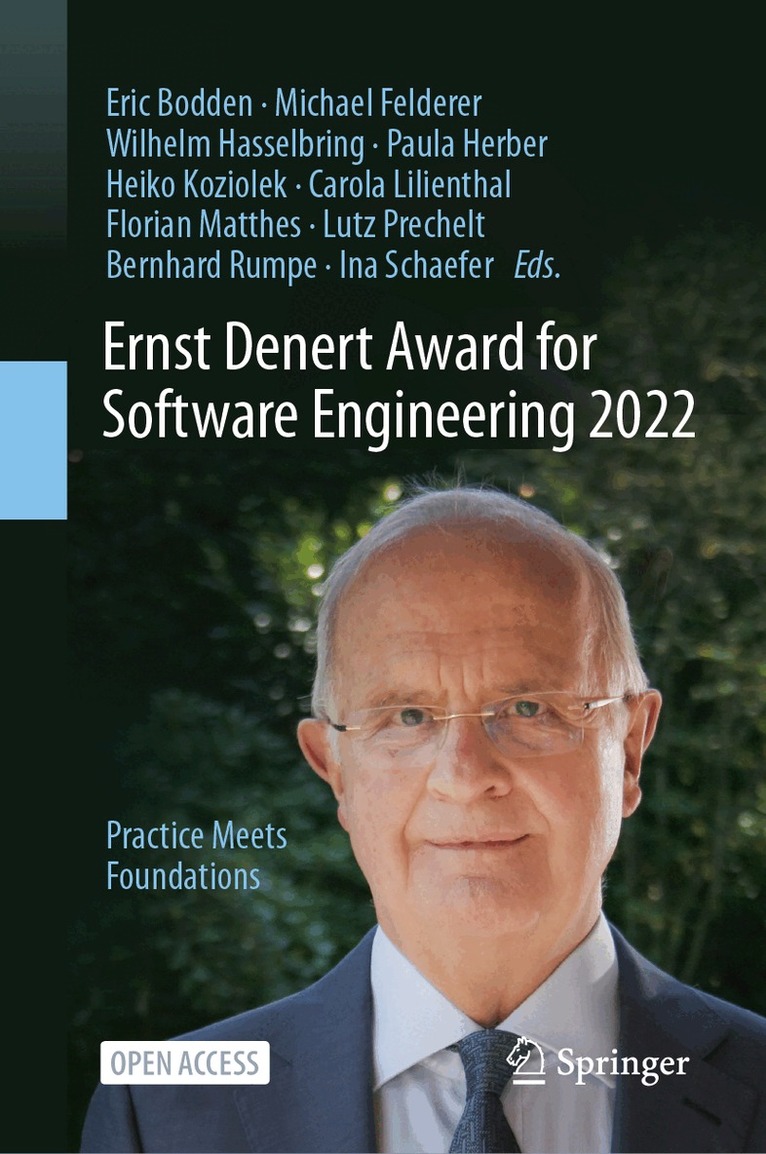
This open access book provides an overview of the dissertations of the five nominees for the Ernst Denert Award for Software Engineering in 2022. The prize, kindly sponsored by the Gerlind & Ernst Denert Stiftung, is awarded for excellent work within the discipline of Software Engineering, which includes methods, tools and procedures for better and efficient development of high quality software. An essential requirement for the nominated work is its applicability and usability in industrial practice.The book contains five papers that describe the works by Jannik Fischbach (Netlight Consulting GmbH and fortiss GmbH), who won the award, entitled Conditional Statements in Requirements Artifacts: Logical Interpretation, Use Cases for Automated Software Engineering, and Fine-Grained Extraction, Christian Kirchhof's (RWTH Aachen University) From Design to Reality: An Overview of the MontiThings Ecosystem for Model-Driven IoT Applications, Sven Peldszus's (Ruhr University Bochum) research about Security Compliance in Model-driven Development of Software Systems in Presence of Long-Term Evolution and Variants, Florian Rademacher's (RWTH Aachen University) work on Model-Driven Engineering of Microservice Architectures, and Alexander Trautsch's (University of Passau) Usefulness of Automatic Static Analysis Tools: Evidence from Four Case Studies.The chapters describe key findings of the respective works, show their relevance and applicability to practice and industrial software engineering projects, and provide additional information and findings that have only been discovered afterwards, e.g. when applying the results in industry. This way, the book is not only interesting to other researchers, but also to industrial software professionals who would like to learn about the application of state-of-the-art methods in their daily work.
441 kr
Skickas inom 10-15 vardagar
This open access book provides an overview of the dissertations of the five nominees for the Ernst Denert Award for Software Engineering in 2022. The prize, kindly sponsored by the Gerlind & Ernst Denert Stiftung, is awarded for excellent work within the discipline of Software Engineering, which includes methods, tools and procedures for better and efficient development of high quality software. An essential requirement for the nominated work is its applicability and usability in industrial practice.The book contains five papers that describe the works by Jannik Fischbach (Netlight Consulting GmbH and fortiss GmbH), who won the award, entitled Conditional Statements in Requirements Artifacts: Logical Interpretation, Use Cases for Automated Software Engineering, and Fine-Grained Extraction, Christian Kirchhof's (RWTH Aachen University) From Design to Reality: An Overview of the MontiThings Ecosystem for Model-Driven IoT Applications, Sven Peldszus's (Ruhr University Bochum) research about Security Compliance in Model-driven Development of Software Systems in Presence of Long-Term Evolution and Variants, Florian Rademacher's (RWTH Aachen University) work on Model-Driven Engineering of Microservice Architectures, and Alexander Trautsch's (University of Passau) Usefulness of Automatic Static Analysis Tools: Evidence from Four Case Studies.The chapters describe key findings of the respective works, show their relevance and applicability to practice and industrial software engineering projects, and provide additional information and findings that have only been discovered afterwards, e.g. when applying the results in industry. This way, the book is not only interesting to other researchers, but also to industrial software professionals who would like to learn about the application of state-of-the-art methods in their daily work.
499 kr
Skickas inom 10-15 vardagar
Überall in der Informatik, in der Forschung wie in der Praxis, werden gelegentlich Fallstudien benutzt, um Methoden, Techniken oder Werkzeuge auf ihre Brauchbarkeit hin zu untersuchen. Jedoch sind die Ergebnisse von Fallstudien oft zweifelhaft, weil ein Vergleich entweder gänzlich fehlt oder möglicherweise unfair ist. Kontrollierte Experimente bieten einen Ausweg, gelten aber als zu aufwendig. Dieses Buch zeigt auf, für welche Zwecke ein Experiment sinnvoll ist, wie man es plant und durchführt und wie man die Kosten niedrig hält. Mit der Idee des "natürlichen Experiments" können die Kosten oft sogar auf das Niveau einer Fallstudie gesenkt werden. Der Schwerpunkt liegt auf Fragen, die in der experimentellen Praxis für den Erfolg besonders wichtig sind. Das Buch ist in sehr leicht lesbarem Stil geschrieben; viele Querverweise erleichtern die Benutzung beim selektiven Lesen.