M. J. Cresswell - Böcker
Visar alla böcker från författaren M. J. Cresswell. Handla med fri frakt och snabb leverans.
7 produkter
7 produkter
443 kr
Tillfälligt slut
428 kr
Skickas inom 7-10 vardagar
What makes the words we speak mean what they do? Possible-worlds semantics articulates the view that the meanings of words contribute to determining, for each sentence, which possible worlds would make the sentence true, and which would make it false. M. J. Cresswell argues that the non-semantic facts on which such semantic facts supervene are facts about the causal interactions between the linguistic behaviour of speakers and the facts in the world that they are speaking about, and that the kind of causation involved is best analysed using David Lewis's account of causation in terms of counterfactuals. Although philosophers have worked on the question of the connection between meaning and linguistic behaviour, it has mostly been without regard to the work done in possible-world semantics and Language in the World is a book-length examination of this problem.
1 192 kr
Skickas inom 7-10 vardagar
What makes the words we speak mean what they do? Possible-worlds semantics articulates the view that the meanings of words contribute to determining, for each sentence, which possible worlds would make the sentence true, and which would make it false. M. J. Cresswell argues that the non-semantic facts on which such semantic facts supervene are facts about the causal interactions between the linguistic behaviour of speakers and the facts in the world that they are speaking about, and that the kind of causation involved is best analysed using David Lewis's account of causation in terms of counterfactuals. Although philosophers have worked on the question of the connection between meaning and linguistic behaviour, it has mostly been without regard to the work done in possible-world semantics and Language in the World is a book-length examination of this problem.
784 kr
Skickas inom 7-10 vardagar
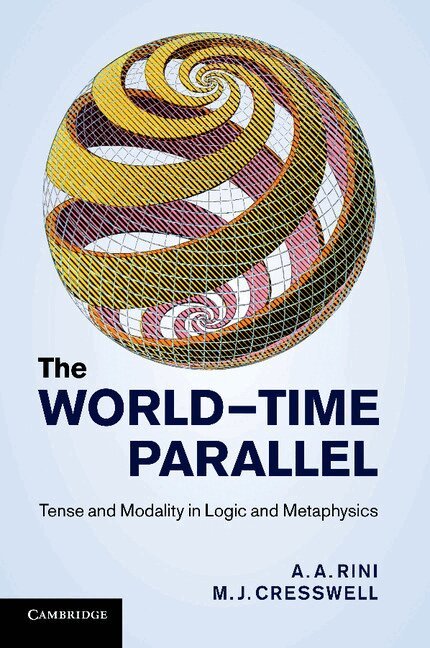
Is what could have happened but never did as real as what did happen? What did happen, but isn't happening now, happened at another time. Analogously, one can say that what could have happened happens in another possible world. Whatever their views about the reality of such things as possible worlds, philosophers need to take this analogy seriously. Adriane Rini and Max Cresswell exhibit, in an easy step-by-step manner, the logical structure of temporal and modal discourse, and show that every temporal construction has an exact parallel that requires a language that can refer to worlds, and vice versa. They make precise, in a way which can be articulated and tested, the claim that the parallel is at work behind even ordinary talk about time and modality. The book gives metaphysicians a sturdy framework for the investigation of time and modality - one that does not presuppose any particular metaphysical view.
560 kr
Skickas inom 7-10 vardagar
Is what could have happened but never did as real as what did happen? What did happen, but isn't happening now, happened at another time. Analogously, one can say that what could have happened happens in another possible world. Whatever their views about the reality of such things as possible worlds, philosophers need to take this analogy seriously. Adriane Rini and Max Cresswell exhibit, in an easy step-by-step manner, the logical structure of temporal and modal discourse, and show that every temporal construction has an exact parallel that requires a language that can refer to worlds, and vice versa. They make precise, in a way which can be articulated and tested, the claim that the parallel is at work behind even ordinary talk about time and modality. The book gives metaphysicians a sturdy framework for the investigation of time and modality - one that does not presuppose any particular metaphysical view.
2 088 kr
Skickas inom 10-15 vardagar
Originally published in 1973, this book shows that methods developed for the semantics of systems of formal logic can be successfully applied to problems about the semantics of natural languages; and, moreover, that such methods can take account of features of natural language which have often been thought incapable of formal treatment, such as vagueness, context dependence and metaphorical meaning. Parts 1 and 2 set out a class of formal languages and their semantics. Parts 3 and 4 show that these formal languages are rich enought to be used in the precise description of natural languages. Appendices describe some of the concepts discussed in the text.
495 kr
Skickas inom 10-15 vardagar
Originally published in 1973, this book shows that methods developed for the semantics of systems of formal logic can be successfully applied to problems about the semantics of natural languages; and, moreover, that such methods can take account of features of natural language which have often been thought incapable of formal treatment, such as vagueness, context dependence and metaphorical meaning. Parts 1 and 2 set out a class of formal languages and their semantics. Parts 3 and 4 show that these formal languages are rich enought to be used in the precise description of natural languages. Appendices describe some of the concepts discussed in the text.