M. M. Dodson - Böcker
Visar alla böcker från författaren M. M. Dodson. Handla med fri frakt och snabb leverans.
2 produkter
2 produkter
Del 134 - London Mathematical Society Lecture Note Series
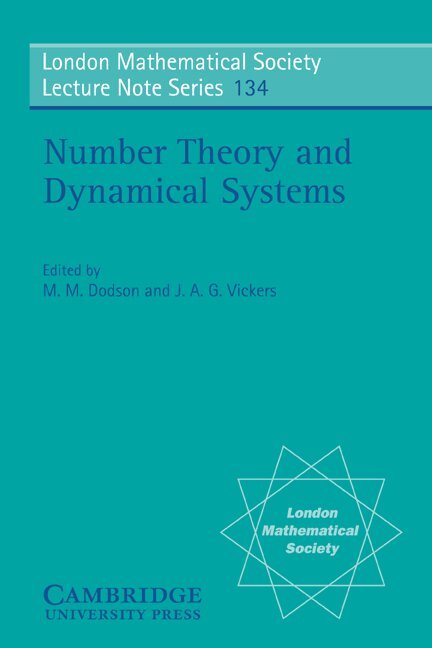
Number Theory and Dynamical Systems
Häftad, Engelska, 1989
784 kr
Skickas inom 7-10 vardagar
This volume contains selected contributions from a very successful meeting on Number Theory and Dynamical Systems held at the University of York in 1987. There are close and surprising connections between number theory and dynamical systems. One emerged last century from the study of the stability of the solar system where problems of small divisors associated with the near resonance of planetary frequencies arose. Previously the question of the stability of the solar system was answered in more general terms by the celebrated KAM theorem, in which the relationship between near resonance (and so Diophantine approximation) and stability is of central importance. Other examples of the connections involve the work of Szemeredi and Furstenberg, and Sprindzuk. As well as containing results on the relationship between number theory and dynamical systems, the book also includes some more speculative and exploratory work which should stimulate interest in different approaches to old problems.
Del 137 - Cambridge Tracts in Mathematics
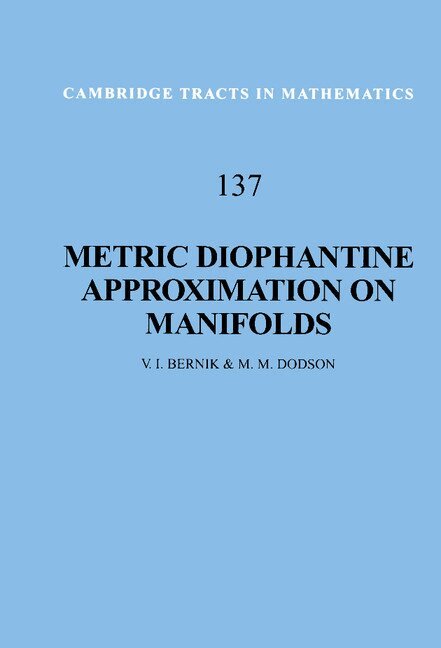
Metric Diophantine Approximation on Manifolds
Inbunden, Engelska, 1999
1 521 kr
Skickas inom 7-10 vardagar
This 1999 book is concerned with Diophantine approximation on smooth manifolds embedded in Euclidean space, and its aim is to develop a coherent body of theory comparable with that which already exists for classical Diophantine approximation. In particular, this book deals with Khintchine-type theorems and with the Hausdorff dimension of the associated null sets. After setting out the necessary background material, the authors give a full discussion of Hausdorff dimension and its uses in Diophantine approximation. A wide range of techniques from the number theory arsenal are used to obtain the upper and lower bounds required, and this is an indication of the difficulty of some of the questions considered. The authors go on to consider briefly the p-adic case, and they conclude with a chapter on some applications of metric Diophantine approximation. All researchers with an interest in Diophantine approximation will welcome this book.