MacGillivray – Författare
Visar alla böcker från författaren MacGillivray. Handla med fri frakt och snabb leverans.
4 produkter
4 produkter
141 kr
Skickas inom 7-10 vardagar
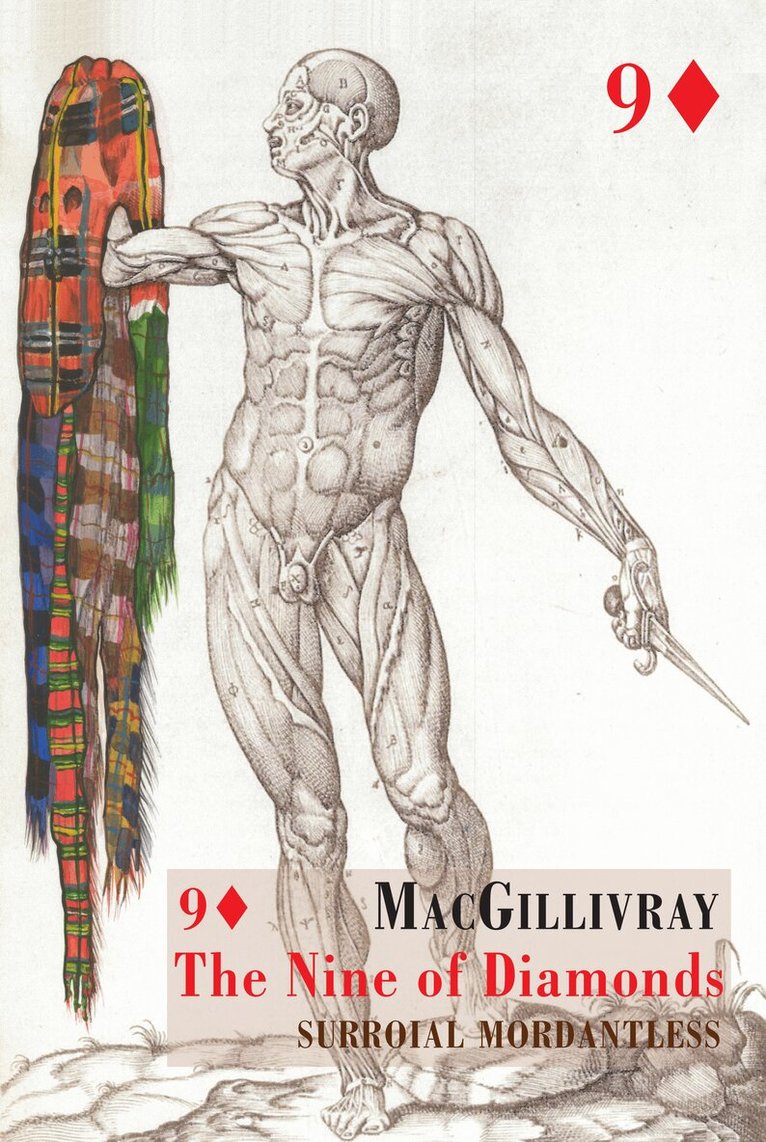
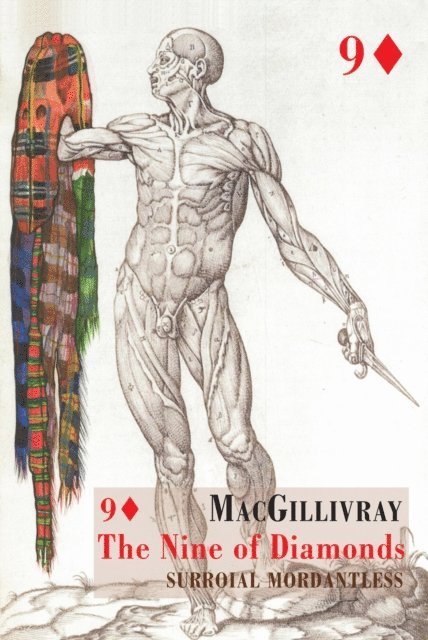
The Nine of Diamonds: Surroial Mordantless is a book in nine parts constructed to play the Butcher - the Duke of Cumberland - in a Gaelic interpretation of the ghost gamble. Given the command on the back of a nine of diamonds - the Curse of Scotland - that the Highlanders should all be slaughtered, the persecution of Jacobite sympathisers after the Battle of Culloden under the Butcher was one of the worst atrocities carried out on British soil. Using a kaleidoscope, a deck of tarot cards and an 1895 Dictionary of Phrase and Fable, The Nine of Diamonds is influenced by French surrealism and opens with the Gaelic visionary practice of inducing visions behind a waterfall. Treating the Highlands as a Gaelic garden, the rebels on the run as herds of deer, and the preservation of Gaelic culture as a type of sugar-cured mummification, The Nine of Diamonds is set in a phantasmagoric landscape described in the Scots of Henryson and Dunbar but evoking Scots Gaelic concepts and motifs to mix Highland and Lowland experience with magical and occult terminology. With the deer as a central image, MacGillivray's poems draw from Nijinsky as gravity-defying faun, from Mallarme, Duchamp and Breton.Written in the run up to the 2014 Scottish referendum, The Nine of Diamonds operates as a powerful wish-text. In this strange vision populated by badly-wired and furious neon unicorns, escorticati preparing their own bodies, Second World War MacLeod fighter pilots with talismanic photographs of the clan's Fairy Flag in their uniform pockets, pole-dancing fauns, stained glass knights and rusty kaleidoscopes, the underlying message is clear: in playing the Butcher back, MacGillivray is still here.
158 kr
Skickas
The Gaelic Garden of the Dead is three Books of the Dead bound as one. This trilogy comprises an alphabet of trees, ten dream pattern poems and thirty-five death sonnets deconstructed to Mary Queen of Scots. Saturated with the languages of arboreal myth, magic and folklore in Gaelic culture, the first book, The Gaelic Garden of the Dead, is a forest quartet whose letters enunciate the imagery of their own form and function, drawing on the traditional Scots Gaelic alphabet of trees. Among reflex-men and co-walkers are corpse measuring aspen rods, the pine hanging tree and the poison yew. As a meta-narrative of ecological preservation and a comment on ancient language culture, The Gaelic Garden of the Dead is a grove of observation: ‘Love’s eyes are colourless: a motive for moving through underworlds.’ A Crisis of Dream, the middle book, is a sequence of ten dream diagrams. Many of the dreams delineated in the second book inform other parts of the trilogy. The third book, In the End Is My Beginning: 35 Destroyed Sonnets to Mary Queen of Scots, consists of thirty-five Petrarchan sonnets for each of the steps Marie Stuart descended to execution. Composed on the anniversary of her death at Fotheringhay, the sonnets were then chewed for the fifteen minutes her lips were said to move after decapitation. Their delicate reconstruction becomes a moving meditation on Mary’s brutal demise: ‘Once, my heart had a skeleton.’
181 kr
Skickas
Ravage: An Astonishment of Fire draws together MacGillivray's extensive research into the life and work of Norwegian-Shetlandic poet Kristján Norge, who vanished from Eilean a’ Bhàis in the Outer Hebrides in 1961. Comprising two previously unpublished manuscripts by Norge, Optik: A History of Ghost (1950) and Ravage (1961), this collection also includes rare original material, giving insight into Norge's troubled existence and mysterious disappearance.Optik: A History of Ghost, the opening triadic poem, typifies Kristján Norge's early work and is a meditation on Greek optics, horary ghostliness and illumination by fire. Composed in 1950, Optik draws on letters twelve and thirteen of the correspondence between scientist-inventor Sir David Brewster and Sir Walter Scott on natural magic, to isolate the figure of 'John Christ' whom Norge positions as a visionary homunculus created from the saline ash of alchemical phantasmic experiments.Ravage is the centrepiece of the collection, a numinous tract written in the months preceding Kristján Norge's disappearance in 1961, convinced he was a demon. Washed up in a storm, subsistence on Bàs had proved an increasing strain on Norge, who felt his self-exiled status intensively. In response to both this isolation and the unexpected revelation of his demoniacal status, Norge evolved a complex amnesiac system, aware that if only he could forget this singular aspect of himself, then release might follow. Inevitably cryptic, this Norgesian schema has been recovered from fragments concealed at ten sites on the Scottish island. Norge's impression of Eilean a’ Bhàis as an underworld threshold leant weight to his suspicion that the island was indeed attracting the Sluagh nam Marbh, or Host of the Dead, a Gaelic westerly wind of malign voices that allegedly imparted the knowledge of his demonhood to him.Optik: A History of Ghost and Ravage are supplemented by additional archival materials which flesh out Norge's intellectual and personal concerns. Among these is a detailed schema of his amnesiac process, items of correspondence, maps, photographs and logbook entries. A work of fiction entitled The Wind of Voices, which is based on this mercurial period in Norge's life, concludes the collection.MacGillivray is the Highland name of writer and artist Kirsten Norrie. She has published three other poetry books, The Last Wolf of Scotland (Pighog/Red Hen, 2013), The Nine of Diamonds: Surroial Mordantless (Bloodaxe Books, 2016) and The Gaelic Garden of the Dead (Bloodaxe Books, 2019).
195 kr
Skickas inom 5-8 vardagar
1864. In a Santa Fe gulley, scalped Scots thirteen-year-old Robert McGee lies bleeding to death. The Last Wolf of Scotland is his dream, etched onto the plate of pioneer America, his scalp lock speaking back to him, a hallucination projected in a near-death cinema.This shocking real-life incident is our point of departure into the ritualistic imagination of MacGilivray. In this, her first collection, she dissects the Scottish imaginary and builds it up anew, creating a poetic panorama which stretches from the Highlands to the Wild West.