Magda Teter - Böcker
Visar alla böcker från författaren Magda Teter. Handla med fri frakt och snabb leverans.
8 produkter
8 produkter
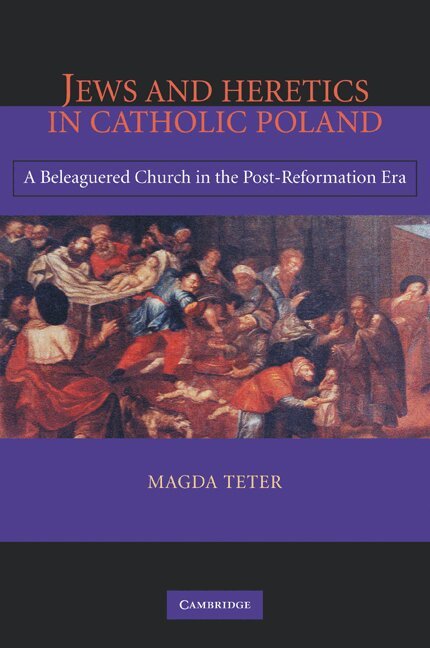
Jews and Heretics in Catholic Poland
A Beleaguered Church in the Post-Reformation Era
Häftad, Engelska, 2009
560 kr
Skickas inom 7-10 vardagar
Jews and Heretics in Catholic Poland takes issue with historians' common contention that the Catholic Church triumphed in Counter-reformation Poland. In fact, the Church's own sources show that the story is far more complex. From the rise of the Reformation and the rapid dissemination of these new ideas through printing, the Catholic Church was overcome with a strong sense of insecurity. The 'infidel Jews, enemies of Christianity' became symbols of the Church's weakness and, simultaneously, instruments of its defence against all of its other adversaries. This process helped form a Polish identity that led, in the case of Jews, to racial anti-Semitism and to the exclusion of Jews from the category of Poles. This book portrays Jews not only as victims of Church persecution but as active participants in Polish society who as allies of the nobles, placed in positions of power, had more influence than has been recognised.
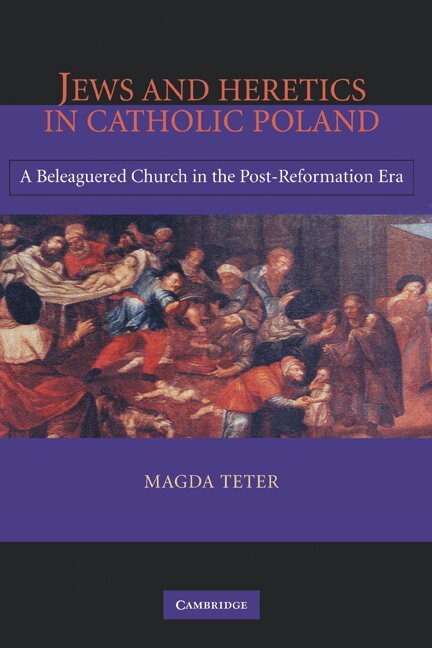
Jews and Heretics in Catholic Poland
A Beleaguered Church in the Post-Reformation Era
Inbunden, Engelska, 2005
1 245 kr
Skickas inom 7-10 vardagar
Jews and Heretics in Catholic Poland takes issue with historians' common contention that the Catholic Church triumphed in Counter-reformation Poland. In fact, the Church's own sources show that the story is far more complex. From the rise of the Reformation and the rapid dissemination of these new ideas through printing, the Catholic Church was overcome with a strong sense of insecurity. The 'infidel Jews, enemies of Christianity' became symbols of the Church's weakness and, simultaneously, instruments of its defence against all of its other adversaries. This process helped form a Polish identity that led, in the case of Jews, to racial anti-Semitism and to the exclusion of Jews from the category of Poles. This book portrays Jews not only as victims of Church persecution but as active participants in Polish society who as allies of the nobles, placed in positions of power, had more influence than has been recognised.
531 kr
Skickas inom 10-15 vardagar
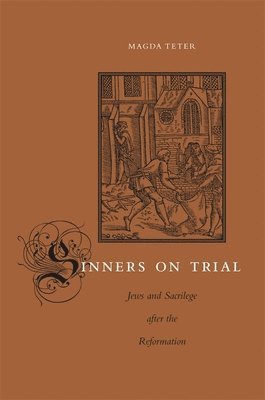
In post-Reformation Poland—the largest state in Europe and home to the largest Jewish population in the world—the Catholic Church suffered profound anxiety about its power after the Protestant threat. Magda Teter reveals how criminal law became a key tool in the manipulation of the meaning of the sacred and in the effort to legitimize Church authority. The mishandling of sacred symbols was transformed from a sin that could be absolved into a crime that resulted in harsh sentences of mutilation, hanging, decapitation, and, principally, burning at the stake.Teter casts new light on the most infamous type of sacrilege, the accusation against Jews for desecrating the eucharistic wafer. These sacrilege trials were part of a broader struggle over the meaning of the sacred and of sacred space at a time of religious and political uncertainty, with the eucharist at its center. But host desecration—defined in the law as sacrilege—went beyond anti-Jewish hatred to reflect Catholic-Protestant conflict, changing conditions of ecclesiastic authority and jurisdiction, and competition in the economic marketplace.Recounting dramatic stories of torture, trial, and punishment, this is the first book to consider the sacrilege accusations of the early modern period within the broader context of politics and common crime. Teter draws on previously unexamined trial records to bring out the real-life relationships among Catholics, Jews, and Protestants and challenges the commonly held view that following the Reformation, Poland was a “state without stakes”—uniquely a country without religious persecution.
393 kr
Skickas inom 10-15 vardagar
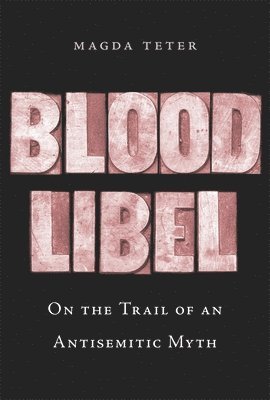
A landmark history of the antisemitic blood libel myth—how it took root in Europe, spread with the invention of the printing press, and persists today.Accusations that Jews ritually killed Christian children emerged in the mid-twelfth century, following the death of twelve-year-old William of Norwich, England, in 1144. Later, continental Europeans added a destructive twist: Jews murdered Christian children to use their blood. While charges that Jews poisoned wells and desecrated the communion host waned over the years, the blood libel survived.Initially blood libel stories were confined to monastic chronicles and local lore. But the development of the printing press in the mid-fifteenth century expanded the audience and crystallized the vocabulary, images, and “facts” of the blood libel, providing a lasting template for hate. Tales of Jews killing Christians—notably Simon of Trent, a toddler whose body was found under a Jewish house in 1475—were widely disseminated using the new technology. Following the paper trail across Europe, from England to Italy to Poland, Magda Teter shows how the blood libel was internalized and how Jews and Christians dealt with the repercussions.The pattern established in early modern Europe still plays out today. In 2014 the Anti-Defamation League appealed to Facebook to take down a page titled “Jewish Ritual Murder.” The following year white supremacists gathered in England to honor Little Hugh of Lincoln as a sacrificial victim of the Jews. Based on sources in eight countries and ten languages, Blood Libel captures the long shadow of a pernicious myth.
282 kr
Skickas inom 7-10 vardagar
A panoramic cultural and legal history that traces the roots of antisemitism and racism to early Christian theologySince the earliest days of Christianity, theologians expressed pervasive anxiety about Jews as equal members of society, and, with European expansion in the early modern period, that anxiety extended to people of color. This troubling legacy still haunts us today. Christian Supremacy demonstrates how theological and legal frameworks created by the church centuries ago laid the seeds of antisemitism and anti-Black racism and reveals why Christian identity lies at the heart of the world’s violent white supremacy movements.In a powerful historical narrative spanning nearly two millennia, Magda Teter describes how Christian theology of late antiquity cast Jews as “children born to slavery,” and how the supposed theological inferiority of Jews became inscribed into law, creating tangible structures that reinforced a sense of Christian domination and superiority. With the dawn of European colonialism, a distinct brand of European Christian supremacy found expression in the legally sanctioned enslavement and exploitation of people of color, later taking the form of white Christian supremacy in the New World.Drawing on a wealth of primary evidence ranging from the theological and legal to the philosophical and artistic, Christian Supremacy is a profound reckoning with history that traces the roots of the modern rejection of Jewish and Black equality to an enduring Christian heritage of exclusion, intolerance, and persecution.
203 kr
Skickas inom 7-10 vardagar
A panoramic cultural and legal history that traces the roots of antisemitism and racism to early Christian theologySince the earliest days of Christianity, theologians expressed pervasive anxiety about Jews as equal members of society, and, with European expansion in the early modern period, that anxiety extended to people of color. This troubling legacy still haunts us today. Christian Supremacy demonstrates how theological and legal frameworks created by the church centuries ago laid the seeds of antisemitism and anti-Black racism and reveals why Christian identity lies at the heart of the world’s violent white supremacy movements.In a powerful historical narrative spanning nearly two millennia, Magda Teter describes how Christian theology of late antiquity cast Jews as “children born to slavery,” and how the supposed theological inferiority of Jews became inscribed into law, creating tangible structures that reinforced a sense of Christian domination and superiority. With the dawn of European colonialism, a distinct brand of European Christian supremacy found expression in the legally sanctioned enslavement and exploitation of people of color, later taking the form of white Christian supremacy in the New World.Drawing on a wealth of primary evidence ranging from the theological and legal to the philosophical and artistic, Christian Supremacy is a profound reckoning with history that traces the roots of the modern rejection of Jewish and Black equality to an enduring Christian heritage of exclusion, intolerance, and persecution.
Del 22 - Polin: Studies in Polish Jewry
Polin: Studies in Polish Jewry Volume 22
Social and Cultural Boundaries in Pre-Modern Poland
Häftad, Engelska, 2009
496 kr
Skickas inom 7-10 vardagar
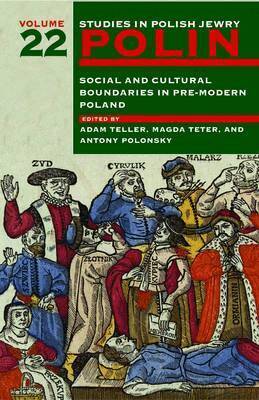
Boundaries—physical, political, social, religious, and cultural—were a key feature of life in medieval and early modern Poland, and this volume focuses on the ways in which these boundaries were respected, crossed, or otherwise negotiated. It throws new light on the contacts between Jews and Poles, including the vexed question of conversion and the tensions it aroused. The collected articles also discuss relations between the various elements of Jewish society—the wealthy and the poor, the educated and the uneducated, and the religious and the lay elites, considering too contacts between Jews in Poland and those in Germany and elsewhere. Classic studies by such eminent scholars as Meir Bałaban, Jacob Goldberg, and Moshe Rosman provide a foil for new research by Hanna Zaremska and David Frick, as well as Adam Teller, Magda Teter, Elisheva Carlebach, Jürgen Heyde, and Adam Kaźmierczyk. Taken together, the contributions on this central theme help redefine the Jewish history of pre-modern Poland. As ever, the New Views section examines a wide variety of other topics. These include accusations of ritual murder in nineteenth-century Poland; the Russian Jewish integrationist politician Mikhail Morgulis; the attitude of Bolesław Prus towards Jewish assimilation and his relationship with the Jewish journalist Nahum Sokolow; women in the Mizrahi movement in Poland; Polish patriotism among Jews; the impact of the first Soviet occupation of 1939–41 on Polish–Jewish relations; how the war affected the views of Julian Tuwim and Antoni Słonimski; the shtetl in the work of American Jewish writers Allen Hoffman and Jonathan Safran Foer; and the initial Polish response to Jan Gross's Fear.
236 kr
Skickas inom 10-15 vardagar
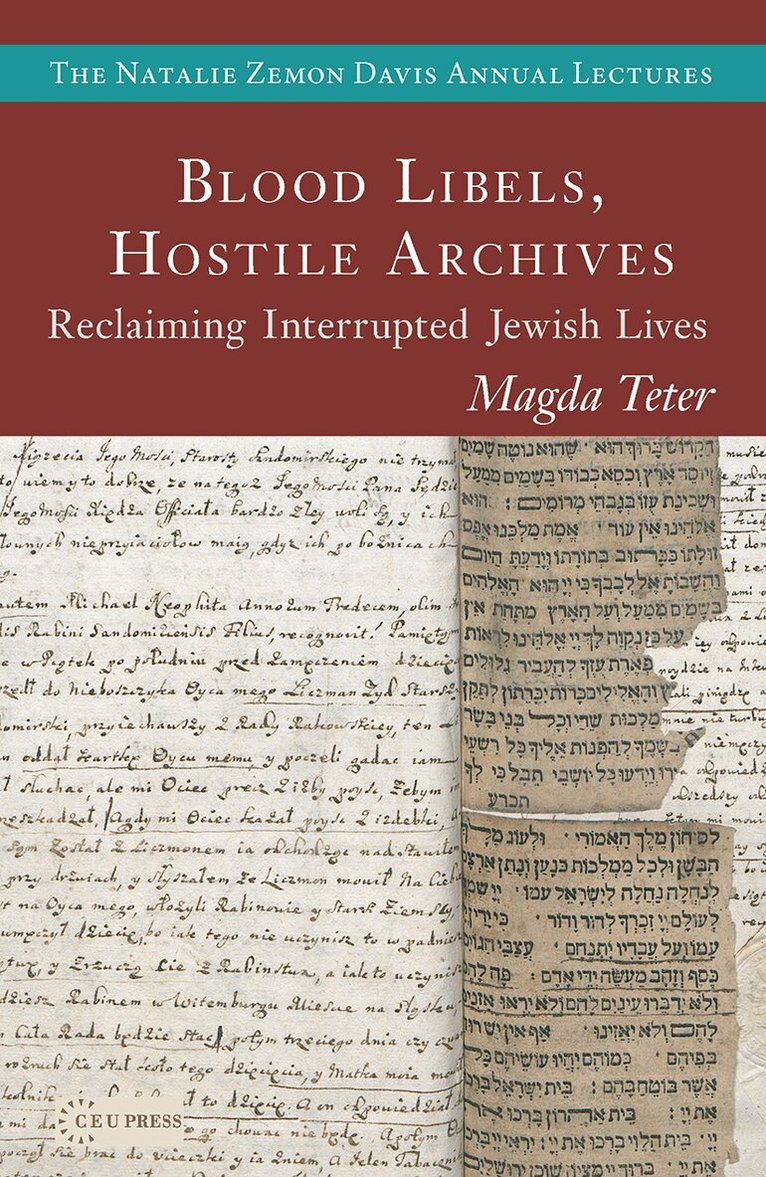
As a minority group for most of their history, Jews were often marginalized and persecuted. Traces of their lives can be found in the archives of the dominant societies, but only as they intersected with the concerns of those in power. Just as Natalie Zemon Davis, Emmanuel Le Roy Ladurie, Carlo Ginzburg, and others recovered the voices of the peasants, so, too, scholars of Jewish history and culture have productively mined these reservoirs of evidence to retrieve glimpses of the ordinary lives of Jews. Blood Libels, Hostile Archives explores what can be reclaimed about everyday lives from what can be called “hostile archives”—from archival evidence produced and collected explicitly to manufacture malicious tales and pass them as “facts.” For Jewish history, in some places, these archival sources may be the only remaining records documenting the lives of Jews there. The book explores two places: Trent, in northern Italy, and Sandomierz, in eastern Poland. Though hundreds of miles away, the towns have many things in common: both had been sites of anti-Jewish libels falsely accusing Jews of killing Christian children, Trent in 1475 and Sandomierz twice—in 1698 and 1710; in both, the instigators of the Jews’ persecution left unique and extensive archives, both towns have physical remnants of these deadly affairs, and, finally, neither town has an existing Jewish population. Yet, centuries later, these anti-Jewish libels have not been relegated to the past; in both towns, their legacies still reverberate today.