Mahesan Niranjan - Böcker
Visar alla böcker från författaren Mahesan Niranjan. Handla med fri frakt och snabb leverans.
4 produkter
4 produkter
1 630 kr
Tillfälligt slut
Computer simulations and modelling are used frequently in science and engineering, in applications ranging from the understanding of natural and artificial phenomena to the design, test and manufacturing stages of production. This widespread use necessarily implies that a detailed knowledge of the limitations of computer simulations is required. In particular, the usefulness of a computer simulation is directly dependent on the user's knowledge of the uncertainty in the simulation. Typical limitations of computer simulations include uncertainty in the data, parameter uncertainty, errors in the initial data, modelling errors, unmodelled phenomena, reduced order models, and approximations and numerical errors. Although an improvement in the physical understanding of the phenomena being modelled is an important requirement of a good computer simulation, the simulation will be plagued by deficiencies if the limitations listed above are not considered when analyzing its results. Since uncertainties can never be completely eliminated, they must be quantified and their propagation through the computations must be considered.The uses of computer modelling are diverse, and one particular application, the effect of uncertainty in geometric computations, is considered in this book. In particular, geometric computations occur extensively in geometric modelling, computer vision, computer graphics and pattern recognition. Uncertainty in Geometric Computations contains the proceedings of a workshop that was held in Sheffield, United Kingdom, in which the management and assessment of uncertainty in geometric computations was considered. The theme that unites these four subject areas is the requirement to perform computations on real geometric data, which may have errors, for example, the tolerance of a coordinate measuring machine that is used in reverse engineering, and/or is incomplete because of occlusion, which may occur in computer vision, for example, a face recognition system. These characteristics of real geometric data impose tight constraints on the methods and algorithms that are used for their processing and interrogation, and this workshop provided a forum for their discussion.One of the novel features of the workshop was the wide background of the audience and invited speakers - applied mathematicians, computer scientists and engineers - and this provided a forum for the establishment of new collaborative links between mathematicians and engineers, thereby emphasizing the interdisciplinary nature of the many outstanding problems.
Del 704 - Springer International Series in Engineering and Computer Science
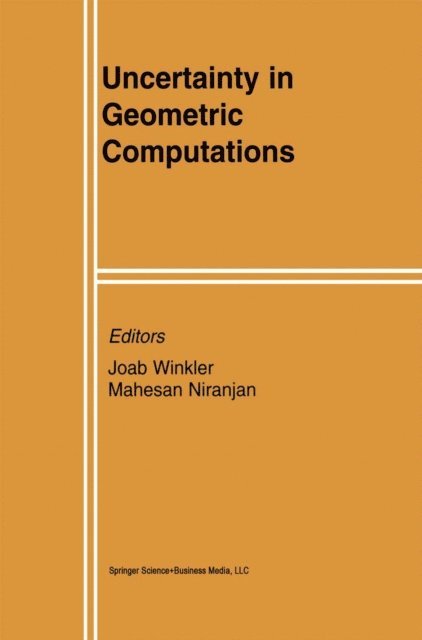
Uncertainty in Geometric Computations
Häftad, Engelska, 2012
536 kr
Skickas inom 10-15 vardagar
This book contains the proceedings of the workshop Uncertainty in Geomet ric Computations that was held in Sheffield, England, July 5-6, 2001. A total of 59 delegates from 5 countries in Europe, North America and Asia attended the workshop. The workshop provided a forum for the discussion of com putational methods for quantifying, representing and assessing the effects of uncertainty in geometric computations. It was organised around lectures by invited speakers, and presentations in poster form from participants. Computer simulations and modelling are used frequently in science and engi neering, in applications ranging from the understanding of natural and artificial phenomena, to the design, test and manufacturing stages of production. This widespread use necessarily implies that detailed knowledge of the limitations of computer simulations is required. In particular, the usefulness of a computer simulation is directly dependent on the user's knowledge of the uncertainty in the simulation. Although an understanding of the phenomena being modelled is an important requirement of a good computer simulation, the model will be plagued by deficiencies if the errors and uncertainties in it are not consid ered when the results are analysed. The applications of computer modelling are large and diverse, but the workshop focussed on the management of un certainty in three areas : Geometric modelling, computer vision, and computer graphics.
Deterministic and Statistical Methods in Machine Learning
First International Workshop, Sheffield, UK, September 7-10, 2004. Revised Lectures
Häftad, Engelska, 2005
552 kr
Skickas inom 10-15 vardagar
Machinelearningis arapidlymaturing?eldthataims toprovidepracticalme- ods for data discovery, categorization and modelling. The She?eld Machine Learning Workshop, which was held 7-10 September 2004, brought together some of the leading international researchers in the ?eld for a series of talks and posters that represented new developments in machine learning and numerical methods. The workshop was sponsored by the Engineering and Physical Sciences - search Council (EPSRC) and the London Mathematical Society (LMS) through the MathFIT program,whose aim is the encouragementof new interdisciplinary research.AdditionalfundingwasprovidedbythePASCALEuropeanFramework 6 Network of Excellence and the University of She?eld. It was the commitment of these funding bodies that enabled the workshop to have a strong program of invited speakers,and the organizerswish to thank these funding bodies for their ?nancial support. The particular focus for interactions at the workshop was - vanced Research Methods in Machine Learning and Statistical Signal Processing.These proceedings contain work that was presented at the workshop, and ideas that were developed through, or inspired by, attendance at the workshop. The proceedings re?ect this mixture and illustrate the diversity of applications and theoretical work in machine learning. We would like to thank the presenters and attendees at the workshop for the excellent quality of presentation and discussion during the oral and poster sessions. We are also grateful to Gillian Callaghan for her support in the orga- zation of the workshop, and ?nally we wish to thank the anonymous reviewers for their help in compiling the proceedings.
Pattern Recognition in Bioinformatics
4th IAPR International Conference, PRIB 2009, Sheffield, UK, September 7-9, 2009, Proceedings
Häftad, Engelska, 2009
536 kr
Skickas inom 10-15 vardagar
The Pattern Recognition in Bioinformatics (PRIB) meeting was established in 2006 under the auspices of the International Association for Pattern Recognition (IAPR) to create a focus for the development and application of pattern recognition techniques in the biological domain. PRIB's aim to explore the full spectrum of pattern recognition application was re?ected in the breadth of techniquesrepresented in this year's subm- sions and in this book. These range from image analysis for biomedical data to systems biology. We werefortunatetohaveinvitedspeakersofthehighestcalibredeliveringkeynotes at the conference. These were Pierre Baldi (UC Irvine), Alvis Brazma (EMBL-EBI), GunnarRats .. ch(MPITubi .. ngen)andMichaelUnser(EPFL).Weacknowledgesupportof theEUFP7NetworkofExcellencePASCAL2forpartiallyfundingtheinvitedspeakers. Immediately prior to the conference, we hosted half day of tutorial lectures, while a special session on "Machine Learningfor IntegrativeGenomics" was held immediately after the main conference.Duringthe conference,a poster session was heldwith further discussion.Wewouldlikeonceagaintothankalltheauthorsforthehighqualityofsubmissions, as well as Yorkshire South and the University of Shef?eld for providing logistical help in organizing the conference. Finally, we would like to thank Springer for their help in assembling this proceedings volume and for the continued support of PRIB.