Manfred W. Padberg – författare
Visar alla böcker från författaren Manfred W. Padberg. Handla med fri frakt och snabb leverans.
5 produkter
5 produkter
Del 3 - International Series in Operations Research & Management Science
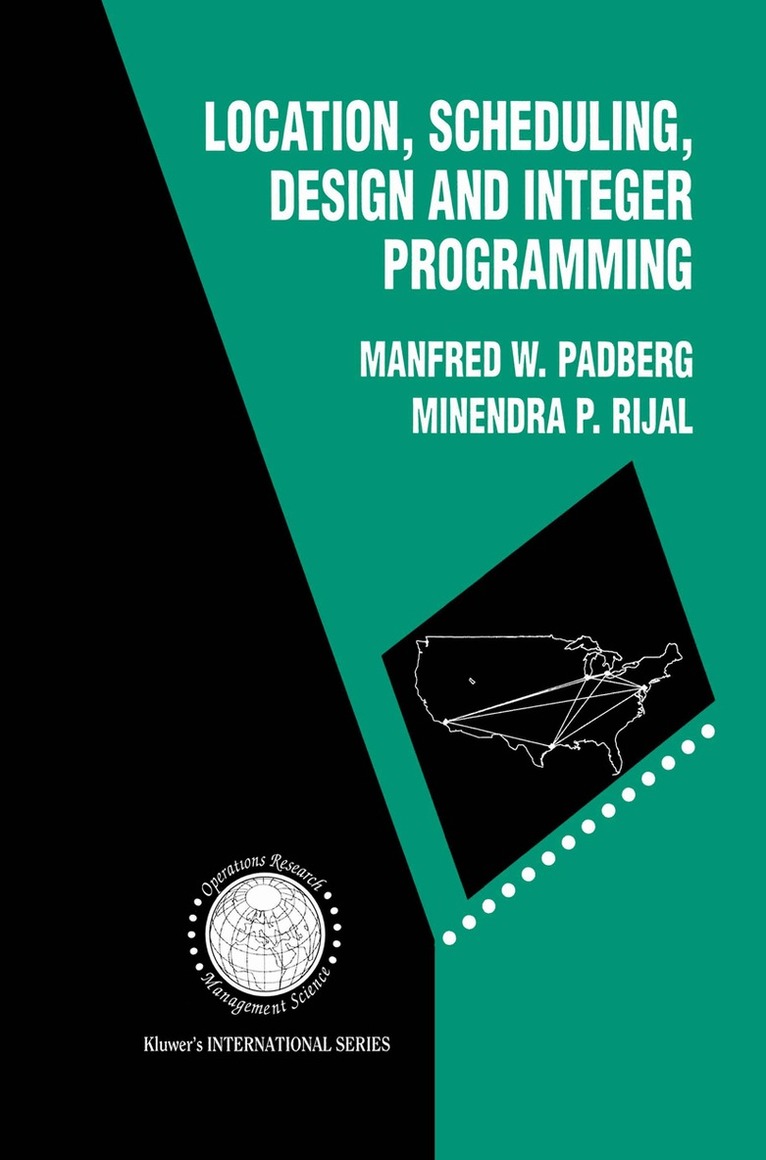
Location, Scheduling, Design and Integer Programming
Inbunden, Engelska, 1996
1 664 kr
Skickas inom 10-15 vardagar
Location, scheduling and design problems are assignment type problems with quadratic cost functions and occur in many contexts stretching from spatial economics via plant and office layout planning to VLSI design and similar prob lems in high-technology production settings. The presence of nonlinear inter action terms in the objective function makes these, otherwise simple, problems NP hard. In the first two chapters of this monograph we provide a survey of models of this type and give a common framework for them as Boolean quadratic problems with special ordered sets (BQPSs). Special ordered sets associated with these BQPSs are of equal cardinality and either are disjoint as in clique partitioning problems, graph partitioning problems, class-room scheduling problems, operations-scheduling problems, multi-processor assign ment problems and VLSI circuit layout design problems or have intersections with well defined joins as in asymmetric and symmetric Koopmans-Beckmann problems and quadratic assignment problems. Applications of these problems abound in diverse disciplines, such as anthropology, archeology, architecture, chemistry, computer science, economics, electronics, ergonomics, marketing, operations management, political science, statistical physics, zoology, etc. We then give a survey of the traditional solution approaches to BQPSs. It is an unfortunate fact that even after years of investigation into these problems, the state of algorithmic development is nowhere close to solving large-scale real life problems exactly. In the main part of this book we follow the polyhedral approach to combinatorial problem solving because of the dramatic algorith mic successes of researchers who have pursued this approach.
Del 3 - International Series in Operations Research & Management Science
Location, Scheduling, Design and Integer Programming
Häftad, Engelska, 2011
1 616 kr
Skickas inom 10-15 vardagar
Location, scheduling and design problems are assignment type problems with quadratic cost functions and occur in many contexts stretching from spatial economics via plant and office layout planning to VLSI design and similar prob lems in high-technology production settings. The presence of nonlinear inter action terms in the objective function makes these, otherwise simple, problems NP hard. In the first two chapters of this monograph we provide a survey of models of this type and give a common framework for them as Boolean quadratic problems with special ordered sets (BQPSs). Special ordered sets associated with these BQPSs are of equal cardinality and either are disjoint as in clique partitioning problems, graph partitioning problems, class-room scheduling problems, operations-scheduling problems, multi-processor assign ment problems and VLSI circuit layout design problems or have intersections with well defined joins as in asymmetric and symmetric Koopmans-Beckmann problems and quadratic assignment problems. Applications of these problems abound in diverse disciplines, such as anthropology, archeology, architecture, chemistry, computer science, economics, electronics, ergonomics, marketing, operations management, political science, statistical physics, zoology, etc. We then give a survey of the traditional solution approaches to BQPSs. It is an unfortunate fact that even after years of investigation into these problems, the state of algorithmic development is nowhere close to solving large-scale real life problems exactly. In the main part of this book we follow the polyhedral approach to combinatorial problem solving because of the dramatic algorith mic successes of researchers who have pursued this approach.
E-bok
PDF, Engelska, 20122 049 kr
Läs direkt efter köp
Location, scheduling and design problems are assignment type problems with quadratic cost functions and occur in many contexts stretching from spatial economics via plant and office layout planning to VLSI design and similar prob lems in high-technology production settings. The presence of nonlinear inter action terms in the objective function makes these, otherwise simple, problems NP hard. In the first two chapters of this monograph we provide a survey of models of this type and give a common framework for them as Boolean quadratic problems with special ordered sets (BQPSs). Special ordered sets associated with these BQPSs are of equal cardinality and either are disjoint as in clique partitioning problems, graph partitioning problems, class-room scheduling problems, operations-scheduling problems, multi-processor assign ment problems and VLSI circuit layout design problems or have intersections with well defined joins as in asymmetric and symmetric Koopmans-Beckmann problems and quadratic assignment problems. Applications of these problems abound in diverse disciplines, such as anthropology, archeology, architecture, chemistry, computer science, economics, electronics, ergonomics, marketing, operations management, political science, statistical physics, zoology, etc. We then give a survey of the traditional solution approaches to BQPSs. It is an unfortunate fact that even after years of investigation into these problems, the state of algorithmic development is nowhere close to solving large-scale real life problems exactly. In the main part of this book we follow the polyhedral approach to combinatorial problem solving because of the dramatic algorith mic successes of researchers who have pursued this approach.
Häftad, Engelska, 2001
811 kr
Skickas inom 10-15 vardagar
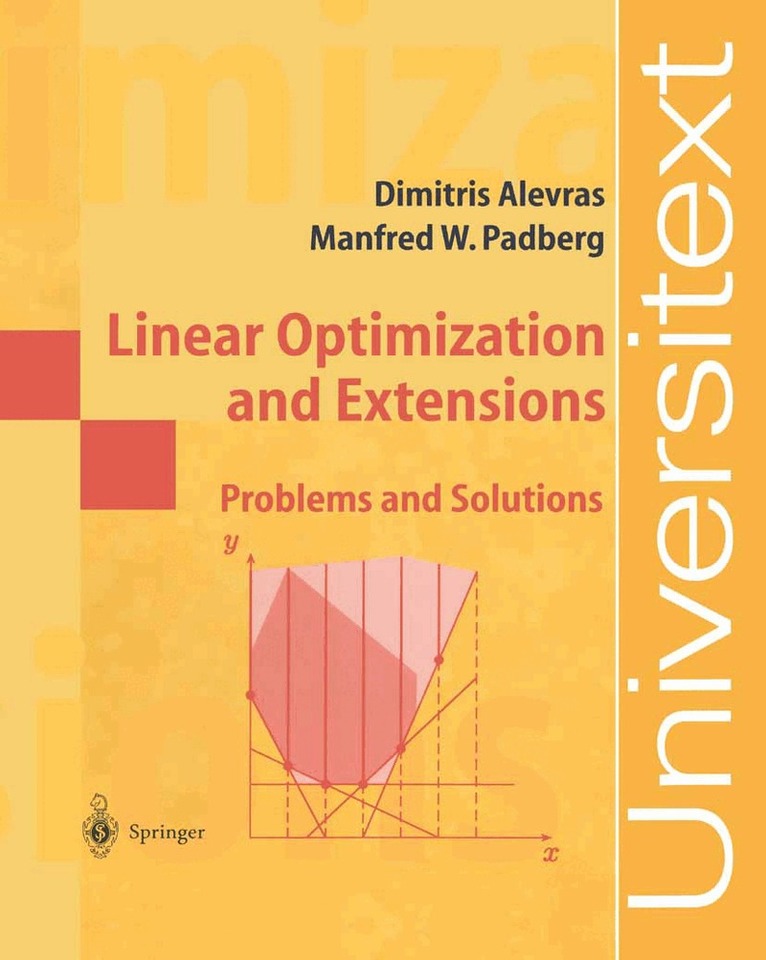
Books on a technical topic - like linear programming - without exercises ignore the principal beneficiary of the endeavor of writing a book, namely the student - who learns best by doing course. Books with exercises - if they are challenging or at least to some extent so exercises, of - need a solutions manual so that students can have recourse to it when they need it. Here we give solutions to all exercises and case studies of M. Padberg's Linear Optimization and Exten sions (second edition, Springer-Verlag, Berlin, 1999). In addition we have included several new exercises and taken the opportunity to correct and change some of the exercises of the book. Here and in the main text of the present volume the terms "book", "text" etc. designate the second edition of Padberg's LPbook and the page and formula references refer to that edition as well. All new and changed exercises are marked by a star * in this volume. The changes that we have made in the original exercises are inconsequential for the main part of the original text where several ofthe exercises (especiallyin Chapter 9) are used on several occasions in the proof arguments. None of the exercises that are used in the estimations, etc. have been changed.
E-bok
PDF, Engelska, 20121 029 kr
Läs direkt efter köp
Books on a technical topic - like linear programming - without exercises ignore the principal beneficiary of the endeavor of writing a book, namely the student - who learns best by doing course. Books with exercises - if they are challenging or at least to some extent so exercises, of - need a solutions manual so that students can have recourse to it when they need it. Here we give solutions to all exercises and case studies of M. Padberg''s Linear Optimization and Exten sions (second edition, Springer-Verlag, Berlin, 1999). In addition we have included several new exercises and taken the opportunity to correct and change some of the exercises of the book. Here and in the main text of the present volume the terms "book", "text" etc. designate the second edition of Padberg''s LPbook and the page and formula references refer to that edition as well. All new and changed exercises are marked by a star * in this volume. The changes that we have made in the original exercises are inconsequential for the main part of the original text where several ofthe exercises (especiallyin Chapter 9) are used on several occasions in the proof arguments. None of the exercises that are used in the estimations, etc. have been changed.