Manjusha Nair - Böcker
Visar alla böcker från författaren Manjusha Nair. Handla med fri frakt och snabb leverans.
6 produkter
6 produkter
1 456 kr
Skickas inom 3-6 vardagar
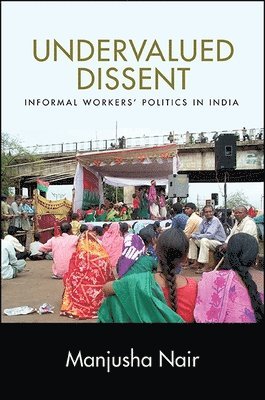
Uses two case studies to demonstrate how neoliberal reforms in India have de-democratized labor politics.Honorable Mention, 2018 Global Division Book Award presented by the Global Division of the Society for the Study of Social Problems Historically, the Indian state has not offered welfare and social rights to all of its citizens, yet a remarkable characteristic of its polity has been the ability of citizens to dissent in a democratic way. In Undervalued Dissent, Manjusha Nair argues that this democratic space has been vanishing slowly. Based on extensive fieldwork in Chhattisgarh, a regional state in central India, this book examines two different informal workers' movements. Informal workers are not part of organized labor unions and make up eighty-five percent of the Indian workforce. The first movement started in 1977 and was a success, while the other movement began in 1989 and still continues today, without success. The workers in both movements had similar backgrounds, skills, demands, and strategies. Nair maintains that the first movement succeeded because the workers contended within a labor regime that allowed space for democratic dissent, and the second movement failed because they contested within a widely altered labor regime following neoliberal reforms, where these spaces of democratic dissent were preempted. The key difference between the two regimes, Nair suggests, is not in the withdrawal of a prolabor state from its protective and regulatory role, as has been argued by many, but rather in the rise of a new kind of state that became functionally decentralized, economically predatory, and politically communalized. These changes, Nair concludes, successfully de-democratized labor politics in India.
394 kr
Skickas inom 5-8 vardagar
Uses two case studies to demonstrate how neoliberal reforms in India have de-democratized labor politics.Honorable Mention, 2018 Global Division Book Award presented by the Global Division of the Society for the Study of Social Problems Historically, the Indian state has not offered welfare and social rights to all of its citizens, yet a remarkable characteristic of its polity has been the ability of citizens to dissent in a democratic way. In Undervalued Dissent, Manjusha Nair argues that this democratic space has been vanishing slowly. Based on extensive fieldwork in Chhattisgarh, a regional state in central India, this book examines two different informal workers' movements. Informal workers are not part of organized labor unions and make up eighty-five percent of the Indian workforce. The first movement started in 1977 and was a success, while the other movement began in 1989 and still continues today, without success. The workers in both movements had similar backgrounds, skills, demands, and strategies. Nair maintains that the first movement succeeded because the workers contended within a labor regime that allowed space for democratic dissent, and the second movement failed because they contested within a widely altered labor regime following neoliberal reforms, where these spaces of democratic dissent were preempted. The key difference between the two regimes, Nair suggests, is not in the withdrawal of a prolabor state from its protective and regulatory role, as has been argued by many, but rather in the rise of a new kind of state that became functionally decentralized, economically predatory, and politically communalized. These changes, Nair concludes, successfully de-democratized labor politics in India.
230 kr
Skickas inom 7-10 vardagar
The Global Agenda for Social Justice provides accessible insights into some of the world’s most pressing social problems and proposes practicable international public policy responses to those problems. Written by a highly respected team of authors brought together by the Society for the Study of Social Problems (SSSP), chapters examine topics such as education, violence, discrimination, substance abuse, public health, and environment. The volume provides recommendations for action by governing officials, policy makers, and the public around key issues of social justice. The book will be of interest to scholars, practitioners, advocates, journalists, and students interested in public sociology, the study of social problems, and the pursuit of social justice.
204 kr
Skickas inom 7-10 vardagar
The Agenda for Social Justice 3: Solutions for 2024 provides accessible insights into some of the most pressing social problems and proposes public policy responses to those problems.Written by a highly respected team of authors brought together by the Society for the Study of Social Problems (SSSP), the book offers recommendations for action by elected officials, policymakers and the public regarding key issues for social justice. Chapters include discussion of social problems related to criminal justice, the economy, food insecurity, education, healthcare, housing and immigration. The book will be of interest to scholars, practitioners, advocates and students interested in public sociology, the study of social problems and the pursuit of social justice.
196 kr
Kommande
The Global Agenda for Social Justice 3 provides accessible insights into some of the most pressing social problems and proposes public policy responses to those problems.Written by a highly respected team of authors brought together by the Society for the Study of Social Problems (SSSP), the book offers recommendations for action by elected officials, policy makers, and the public regarding key issues for social justice. Chapters include discussion of social problems related to period poverty, climate justice, algorithmic bias, labor rights, and global inequality.The book will be of interest to scholars, practitioners, advocates, and students interested in public sociology, the study of social problems, and the pursuit of social justice.
4 125 kr
Skickas inom 7-10 vardagar
This timely Handbook explores social justice in the Global South in an era of planetary crisis and shifting global dynamics. Presenting the Global South as a space of belonging and resistance to the hegemony of global capitalism, it identifies how to reimagine transformative futures for a just world.Adopting an interdisciplinary perspective, expert contributors examine the many dimensions of justice. They investigate the disparate impacts of injustices on marginalized groups across the Global South, highlighting the major shortcomings of conventional development models based around global mass consumption. The Handbook also covers the role of ecological considerations, localized struggles, resistance movements and the broader geopolitical landscape in shaping narratives of social justice. Drawing on inclusionary practices to create a balanced relationship in global knowledge production, it gives voice to scholars based in the Global South as well as those who have created a third space in the Global North.The Handbook of Social Justice in the Global South is an essential resource for students and scholars of development studies, social justice, and inequality. Policymakers will also find it invaluable for enhancing their understanding of the conditions needed for global justice.