Marc Bergermann – författare
Visar alla böcker från författaren Marc Bergermann. Handla med fri frakt och snabb leverans.
2 produkter
2 produkter
2 387 kr
Skickas inom 7-10 vardagar
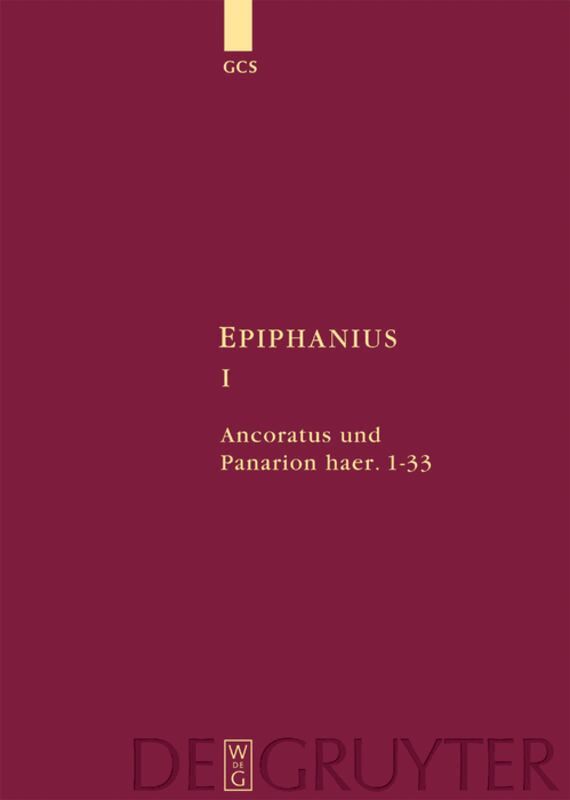
Karl Holl’s edition of the anti-heretical text by the late Classical Bishop Epiphanius of Salamis (Cyprus) is a classic among the editions of Greek Christian writers from classical antiquity. The work itself, which the author published under the eloquent title of ‘Medicine Chest against Heresies’, contains a large number of original texts, not preserved elsewhere, produced by various Christian groups which were rejected as heretical by the majority of the Church. With great zeal, Epiphanius described above all the teachings and lives of gnostic groups, but he also turned his attention to other movements, for example the Monists. In his edition, the Berlin-based ecclesiastical historian Karl Holl attempted to produce a legible and grammatically correct text from the difficult manuscript sources; in the critical apparatus, he provided a rich factual commentary. Even though critics were annoyed by his frequent interference with the source texts, still the latest major English translation uses Holl’s text. Two volumes appeared during Holl’s lifetime (in 1915 and 1922). After his death in 1926, Hans Lietzmann published a third volume in 1933. In 2006,a fourth volume, containing a detailed index, was published.While the 2nd and 3rd volumes have been available since 1980 and 1985 respectively as a corrected reprint with addenda by Jürgen Dummer, the first volume, with important information on Jewish sects and the Gnostics, has long been out of print. It is now also available again in a corrected version.
Del 198 - Beiträge zur historischen Theologie
Historia Pelagiana
Wahrnehmung und Darstellung des pelagianischen Streites in der protestantischen Kirchenhistoriographie des 18. Jahrhunderts
Inbunden, Tyska, 2021
2 186 kr
Tillfälligt slut
Wie gestaltet sich das Verhältnis von göttlicher Allmacht und Prädestination zur menschlichen Freiheit und Verantwortung? Die dogmatischen Fragestellungen, die der pelagianische Streit im fünften Jahrhundert aufwarf, hatten weitreichende Folgen für die christliche Anthropologie, Sünden- und Gnadenlehre. Verfechter eines optimistischen Menschenbildes galten in dessen Folge für Jahrhunderte als Feinde der Gnade und Anhänger des Häretikers Pelagius. Die Erbsündenlehre seines Widerstreiters Augustinus von Hippo hingegen wurde zum zentralen Identitätsmerkmal westlicher Theologie, auch der Reformatoren. Erst die Umbrüche des 18. Jahrhunderts führten zu signifikanten Neudarstellungen und -beurteilung des Streites, seiner Akteure und der verhandelten Theologumena. Marc Bergermann zeichnet anhand ausgewählter Kirchengeschichtsdarstellungen diese sich vollziehende Veränderung und ihre Ursachen im deutschsprachigen Protestantismus des 18. Jahrhunderts nach.