Marc De Mey - Böcker
Visar alla böcker från författaren Marc De Mey. Handla med fri frakt och snabb leverans.
4 produkter
4 produkter
279 kr
Skickas inom 7-10 vardagar
In this study of the cognitive paradigm, De Mey applies the study of computer models of human perception to the philosophy and sociology of science. "A most stimulating, and intellectually delightful book."--John Goldsmith "[De Mey] has brought together an unusually wide range of material, and suggested some interesting lines of thought, about what should be an important application of cognitive science: The understanding of science itself."--Cognition and Brain Theory "It ought to be on the shelf of every teacher and researcher in the field and on the reading list of any student or practitioner seriously interested in how those they serve are likely to set about knowing."--ISIS
1 546 kr
Skickas inom 10-15 vardagar
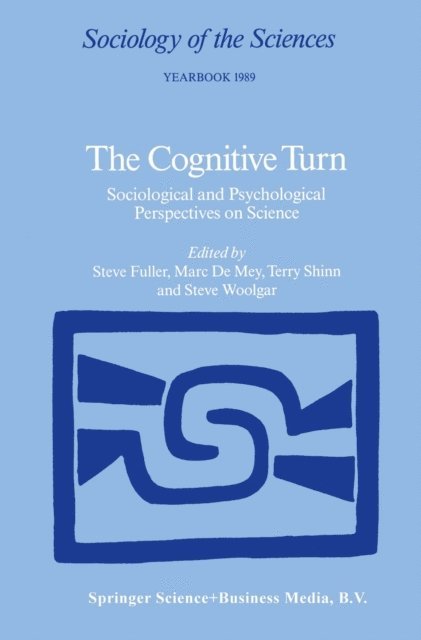
If nothing else, the twelve papers assembled in this volume should lay to rest the idea that the interesting debates about the nature of science are still being conducted by "internalists" vs. "externalists,"" rationalists" vs. "arationalists, n or even "normative epistemologists" vs. "empirical sociologists of knowledge. " Although these distinctions continue to haunt much of the theoretical discussion in philosophy and sociology of science, our authors have managed to elude their strictures by finally getting beyond the post-positivist preoccupation of defending a certain division of labor among the science studies disciplines. But this is hardly to claim that our historians, philosophers, sociologists, and psychologists have brought about an "end of ideology," or even an "era of good feelings," to their debates. Rather, they have drawn new lines of battle which center more squarely than ever on practical matters of evaluating and selecting methods for studying science. To get a vivid sense of the new terrain that was staked out at the Yearbook conference, let us start by meditating on a picture. The front cover of a recent collection of sociological studies edited by one of us (Woolgar 1988) bears a stylized picture of a series of lined up open books presented in a typical perspective fashion. The global shape comes close to a trapezium, and is composed of smaller trapeziums gradually decreasing in size and piled upon each other so as to suggest a line receding in depth. The perspective is stylized too.
Cognitive Paradigm
Cognitive Science, a Newly Explored Approach to the Study of Cognition Applied in an Analysis of Science and Scientific Knowledge
Häftad, Engelska, 1984
1 546 kr
Skickas inom 10-15 vardagar
The growing importance of the sciences in industrialised societies has been acknowledged by the increasing number of studies concerned with their development, change and control. In the past 20 or so years there has been a considerable growth in teaching and research programmes dealing with science and technology policy, science and society, sociology and history of science and similar areas which has resulted in much new material about the production and validation of scientific knowledge. In addition to the quanti tative growth of this literature, there has also been a substantial shift in the problems addressed and approaches adopted. In particular, the substantive content of scientific knowledge has become the focus of many historical and sociological studies which seek to understand how knowledges develop and change in different social circumstances. Instead of taking the privileged epistemological status of scientific knowledge for granted, recent approaches have emphasised the socially contingent nature of knowledge production and validation and the pluralistic nature of the sciences. Parallel to these develop ments, there has been a shift in the treatment of science by the state, business and public pressure groups. Increasingly they have sought to control the direction of research, and thus the content of knowledge, directly rather than simply applying existing knowledge. Science has become amenable to social control and influence. Its sacred status has declined and it is increasingly viewed as a socially constituted phenomenon which can be studied in a similar manner to other cultural products.
1 590 kr
Skickas inom 10-15 vardagar
If nothing else, the twelve papers assembled in this volume should lay to rest the idea that the interesting debates about the nature of science are still being conducted by "internalists" vs. "externalists,"" rationalists" vs. "arationalists, n or even "normative epistemologists" vs. "empirical sociologists of knowledge. " Although these distinctions continue to haunt much of the theoretical discussion in philosophy and sociology of science, our authors have managed to elude their strictures by finally getting beyond the post-positivist preoccupation of defending a certain division of labor among the science studies disciplines. But this is hardly to claim that our historians, philosophers, sociologists, and psychologists have brought about an "end of ideology," or even an "era of good feelings," to their debates. Rather, they have drawn new lines of battle which center more squarely than ever on practical matters of evaluating and selecting methods for studying science. To get a vivid sense of the new terrain that was staked out at the Yearbook conference, let us start by meditating on a picture. The front cover of a recent collection of sociological studies edited by one of us (Woolgar 1988) bears a stylized picture of a series of lined up open books presented in a typical perspective fashion. The global shape comes close to a trapezium, and is composed of smaller trapeziums gradually decreasing in size and piled upon each other so as to suggest a line receding in depth. The perspective is stylized too.