Marc Saperstein - Böcker
Visar alla böcker från författaren Marc Saperstein. Handla med fri frakt och snabb leverans.
10 produkter
10 produkter
359 kr
Tillfälligt slut
696 kr
Skickas inom 5-8 vardagar
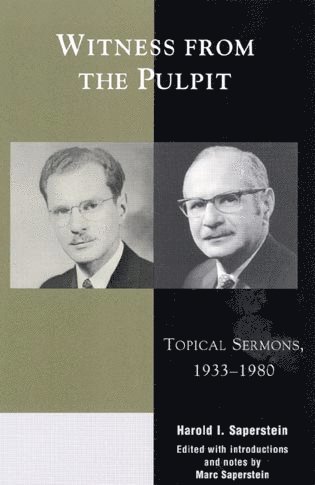
Harold I. Saperstein served as rabbi of Temple Emanu-El of Lynbrook, N.Y., from 1933 until his retirement in 1980. The specific contours of his career reflect a sustained effort to use the pulpit of this suburban temple to communicate a Jewish perspective based on personal encounters with great issues of the day-including the rise of Nazism and the Holocaust, the civil rights era, the McCarthy era, and other turning points in American history. The fifty-two sermons in this book have been selected, introduced, and annotated by Marc Saperstein, whose award-winning books on the history of Jewish preaching have established him as a leading expert on this subject. No other book illustrates as effectively the value of the sermon as a resource for understanding the challenges faced by American Jews at some of the most dramatic moments in the turbulent history of this century.
467 kr
Skickas inom 7-10 vardagar
The messianic idea that a redeemer sent by God will come to end the suffering of a persecuted people and inaugurate a new age of justice and peace has been one of the most powerful and influential concepts given by the Jewish people to western civilization. This book represents a sample of the most penetrating and provocative scholarly interpretations of Jewish messianic movement from various perspectives- historical, sociological, psychological, and religious.
Del 32 - Monographs of the Hebrew Union College
Exile in Amsterdam
Saul Levi Morteira's Sermons to a Congregation of New Jews
Häftad, Engelska, 2005
635 kr
Skickas inom 5-8 vardagar
Exile in Amsterdam is based on a rich, extensive, and previously untapped source for one of the most important and fascinating Jewish communities in early modern Europe: the sermons of Saul Levi Morteira (ca. 1596-1660). It offers those interested in European Jewish history access to primary source documents.
539 kr
Skickas inom 5-8 vardagar
Jacob Marcus's The Jews in The Medieval World (1938) has remained an indispensable resource for its comprehensive view of Jewish historical experience from late antiquity through the early modern period using primary source documents in English translation. This new work based on Marcus's book centres the focus squarely on Christian Europe.
373 kr
Skickas inom 7-10 vardagar
This first comprehensive anthology examining Jewish responses to exile from the biblical period to our modern day gathers texts from all genres of Jewish literary creativity to explore how the realities and interpretations of exile have shaped Judaism, Jewish politics, and individual Jewish identity for millennia. Ordered along multiple arcs-from universal to particular, collective to individual, and mythic-symbolic to prosaic everyday living-the chapters present different facets of exile: as human condition, in history and life, in holiday rituals, in language, as penance and atonement, as internalized experience, in relation to the Divine Presence, and more. By illuminating the multidimensional nature of “exile”-political, philosophical, religious, psychological, and mythological-widely divergent evaluations of Jewish life in the Diaspora emerge. The word “exile” and its Hebrew equivalent, galut, evoke darkness, bleakness-and yet the condition offers spiritual renewal and engenders great expressions of Jewish cultural creativity: the Babylonian Talmud, medieval Jewish philosophy, golden age poetry, and modern Jewish literature.Exile and the Jews will engage students, academics, and general readers in contemplating immigration, displacement, evolving identity, and more.
Del 18 - Monographs of the Hebrew Union College
Your Voice Like a Ram's Horn
Themes and Texts in Traditional Jewish Preaching
Häftad, Engelska, 2014
582 kr
Tillfälligt slut
The eighteen studies in this book continue the exploration of the Jewish sermon Saperstein began in his groundbreaking Jewish Preaching 1200-1800. His new research further illustrates the importance of this genre, largely ignored by modern scholarship, as an indispensible resource for understanding Jewish history, spirituality, and thought from the High Middle Ages to the beginning of the Emancipation in Europe. Saperstein's thematic studies explore the most important occasions for traditional rabbinic preaching: the Days of Awe and the Passover season. Two studies focus on the homiletical exegesis of classical Jewish texts, and two deal with the historical interaction of Christians and Jews. Saperstein discusses the diffusion of philosophical ideas through homiletics and identifies central conceptual issues presented in the Italian Jewish pulpit. Other essays include a critical analysis of the work of Saul Levi Morteira of Amsterdam, an examination of sermons in eighteenth-century Prague for indications of a traditional community in crisis, and homiletical evidence for a developing sense of patriotic identification with the state, even before Emancipation changed the legal status of the Jews. Saperstein also presents newly discovered sermonic texts in order to explore a full panoply of issues relating to historical context and genre. All are published for the first time with his annotated translation accompanying the Hebrew original. Included are a Guide for Preachers, sermons on repentance and on the Binding of Isaac, and three eulogies, the last a fascinating memorialization of the antisemitic empress Maria Theresa.
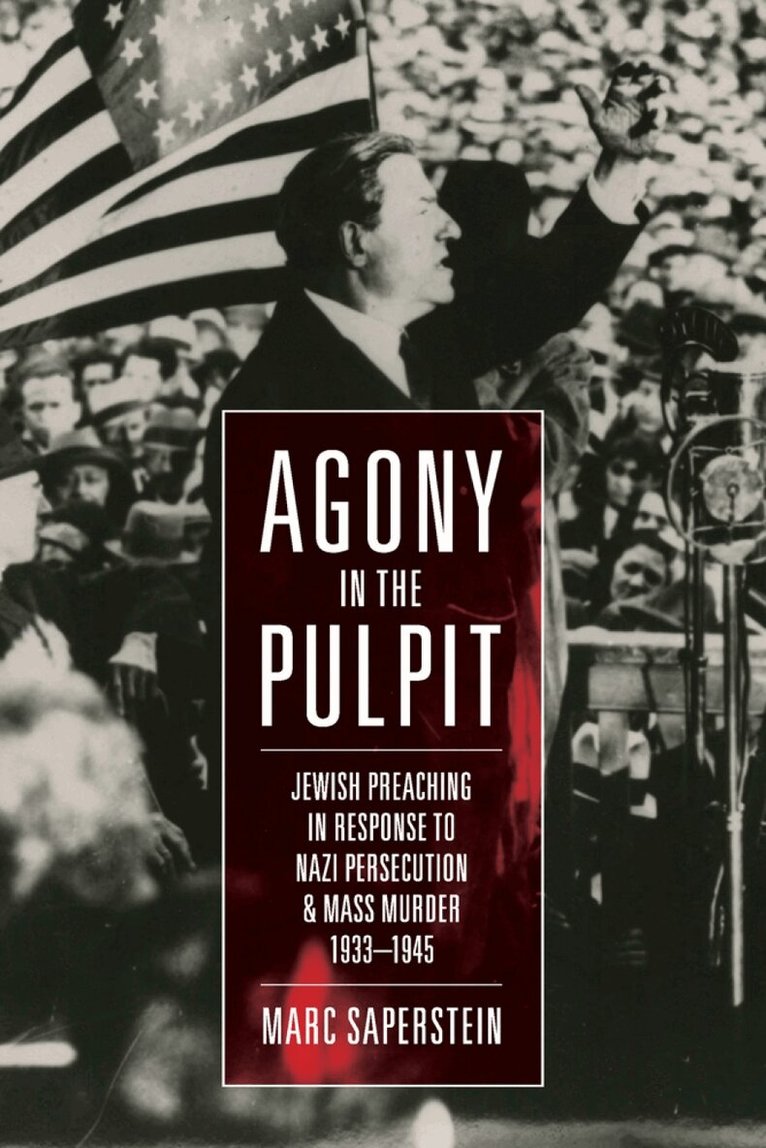
Agony in the Pulpit
Jewish Preaching in Response to Nazi Persecution and Mass Murder 1933-1945
Inbunden, Engelska, 2018
1 524 kr
Skickas inom 5-8 vardagar
Many scholars have focused on contemporary sources pertaining to the Nazi persecution and mass murder of Jews between 1933 and 1945--citing dated documents, newspapers, diaries, and letters--but the sermons delivered by rabbis describing and protesting against the ever-growing oppression of European Jews have been largely neglected. Agony in the Pulpit is a response to this neglect, and to the accusations made by respected figures that Jewish leaders remained silent in the wake of catastrophe. The passages from sermons reproduced in this volume--delivered by 135 rabbis in fifteen countries, mainly from the United States and England--provide important evidence of how these rabbis communicated the ever-worsening news to their congregants, especially on important religious occasions when they had peak attendance and peak receptivity. A central theme is how the preachers related the contemporary horrors to ancient examples of persecution. Did they present what was occurring under Hitler as a reenactment of the murderous oppressions by Pharaoh, Amalek, Haman, Ahasuerus, the Crusaders, the Spanish Inquisition, the Russian Pogroms? When did they begin to recognize and articulate from their pulpits an awareness that current events were fundamentally unprecedented? Was the developing cataclysm consistent with traditional beliefs about God's control of what happened on earth? No other book-length study has presented such abundant evidence of rabbis in all streams of Jewish religious life seeking to rouse and inspire their congregants to full awareness of the catastrophic realities that were taking shape in the world beyond their synagogues.
355 kr
Skickas inom 5-8 vardagar
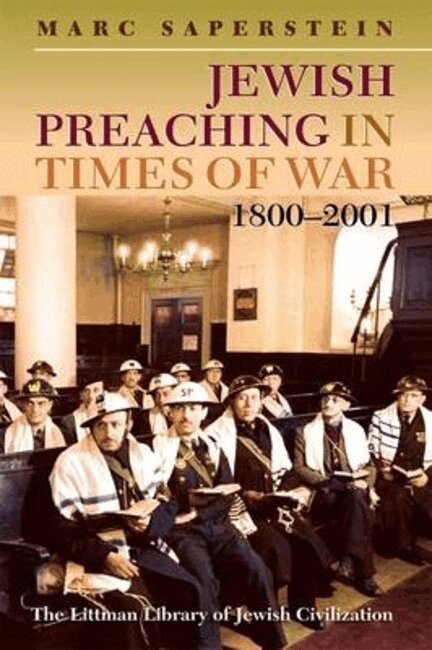
Wartime sermons reveal how Jews perceive themselves in relation to the majority society and how Jewish and national values are reconciled when the fate of a nation is at stake. They also illustrate how rabbis guide their communities through the challenges of their times.The sermons reproduced here were delivered by American and British rabbis from across the Jewish spectrum—Orthodox to Liberal, Ashkenazi and Sephardi—from the Napoleonic Wars to the attacks of 9/11. Each sermon is prefaced by a comprehensive introduction explaining the context in which it was delivered. Detailed notes explain allusions unfamiliar to a present-day readership and draw comparisons where appropriate to similar passages in contemporary newspapers and other sermons. A general introduction surveys more broadly the distinctive elements of modern Jewish preaching—the new preaching occasions bound up with the history of the countries in which Jews were living; new modes for the dissemination of the sermons (printed pamphlets and the Jewish and general press), and the emergence of women’s voices from the pulpit. It also surveys the distinctive themes of modern Jewish sermons, including responses to Jewish suffering, social justice, eulogies for national leaders, Zionism, and war.What Jewish religious leaders said to their congregations when their countries went to war (or, in some cases, were considering going to war) raises questions of central significance for both modern Jewish history and religious thinking in the civic context. What evidence do these sermons present concerning the degree of patriotism felt by Jews? Where and when do we find examples of dissent from the policies taken by their governments, or explicit criticism? What theological problems are raised by the preachers in the context of unprecedented and unimagined destruction, and how do they respond to these problems? How is the enemy presented in these texts? How is the problem of Jews fighting and killing other Jews addressed? Are the preachers functioning to articulate traditions that challenge the consensus of the moment, or as instruments of social control serving the needs of governments looking for unquestioning support from their citizenry? In all these areas, this book makes an important contribution to the American- and Anglo-Jewish history of this period while also making available a collection of mostly unknown Jewish texts produced at dramatic moments of the past two centuries.
Leadership and Conflict
Tensions in Medieval and Modern Jewish History and Culture
Inbunden, Engelska, 2014
915 kr
Skickas inom 7-10 vardagar
This masterly collection of essays offers a multifaceted analysis of how Jewish leaders in medieval and early modern times responded to the challenges presented by a changing world. Based largely on the study of sermons and response - genres that show them addressing real situations in the lives of their people - the book reveals how they handled intellectual, social, and political diversity and conflict. As medieval Jews were exposed to new philosophical ideas, many began to question and challenge rabbinical leadership. Leadership and Conflict explores the process by which these ideas became more accessible, the doubts that consequently arose regarding certain biblical and rabbinic texts, and the attempt by some leaders to ban the study of philosophical texts altogether. The book also addresses the rhetoric of rebuke used by preachers to criticize behavior within their community that they considered to be a violation of Jewish law and tradition. Another set of challenges to traditional Jewish life emerged from political developments in the wider world, including the unification of France, the Spanish Inquisition and Edict of Expulsion, and the beginning of the Counter-Reformation. Leadership and Conflict asks whether criticism of the talent and leadership of rabbis in such times of crisis was justified. The final section of the book is devoted to conflicting attitudes within Jewish society: towards the Holy Land, exile and diasporic existence, and messianic movements and personalities. Leadership and Conflict represents three decades of scholarship by Professor Marc Saperstein, a distinguished historian. Bringing his perceptive essays together in a single volume allows a new generation of students and scholars to have access to his insights and conclusions.