Marcel Lesieur - Böcker
Visar alla böcker från författaren Marcel Lesieur. Handla med fri frakt och snabb leverans.
6 produkter
6 produkter
2 121 kr
Skickas inom 10-15 vardagar
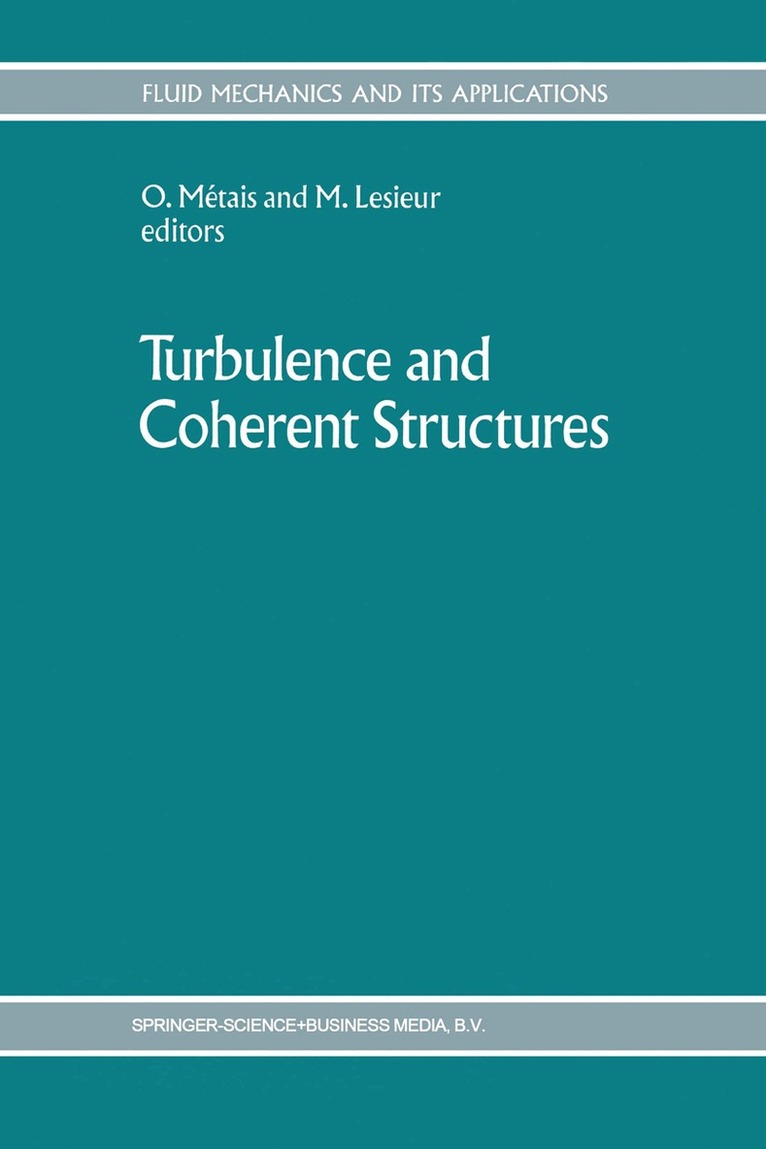
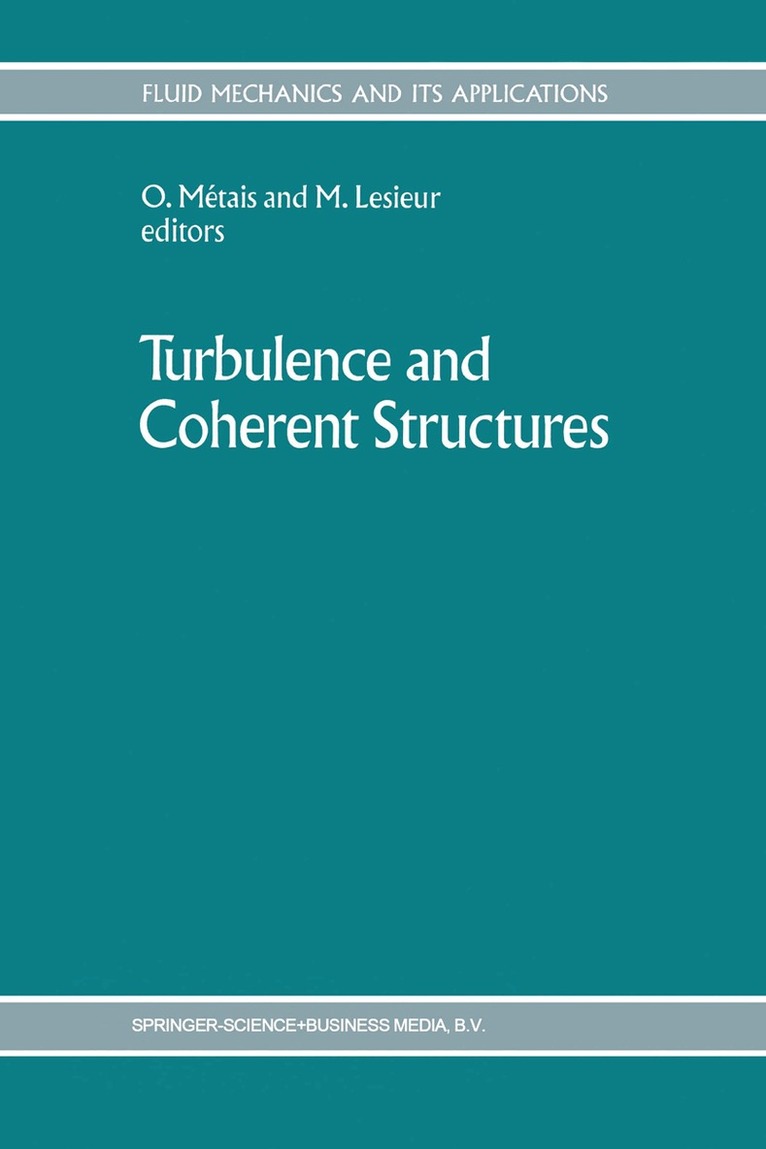
In the last 25 years, one of the most striking advances in Fluid Mecha nics was certainly the discovery of coherent structures in turbulence: lab oratory experiments and numerical simulations have shown that most turbulent flows exhibit both spatially-organized large-scale structures and disorganized motions, generally at smaller scales. The develop ment of new measurement and visualization techniques have allowed a more precise characterization and investigation of these structures in the laboratory. Thanks to the unprecedented increase of computer power and to the development of efficient interactive three-dimensional colour graphics, computational fluid dynamicists can explore the still myste rious world of turbulence. However, many problems remain unsolved concerning the origin of these structures, their dynamics, and their in teraction with the disorganized motions. In this book will be found the latest results of experimentalists, theoreticians and numerical modellers interested in these topics. These coherent structures may appear on airplane wings or slender bodies, mixing layers, jets, wakes or boundary-layers. In free-shear flows and in boundary layers, the results presented here highlight the intense three-dimensional character of the vortices. The two-dimensional large scale eddies are very sensitive to three-dimensional perturbations, whose amplification leads to the formation of three-dimensional coherent vorti cal structures, such as streamwise, hairpin or horseshoe vortex filaments. This book focuses on modern aspects of turbulence study. Relations between turbulence theory and optimal control theory in mathematics are discussed. This may have important applications with regard to, e. g. , numerical weather forecasting.
850 kr
Skickas inom 10-15 vardagar
Turbulence is a dangerous topic which is often at the origin of serious ?ghts in the scienti?c meetings devoted to it since it represents extremely di?erent points of view, all of which have in common their complexity, as well as an inability to solve the problem. It is even di?cult to agree on what exactly is the problem to be solved. Extremely schematically, two opposing points of view had been adv- ated during these last thirty years: the ?rst one was “statistical”, and tried to model the evolution of averaged quantities of the ?ow. This community, which had followed the glorious trail of Taylor and Kolmogorov, believed in the phenomenology of cascades, and strongly disputed the possibility of any coherence or order associated to turbulence. On the other bank of the river standed the “coherence among chaos” community, which considered turbulence from a purely deterministic point of view, by studying either the behaviour of dynamical systems, or the stability of ?ows in various situations. To this community were also associated the experimentalists and computer simulators who sought to identify coherent vortices in ?ows. Situation is more complex now, and the existence of these two camps is less clear. In fact a third point of view pushed by people from the physics community has emerged, with the concepts of renormalization group theory, multifractality, mixing, and Lagrangian approaches.
2 121 kr
Skickas inom 10-15 vardagar
In the last 25 years, one of the most striking advances in Fluid Mecha nics was certainly the discovery of coherent structures in turbulence: lab oratory experiments and numerical simulations have shown that most turbulent flows exhibit both spatially-organized large-scale structures and disorganized motions, generally at smaller scales. The develop ment of new measurement and visualization techniques have allowed a more precise characterization and investigation of these structures in the laboratory. Thanks to the unprecedented increase of computer power and to the development of efficient interactive three-dimensional colour graphics, computational fluid dynamicists can explore the still myste rious world of turbulence. However, many problems remain unsolved concerning the origin of these structures, their dynamics, and their in teraction with the disorganized motions. In this book will be found the latest results of experimentalists, theoreticians and numerical modellers interested in these topics. These coherent structures may appear on airplane wings or slender bodies, mixing layers, jets, wakes or boundary-layers. In free-shear flows and in boundary layers, the results presented here highlight the intense three-dimensional character of the vortices. The two-dimensional large scale eddies are very sensitive to three-dimensional perturbations, whose amplification leads to the formation of three-dimensional coherent vorti cal structures, such as streamwise, hairpin or horseshoe vortex filaments. This book focuses on modern aspects of turbulence study. Relations between turbulence theory and optimal control theory in mathematics are discussed. This may have important applications with regard to, e. g. , numerical weather forecasting.
1 064 kr
Skickas inom 10-15 vardagar
Turbulence is a dangerous topic which is often at the origin of serious fights in the scientific meetings devoted to it since it represents extremely different points of view, all of which have in common their complexity, as well as an inability to solve the problem. It is even difficult to agree on what exactly is the problem to be solved. Extremely schematically, two opposing points of view have been advocated during these last ten years: the first one is "statistical", and tries to model the evolution of averaged quantities of the flow. This com has followed the glorious trail of Taylor and Kolmogorov, munity, which believes in the phenomenology of cascades, and strongly disputes the possibility of any coherence or order associated to turbulence. On the other bank of the river stands the "coherence among chaos" community, which considers turbulence from a purely deterministic po int of view, by studying either the behaviour of dynamical systems, or the stability of flows in various situations. To this community are also associated the experimentalists who seek to identify coherent structures in shear flows.
Del 6 - Mechanics of Fluids and Transport Processes
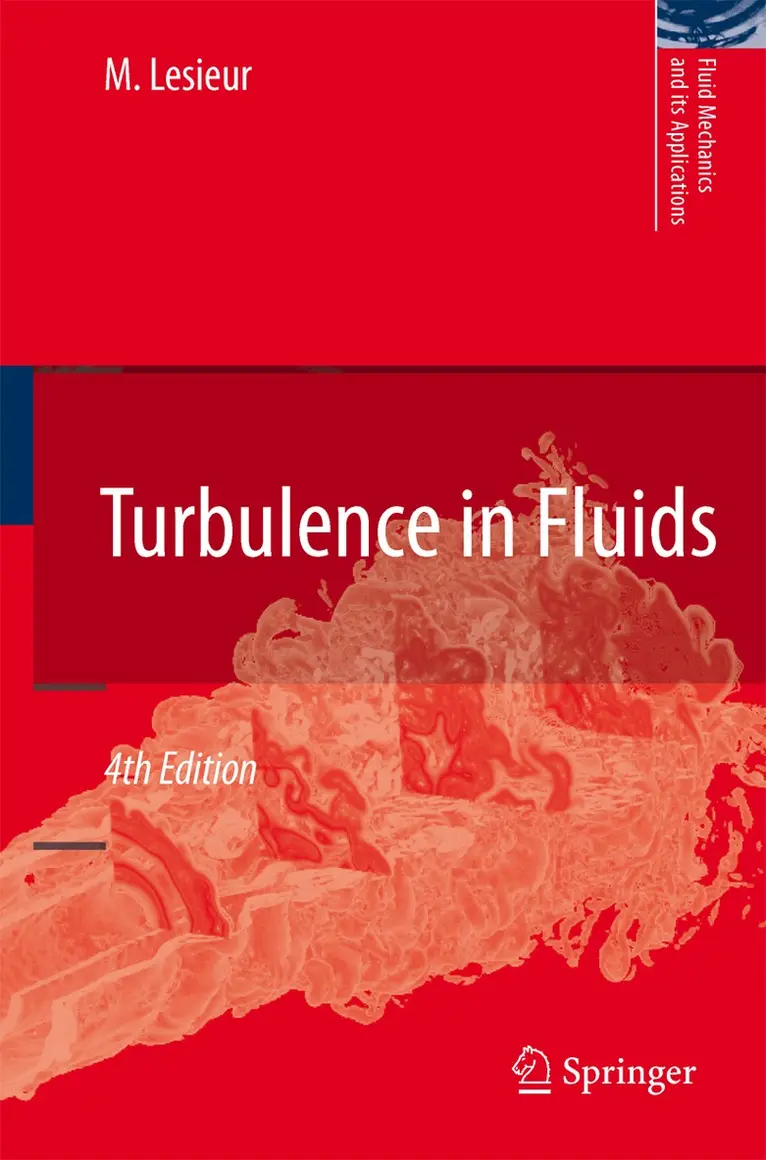
Turbulence in Fluids
Stochastic and Numerical Modelling
Häftad, Engelska, 2012
536 kr
Skickas inom 10-15 vardagar
610 kr
Skickas inom 10-15 vardagar
Turbulence is a dangerous topic which is often at the origin of serious ?ghts in the scienti?c meetings devoted to it since it represents extremely di?erent points of view, all of which have in common their complexity, as well as an inability to solve the problem. It is even di?cult to agree on what exactly is the problem to be solved. Extremely schematically, two opposing points of view had been adv- ated during these last thirty years: the ?rst one was “statistical”, and tried to model the evolution of averaged quantities of the ?ow. This community, which had followed the glorious trail of Taylor and Kolmogorov, believed in the phenomenology of cascades, and strongly disputed the possibility of any coherence or order associated to turbulence. On the other bank of the river standed the “coherence among chaos” community, which considered turbulence from a purely deterministic point of view, by studying either the behaviour of dynamical systems, or the stability of ?ows in various situations. To this community were also associated the experimentalists and computer simulators who sought to identify coherent vortices in ?ows. Situation is more complex now, and the existence of these two camps is less clear. In fact a third point of view pushed by people from the physics community has emerged, with the concepts of renormalization group theory, multifractality, mixing, and Lagrangian approaches.