Marco Lippi – författare
Visar alla böcker från författaren Marco Lippi. Handla med fri frakt och snabb leverans.
3 produkter
3 produkter
Inbunden, Engelska, 1997
2 326 kr
Skickas inom 7-10 vardagar
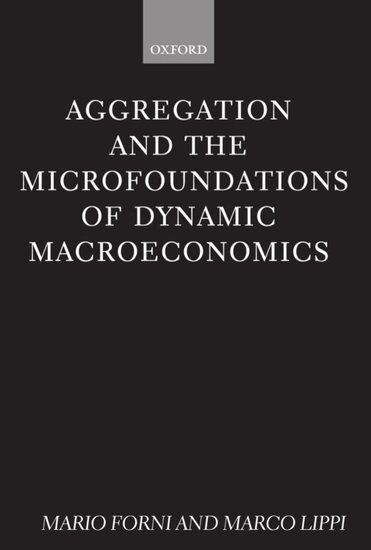
This book argues that modern macroeconomics has completely overlooked the aggregate nature of the data. Standard models start with intertemporally maximizing agents and obtain dynamic equations linking economic variables like consumption, income, investment interest rate and employment. Such equations exhibit testable properties like cointegration, definite patterns of Granger causality, and restrictions on the parameters. The usual simplification that agents are identical leads to testing these properties directly on aggregate data. Here this simplification is systematically questioned. In Part I the homogeneity assumption is tested using disaggregate data and strongly rejected. As shown in Part II, the consequence of introducing heterogeneity is that, apart from flukes, cointegration unidirectional Granger causality, restrictions on parameters do not survive aggregation: thus the claim that modern macroeconomics has solid microfoundations is unwarranted. However, it is argued in Part III that aggregation is not necessarily bad. Some important theory-based models that do not fit aggregate data well in their representative-agent version can be reconciled with aggregate data by introducing heterogeneity.
E-bok
Engelska, 2017123 kr
Läs direkt efter köp
When Value and Naturalism in Marx was first published in English in 1979, recent controversies in socialist economic theory had been concentrated on the tenability or untenability of Marx''s labour theory of value. Marco Lippi''s provocative book accepts the Sraffian correction of Marx''s account of profits and prices, but goes on to ask the central question: why did Marx identify value with embodied labour-time? The answer, Lippi argues, lies in a strong-though little-discussed-naturalistic strain in Marx''s thought. Through a novel analysis of the discussion of circulation costs in Volume Two of Capital, he contends that Marx operated with a concept of ''production in general'', as a relationship of man to nature common to all forms of society, in which labour-time appears as the sole real cost. It was this general conception of production, he suggests, that underlay Marx''s insistence that profits, interest, rent and faux frais represent no more than a redistribution of a pre-given total-the mass of surplus value, in a system in which total profit equalled total surplus value and total price total value. While Lippi rejects Marx''s naturalistic identification of value with embodied labour-time, he claims that the account developed from it of the anarchy of the market, of commodity fetishism, and of the laws of motion of capitalism is in fact logically independent and retains all its empirical validity. Value and Naturalism in Marx, the work of one of the most outstanding younger economists in Italy, reveals the classic economic theory of historical materialism in a quite new light.
Inbunden, Engelska, 2020
3 099 kr
Skickas inom 3-6 vardagar
Factor models have become the most successful tool in the analysis and forecasting of high-dimensional time series. This monograph provides an extensive account of the so-called General Dynamic Factor Model methods. The topics covered include: asymptotic representation problems, estimation, forecasting, identification of the number of factors, identification of structural shocks, volatility analysis, and applications to macroeconomic and financial data.