Marco Palacios - Böcker
Visar alla böcker från författaren Marco Palacios. Handla med fri frakt och snabb leverans.
4 produkter
4 produkter
Del 36 - Cambridge Latin American Studies
Coffee in Colombia, 1850-1970
An Economic, Social and Political History
Häftad, Engelska, 2002
726 kr
Skickas inom 7-10 vardagar
In this book, Marco Palacios explores the history of Colombia as a coffee-producer, and the implications that coffee has had for its economy, society, and politics since the middle of the nineteenth century. He provides a history of the commercialization of the crop, and relates it to the general evolution of Colombian society, an evolution often determined by coffee even in areas remote from the crop itself. The book also covers the development of the specific institutions that have been set up to manage coffee affairs, and their role in the Colombian state. Since the last quarter of the nineteenth century coffee has been the mainstay of the Colombian economy, and no historian, economist, or sociologist interested in the country can escape its importance; nor can anyone interested in the commodity ignore Colombia. This is the first work on the subject to appear in English.
475 kr
Skickas inom 3-6 vardagar
Between Legitimacy and Violence is an authoritative, sweeping history of Colombia’s “long twentieth century,” from the tumultuous civil wars of the late nineteenth century to the drug wars of the late twentieth. Marco Palacios, a leading Latin American historian, skillfully blends political, economic, social, and cultural history. In an expansive chronological narrative full of vivid detail, he explains Colombia’s political history, discussing key leaders, laws, parties, and ideologies; corruption and inefficiency; and the paradoxical nature of government institutions, which, while stable and enduring, are unable to prevent frequent and extreme outbursts of violence. Palacios traces the trajectory of the economy, addressing agriculture (particularly the economic significance of coffee), the development of a communication and transportation infrastructure, industrialization, and labor struggles. Palacios also gives extensive attention to persistent social inequalities, the role of the Catholic Church, demographic shifts such as urbanization and emigration, and Colombia’s relationship with the United States. Offering a comparative perspective, he frequently contrasts Colombia with other Latin American nations. Throughout, Palacios offers a helpful interpretive framework, connecting developments with their causes and consequences. By thoroughly illuminating Colombia’s past, Between Legitimacy and Violence sheds much-needed light on the country’s violent present.
1 433 kr
Skickas inom 10-15 vardagar
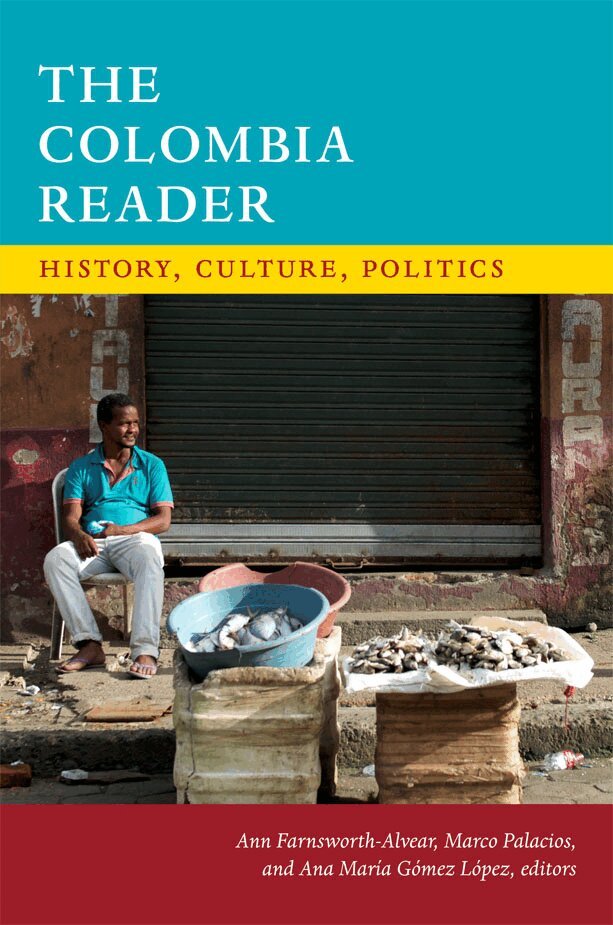
Containing over one hundred selections-most of them published in English for the first time-The Colombia Reader presents a rich and multilayered account of this complex nation from the colonial era to the present. The collection includes journalistic reports, songs, artwork, poetry, oral histories, government documents, and scholarship to illustrate the changing ways Colombians from all walks of life have made and understood their own history. Comprehensive in scope, it covers regional differences; religion, art, and culture; the urban/rural divide; patterns of racial, economic, and gender inequalities; the history of violence; and the transnational flows that have shaped the nation. The Colombia Reader expands readers' knowledge of Colombia beyond its reputation for violence, contrasting experiences of conflict with the stability and significance of cultural, intellectual, and economic life in this plural nation.
336 kr
Skickas inom 10-15 vardagar
Containing over one hundred selections-most of them published in English for the first time-The Colombia Reader presents a rich and multilayered account of this complex nation from the colonial era to the present. The collection includes journalistic reports, songs, artwork, poetry, oral histories, government documents, and scholarship to illustrate the changing ways Colombians from all walks of life have made and understood their own history. Comprehensive in scope, it covers regional differences; religion, art, and culture; the urban/rural divide; patterns of racial, economic, and gender inequalities; the history of violence; and the transnational flows that have shaped the nation. The Colombia Reader expands readers' knowledge of Colombia beyond its reputation for violence, contrasting experiences of conflict with the stability and significance of cultural, intellectual, and economic life in this plural nation.