Marcos M. López de Prado - Böcker
Visar alla böcker från författaren Marcos M. López de Prado. Handla med fri frakt och snabb leverans.
4 produkter
4 produkter
241 kr
Skickas inom 7-10 vardagar
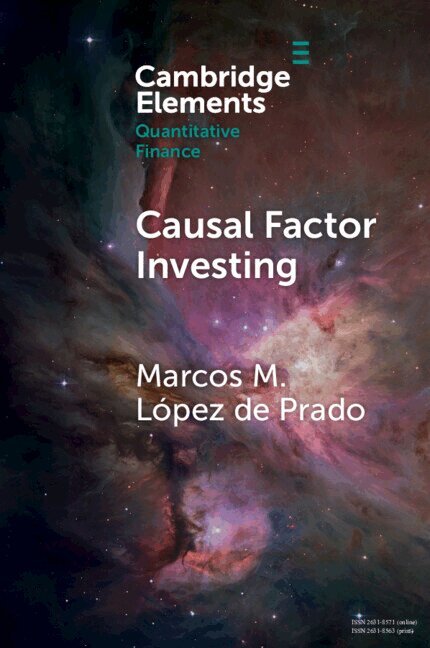
Virtually all journal articles in the factor investing literature make associational claims, in denial of the causal content of factor models. Authors do not identify the causal graph consistent with the observed phenomenon, they justify their chosen model specification in terms of correlations, and they do not propose experiments for falsifying causal mechanisms. Absent a causal theory, their findings are likely false, due to rampant backtest overfitting and incorrect specification choices. This Element differentiates between type-A and type-B spurious claims, and explains how both types prevent factor investing from advancing beyond its current phenomenological stage. It analyzes the current state of causal confusion in the factor investing literature, and proposes solutions with the potential to transform factor investing into a truly scientific discipline. This title is also available as Open Access on Cambridge Core.
775 kr
Skickas inom 7-10 vardagar
Virtually all journal articles in the factor investing literature make associational claims, in denial of the causal content of factor models. Authors do not identify the causal graph consistent with the observed phenomenon, they justify their chosen model specification in terms of correlations, and they do not propose experiments for falsifying causal mechanisms. Absent a causal theory, their findings are likely false, due to rampant backtest overfitting and incorrect specification choices. This Element differentiates between type-A and type-B spurious claims, and explains how both types prevent factor investing from advancing beyond its current phenomenological stage. It analyzes the current state of causal confusion in the factor investing literature, and proposes solutions with the potential to transform factor investing into a truly scientific discipline. This title is also available as Open Access on Cambridge Core.
775 kr
Skickas inom 7-10 vardagar
Successful investment strategies are specific implementations of general theories. An investment strategy that lacks a theoretical justification is likely to be false. Hence, an asset manager should concentrate her efforts on developing a theory rather than on backtesting potential trading rules. The purpose of this Element is to introduce machine learning (ML) tools that can help asset managers discover economic and financial theories. ML is not a black box, and it does not necessarily overfit. ML tools complement rather than replace the classical statistical methods. Some of ML's strengths include (1) a focus on out-of-sample predictability over variance adjudication; (2) the use of computational methods to avoid relying on (potentially unrealistic) assumptions; (3) the ability to "learn" complex specifications, including nonlinear, hierarchical, and noncontinuous interaction effects in a high-dimensional space; and (4) the ability to disentangle the variable search from the specification search, robust to multicollinearity and other substitution effects.
241 kr
Skickas inom 7-10 vardagar
Successful investment strategies are specific implementations of general theories. An investment strategy that lacks a theoretical justification is likely to be false. Hence, an asset manager should concentrate her efforts on developing a theory rather than on backtesting potential trading rules. The purpose of this Element is to introduce machine learning (ML) tools that can help asset managers discover economic and financial theories. ML is not a black box, and it does not necessarily overfit. ML tools complement rather than replace the classical statistical methods. Some of ML's strengths include (1) a focus on out-of-sample predictability over variance adjudication; (2) the use of computational methods to avoid relying on (potentially unrealistic) assumptions; (3) the ability to "learn" complex specifications, including nonlinear, hierarchical, and noncontinuous interaction effects in a high-dimensional space; and (4) the ability to disentangle the variable search from the specification search, robust to multicollinearity and other substitution effects.