Maren Kusch – författare
Visar alla böcker från författaren Maren Kusch. Handla med fri frakt och snabb leverans.
9 produkter
9 produkter
Del 207 - Synthese Library
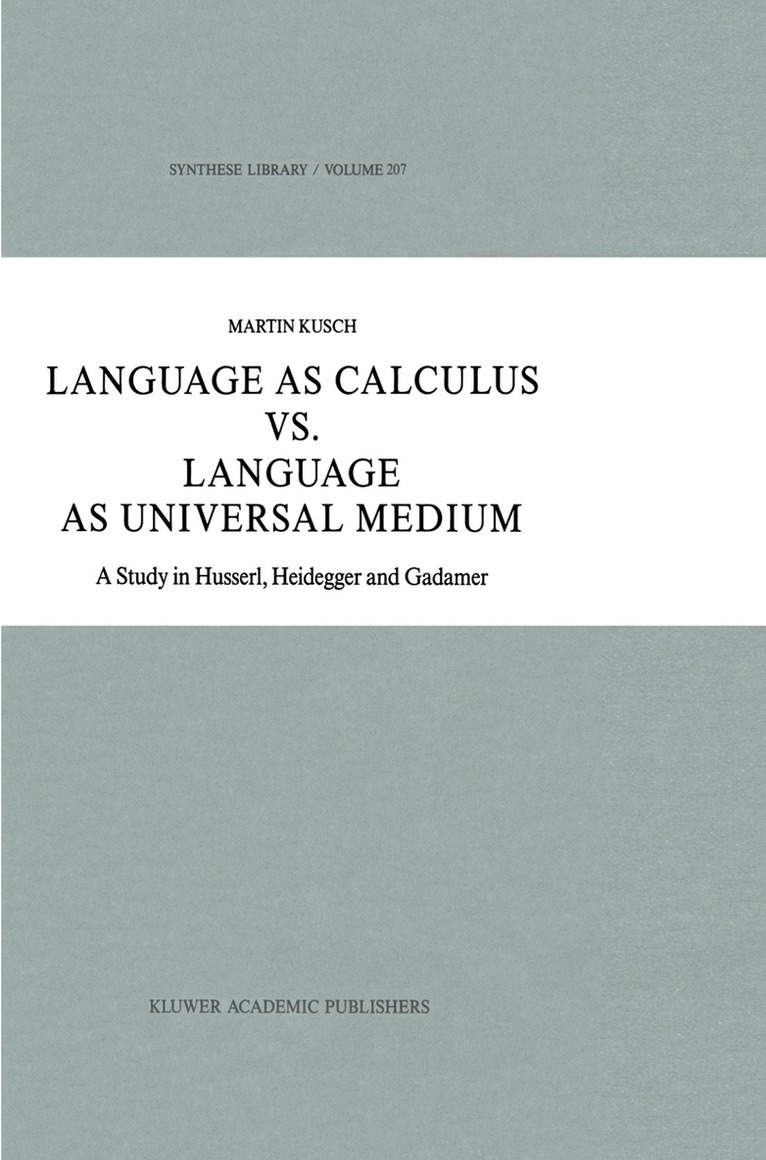
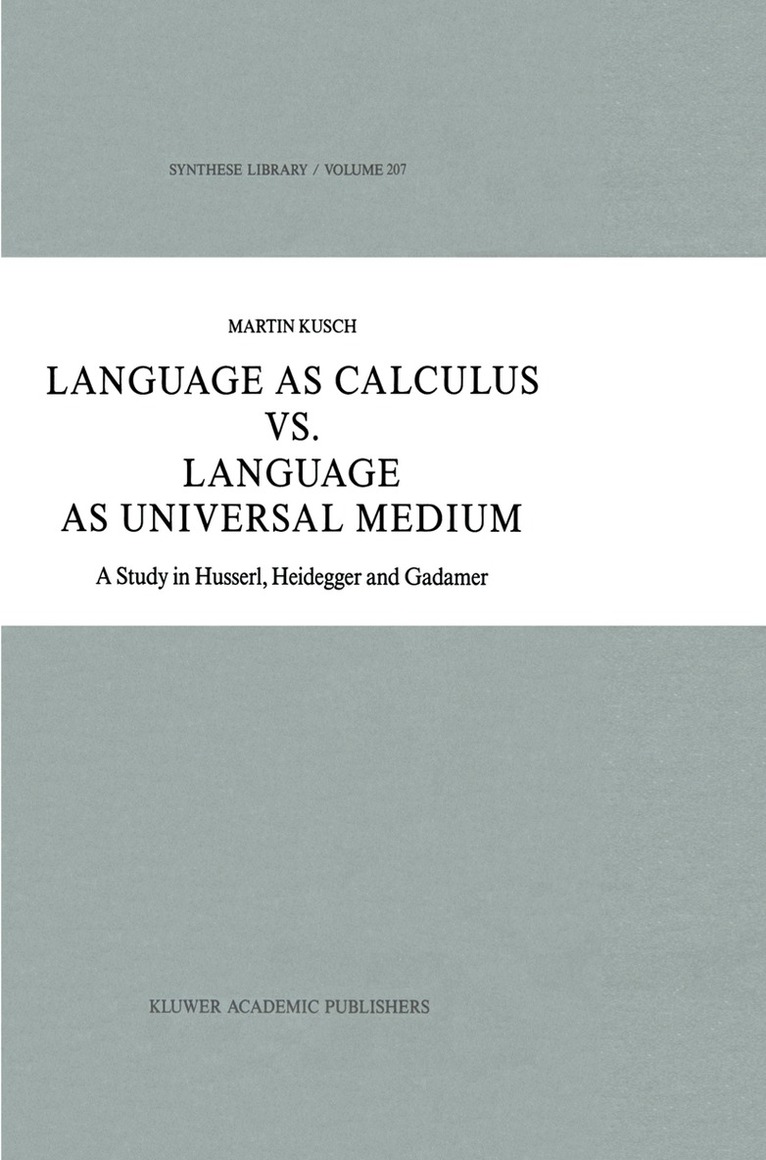
Language as Calculus vs. Language as Universal Medium
A Study in Husserl, Heidegger and Gadamer
Inbunden, Engelska, 1989
1 619 kr
Skickas inom 10-15 vardagar
I first became interested in Husserl and Heidegger as long ago as 1980, when as an undergraduate at the Freie Universitat Berlin I studied the books by Professor Ernst Tugendhat. Tugendhat's at tempt to bring together analytical and continental philosophy has never ceased to fascinate me, and even though in more recent years other influences have perhaps been stronger, I should like to look upon the present study as still being indebted to Tugendhat's initial incentive. It was my good fortune that for personal reasons I had to con tinue my academic training from 1981 onwards in Finland. Even though Finland is a stronghold of analytical philosophy, it also has a tradition of combining continental and Anglosaxon philosophical thought. Since I had already admired this line of work in Tugendhat, it is hardly surprising that once in Finland I soon became impressed by Professor Jaakko Hintikka's studies on Husserl and intentionality, and by Professor Georg Henrik von Wright's analytical hermeneu tics. While the latter influence has-at least in part-led to a book on the history of hermeneutics, the former influence has led to the present work. My indebtedness to Professor Hintikka is enormous. Not only is the research reported here based on his suggestions, but Hintikka has also commented extensively on different versions of the manuscript, helped me to make important contacts, found a publisher for me, and-last but not least-was a never failing source of encouragement.
Inbunden, Engelska, 1991
1 082 kr
Skickas inom 10-15 vardagar
In recent years, a large number of books and articles on Foucault has been published. Almost all of the book-size studies are expository and introductory. Indeed, there seems to be no other modern philosopher with reference to whom a comparable numberofintroductionshavebeen produced in such a short period. Most ofthe articles too provide over- views, rather than critical assessments or rational reconstructions, even though there existsby now a small numberoffine papers also inthe two latter genres. Moreover, more often than not, writers on Foucault approach his work as part and parcel of so-called "postmodern" philo- sophy. They concentrate on topics like the "death of the subject", the relation ofFoucault's work to.Derrida or Habermas, or its significance for postmodern art and culture. Without wanting to deny the merits, either of introductory exposi- tions, or ofstudies that read Foucault as a postmodern thinker, it seems to me that these received perspectives have tended to leave central areas and aspects ofFoucault's work somewhat underexposed.As I see it, the most important of these areas are such as would suggest reading Fou- cault from the vantage point of recent developments in the philosophy, sociology and history of science.
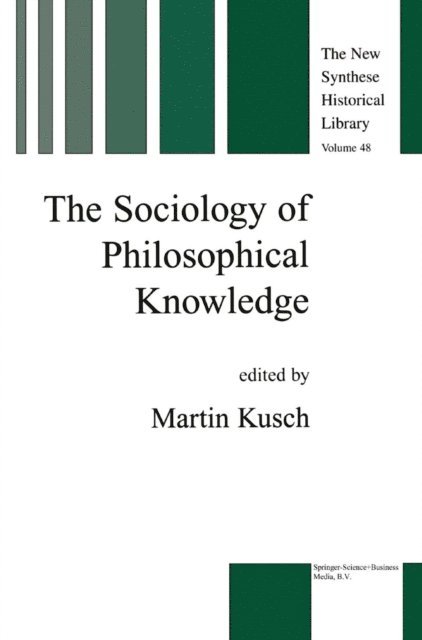
Del 48 - New Synthese Historical Library
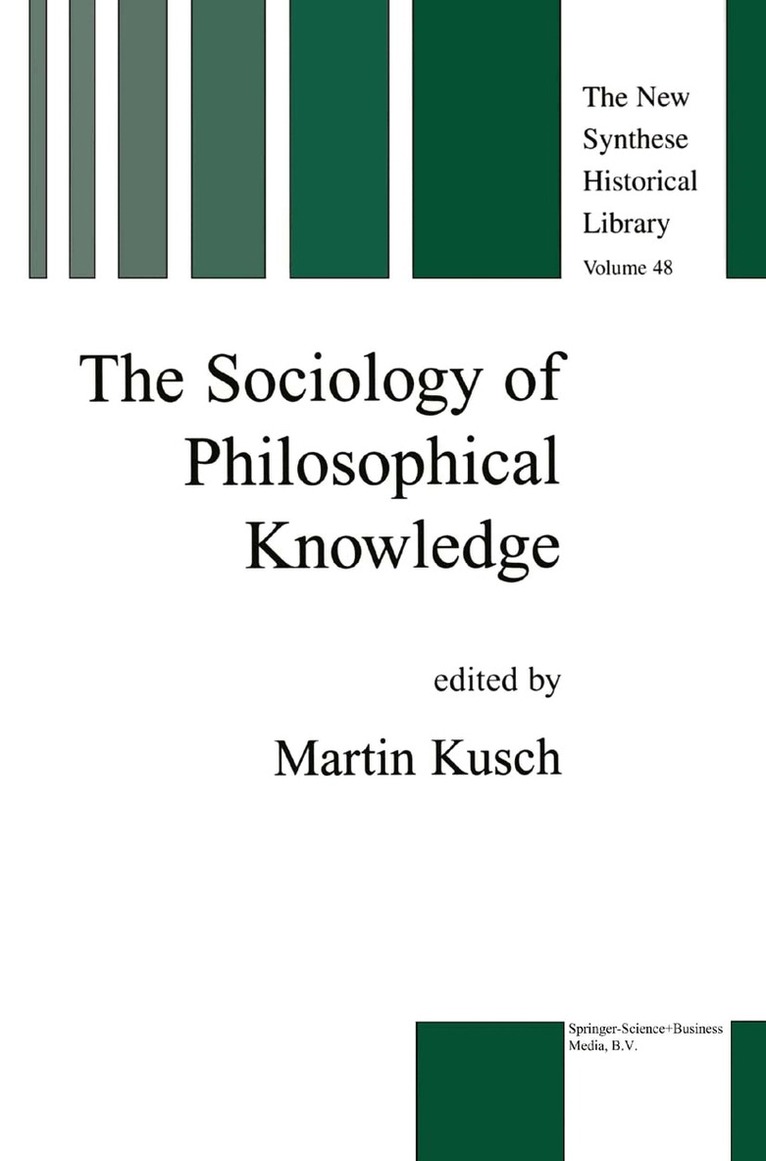
Sociology of Philosophical Knowledge
Inbunden, Engelska, 2000
1 083 kr
Skickas inom 10-15 vardagar
Until the 1970s, most sociologists believed that only knowledge in the humanities and social sciences is open to sociological analysis. This is no longer the case: a large number of studies have shown that the knowledge of science and technology also has the character of social institutions. The success of sociologists in understanding the social dimensions of science and technology has led to a relative decline of sociological studies of the humanities in general, philosophy in particular. This anthology seeks to correct that neglect. The authors seek to show that contextual and sociological sensitivity is crucial to an understanding of the very content of philosophical positions and controversies, and for recapturing the contingency in the history of philosophy.
Del 48 - New Synthese Historical Library
Sociology of Philosophical Knowledge
Häftad, Engelska, 2010
1 082 kr
Skickas inom 10-15 vardagar
Until 30 years ago, most sociologists believed that only knowledge in the humanities and social sciences is open to sociological analysis. This is no longer the case: a large number of studies have shown that the knowledge of science and technology also has the character of social institutions. The success of sociologists in understanding the social dimensions of science and technology has led to a relative decline of sociological studies of the humanities in general, philosophy in particular. This anthology seeks to correct that neglect. The authors seek to show that contextual and sociological sensitivity is crucial to an understanding of the very content of philosophical positions and controversies, and for recapturing the contingency in the history of philosophy. Readership: All students of the history of philosophy and sociologists of knowledge.
E-bok
PDF, Engelska, 20121 977 kr
Läs direkt efter köp
I first became interested in Husserl and Heidegger as long ago as 1980, when as an undergraduate at the Freie Universitat Berlin I studied the books by Professor Ernst Tugendhat. Tugendhat''s at tempt to bring together analytical and continental philosophy has never ceased to fascinate me, and even though in more recent years other influences have perhaps been stronger, I should like to look upon the present study as still being indebted to Tugendhat''s initial incentive. It was my good fortune that for personal reasons I had to con tinue my academic training from 1981 onwards in Finland. Even though Finland is a stronghold of analytical philosophy, it also has a tradition of combining continental and Anglosaxon philosophical thought. Since I had already admired this line of work in Tugendhat, it is hardly surprising that once in Finland I soon became impressed by Professor Jaakko Hintikka''s studies on Husserl and intentionality, and by Professor Georg Henrik von Wright''s analytical hermeneu tics. While the latter influence has-at least in part-led to a book on the history of hermeneutics, the former influence has led to the present work. My indebtedness to Professor Hintikka is enormous. Not only is the research reported here based on his suggestions, but Hintikka has also commented extensively on different versions of the manuscript, helped me to make important contacts, found a publisher for me, and-last but not least-was a never failing source of encouragement.
Del 218 - Synthese Library
Foucault’s Strata and Fields
An Investigation into Archaeological and Genealogical Science Studies
Häftad, Engelska, 2012
1 105 kr
Skickas inom 10-15 vardagar
In recent years, a large number of books and articles on Foucault has been published. Almost all of the book-size studies are expository and introductory. Indeed, there seems to be no other modern philosopher with reference to whom a comparable numberofintroductionshavebeen produced in such a short period. Most ofthe articles too provide over- views, rather than critical assessments or rational reconstructions, even though there existsby now a small numberoffine papers also inthe two latter genres. Moreover, more often than not, writers on Foucault approach his work as part and parcel of so-called "postmodern" philo- sophy. They concentrate on topics like the "death of the subject", the relation ofFoucault's work to.Derrida or Habermas, or its significance for postmodern art and culture. Without wanting to deny the merits, either of introductory exposi- tions, or ofstudies that read Foucault as a postmodern thinker, it seems to me that these received perspectives have tended to leave central areas and aspects ofFoucault's work somewhat underexposed.As I see it, the most important of these areas are such as would suggest reading Fou- cault from the vantage point of recent developments in the philosophy, sociology and history of science.
Del 207 - Synthese Library
Language as Calculus vs. Language as Universal Medium
A Study in Husserl, Heidegger and Gadamer
Häftad, Engelska, 2011
1 712 kr
Skickas inom 10-15 vardagar
I first became interested in Husserl and Heidegger as long ago as 1980, when as an undergraduate at the Freie Universitat Berlin I studied the books by Professor Ernst Tugendhat. Tugendhat's at tempt to bring together analytical and continental philosophy has never ceased to fascinate me, and even though in more recent years other influences have perhaps been stronger, I should like to look upon the present study as still being indebted to Tugendhat's initial incentive. It was my good fortune that for personal reasons I had to con tinue my academic training from 1981 onwards in Finland. Even though Finland is a stronghold of analytical philosophy, it also has a tradition of combining continental and Anglosaxon philosophical thought. Since I had already admired this line of work in Tugendhat, it is hardly surprising that once in Finland I soon became impressed by Professor Jaakko Hintikka's studies on Husserl and intentionality, and by Professor Georg Henrik von Wright's analytical hermeneu tics. While the latter influence has-at least in part-led to a book on the history of hermeneutics, the former influence has led to the present work. My indebtedness to Professor Hintikka is enormous. Not only is the research reported here based on his suggestions, but Hintikka has also commented extensively on different versions of the manuscript, helped me to make important contacts, found a publisher for me, and-last but not least-was a never failing source of encouragement.
E-bok
PDF, Engelska, 20121 408 kr
Läs direkt efter köp
E-bok
PDF, Engelska, 20131 367 kr
Läs direkt efter köp
This volume brings together a number of authors that see themselves as contribu tors to, or critical commentators on, a new field that has recently emerged within the sociology of knowledge. This new field is ''the Sociology of Philosophical Knowledge'' (SPK). Studying philosophers and their knowledge from broadly sociological or political perspectives is not, of course, a recent phenomenon. Marxist writers have used such perspectives throughout the twentieth century, and, since the sixties, feminist authors have also occasionally engaged in sociological analysis of philosophers'' texts. What distinguishes SPK from these sociologies is that SPK is not engaged in a political struggle; indeed, SPK remains, in general, neutral with respect to the truth or falsity of the doctrines it studies. In doing so, SPK follows the ''strong programme'' in the sociology of scientific knowledge. In ''Wittgenstein as a Conservative Thinker'', David Bloor draws on the work of the sociologist Karl Mannheim in order to situate Wittgenstein''s philosophy. Mannheim distinguished between two important styles of thought in the nine teenth century. The first, the ''natural law'' ideology was associated with ideas of the Enlightenment and the French Revolution. It emphasized individualism, progress, and universal reason. The second style of thought was ''conservatism''.