Margaret Jones – författare
Visar alla böcker från författaren Margaret Jones. Handla med fri frakt och snabb leverans.
10 produkter
10 produkter
Häftad, Engelska, 2002
359 kr
Skickas inom 5-8 vardagar
The creation of Britain’s welfare state in 1948 was an event of major international importance. Designed to provide a concise introduction to the evolution of both the structure of the welfare state and attitudes towards it. Concentrates on five core services: health care, education, social security, the personal social services and housing. For each service it examines the original vision, the attempts to implement this vision, the resulting complexities and controversies and, above all, the impact on individual ‘customers'. A wide range of documentary evidence is used, including published and unpublished government sources, political memoirs, newspaper exposés and personal testimony.
Häftad, Engelska, 1997
624 kr
Skickas inom 10-15 vardagar
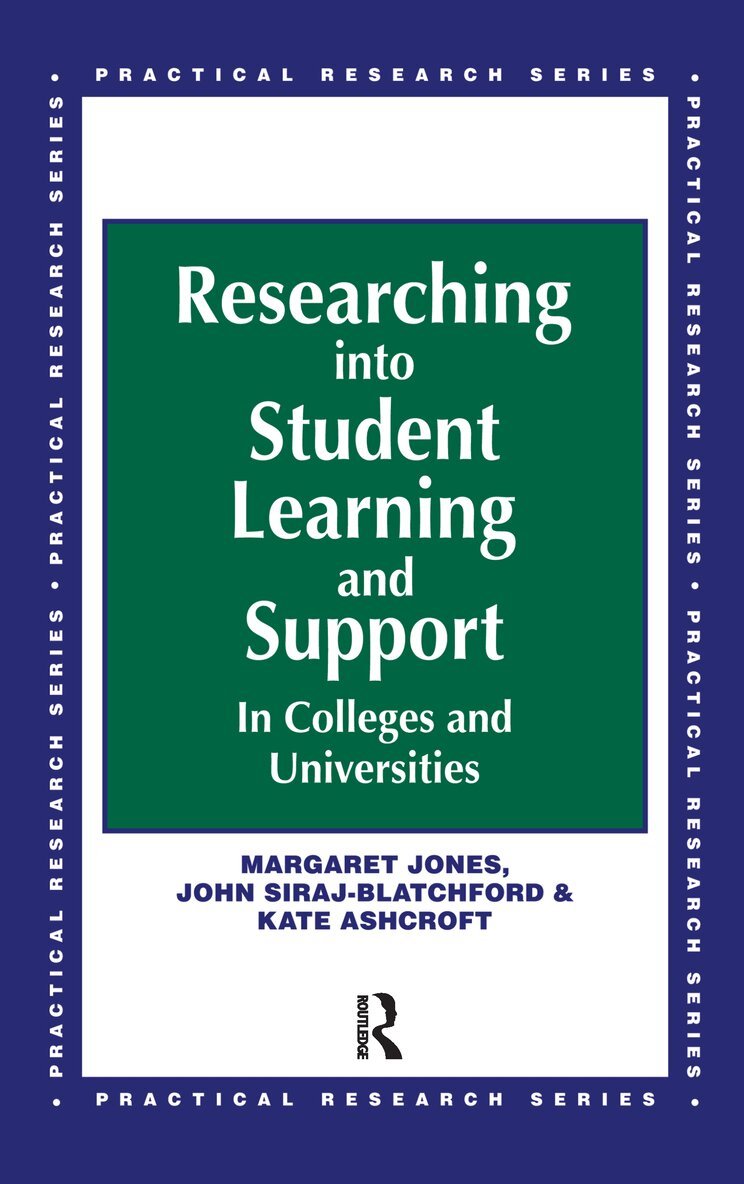
This work looks at the issues of student learning and support, in the context of their own institution. Issues covered include student representation, underachievement and the overall aims and ethics of further and higher education.
Häftad, Engelska, 2023
284 kr
Skickas inom 5-8 vardagar
Del 4 - Thames Valley Landscapes Monograph
Excavations at Roughground Farm, Lechlade, Gloucestershire: A Prehistoric and Roman Landscape
The Cotswold Water Park Volume 1
Häftad, Engelska, 1993
340 kr
Skickas
The archaeological remains at Roughground Farm cover an area of c 8 hectares on the second gravel terrace just north of Lechlade between the rivers Leach and Thames (SP 216/009 to 221/005). The site was investigated by Margaret Jones in advance of gravel extraction between 1957 and 1965. These excavations revealed evidence of occupation from the Late Neolithic to the end of the Roman period and represent one of the first landscape studies undertaken in this country. The work was stimulated by the discovery of a Roman villa, whose buildings were partly investigated in 1957 and 1959. Further excavations on the villa buildings were carried out by Tim Allen in 1981-2 and in 1990 prior to a housing development.The Neolithic occupation consists of a small cluster of pits containing Grooved Ware, contrasting with a dispersed scatter of pits with Beaker pottery. The Earlier Bronze Age is only represented by a stray sherd, but there is a wide scatter of Later Bronze Age pits, which tend to congregate in small groups. In the Early Iron Age the landscape was divided by large boundary ditches, roughly parallel to one another and at right angles to the river Leach, with smaller ditched subdivisions. This land-division appears to respect established trackways, which met within the excavated area. Pit groups indicate an arable economy and occupation, including posthole groups and burials, was concentrated at the east edge of the site.The Middle and Late Iron Ages are hardly represented, but an Early Roman native settlement was established just west of the trackways. This included an oval house-enclosure with accompanying pit-group, small stock enclosures, and pens, lying within a larger rectilinear enclosure. Between the trackways and the settlement was an open 'green'-like area. The economy was similar to that of the Iron Age and this settlement persisted until the early 2nd century AD, when it was replaced by the building of a villa.At least two masonry buildings were put up in the mid 2nd century and were surrounded by an enclosure ditch. One of these was an aisled building, with^an apsidal end unique in Roman Britain. Outside this was a regular system of paddocks and larger fields laid out to a standard unit of length. The villa occupation area, however, kept within the limits of the preceding native settlement. Trackways and droveways approaching the villa were delineated by boundary ditches.In the 3rd century another large domestic building was constructed, while the ends of the trackways east of the villa were overlaid by two groups of enclosures facing each other across the 'green', which were used for various agricultural and semi-industrial activities and may also have been occupied. These may represent centralisation of the villa's estate management. Small groups of late Roman burials were found in and around these enclosures. In the 4th century, if not before, another domestic building was added to the villa. Occupation of the villa and adjacent enclosures continued beyond 360 AD, but possibly not as late as the end of the 4th century.There was very little evidence of Saxon activity, although the villa buildings were robbed for stone for graves in this period. The east part of the site was overlaid by ridge and furrow in the medieval period and the west appears to have been pasture; both parts remained open fields until gravel extraction began in the 1930s. Virtually the whole site has now been destroyed.
Häftad, Engelska, 2021
231 kr
Skickas inom 5-8 vardagar
E-bok
PDF, Engelska, 2013735 kr
Läs direkt efter köp
This work looks at the issues of student learning and support, in the context of their own institution. Issues covered include student representation, underachievement and the overall aims and ethics of further and higher education.
E-bok
Engelska, 2013735 kr
Läs direkt efter köp
This work looks at the issues of student learning and support, in the context of their own institution. Issues covered include student representation, underachievement and the overall aims and ethics of further and higher education.
Inbunden, Engelska, 2016
2 133 kr
Skickas inom 10-15 vardagar
This work looks at the issues of student learning and support, in the context of their own institution. Issues covered include student representation, underachievement and the overall aims and ethics of further and higher education.
Häftad, Engelska, 2013
350 kr
Skickas inom 10-15 vardagar
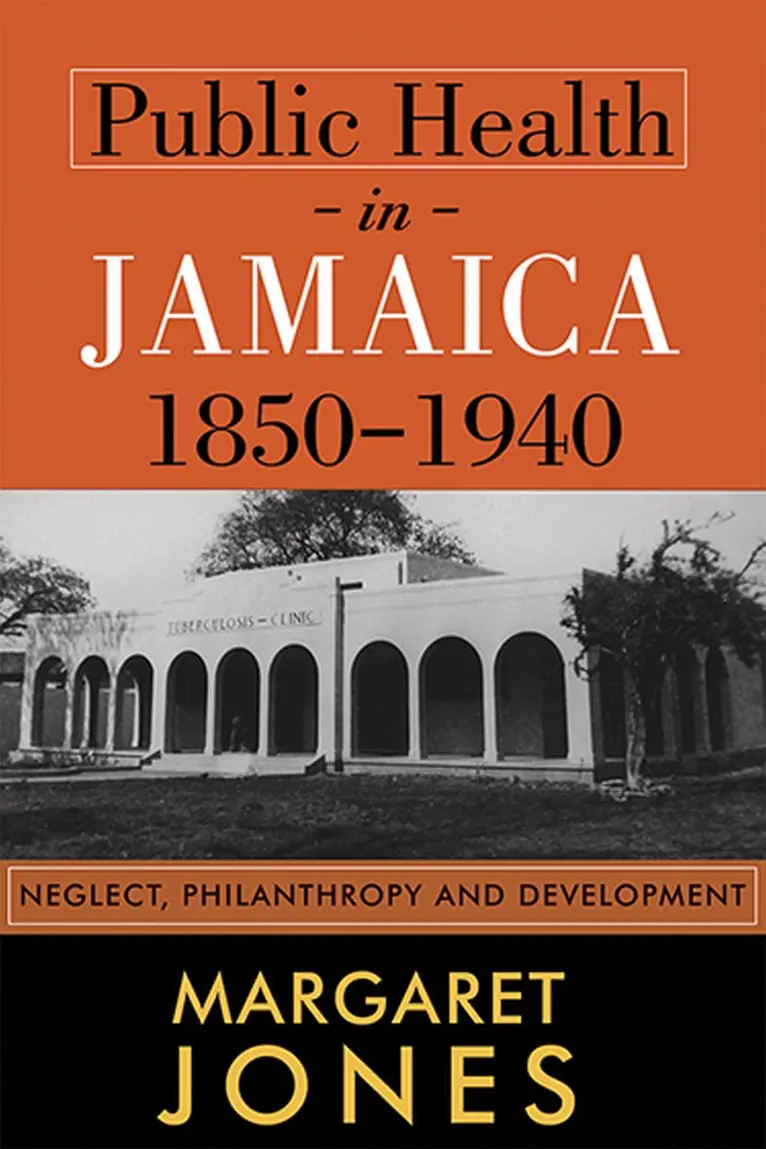
Using a range of primary sources from imperial, colonial and local government records, Rockefeller Foundation Archives, memoirs and reports, this study provides the most comprehensive account to date of public health in Jamaica in the post-emancipation colonial period to the onset of the Second World War. The account is framed by two pivotal Jamaican experiences that were vital in precipitating significant policy changes at the imperial centre. An examination of the development of the part-time colonial medical service reveals it to be underresourced and inadequate. Most Jamaicans accessed Western medical aid through the Poor Law, a distinguishing feature of the British West Indian colonies, and the issues around the intermeshing of medical and Poor Law aid is a vital contextual question. Chapters on the epidemic and endemic diseases of smallpox and malaria expose the attitudes and the nature of the responses of government, elites and the medical services to such threats. The International Health Division of the Rockefeller Foundation was active in Jamaica from 1919 until 1950. A detailed analysis of their hookworm campaign, public health education programme and tuberculosis work contributes to a critical understanding of this philanthropic endeavour.The contribution of Jamaica to a new imperial development policy, as exemplified in the 1940 Colonial Development and Welfare Act, is also assessed. A story of government and elite reluctance to finance public health services emerges in which Jamaicans were frequently blamed for their own ill health. Socio-economic causation was sidestepped as class and race perceptions, underpinned by the legacy of slavery, held sway.
Häftad, Engelska, 2005
166 kr
Tillfälligt slut
An exploration of the way "Theatre for Children and Young People" has responded to cultural diversity in a continually changing social and political context over the last fifty years. The resourcefulness of companies in sustaining output, quality and innovation over many years is an example to other sectors. This publication is a tool to record and stimulate innovation and excellence - contributing to the long-term stability of the arts. It is the first publication to give the whole story of "Theatre for Children and Young People" and its development in the UK. It is essential reading for drama and theatre practitioners and for students of contemporary British theatre everywhere.