María Pía Lara - Böcker
Visar alla böcker från författaren María Pía Lara. Handla med fri frakt och snabb leverans.
4 produkter
4 produkter
258 kr
Skickas inom 7-10 vardagar
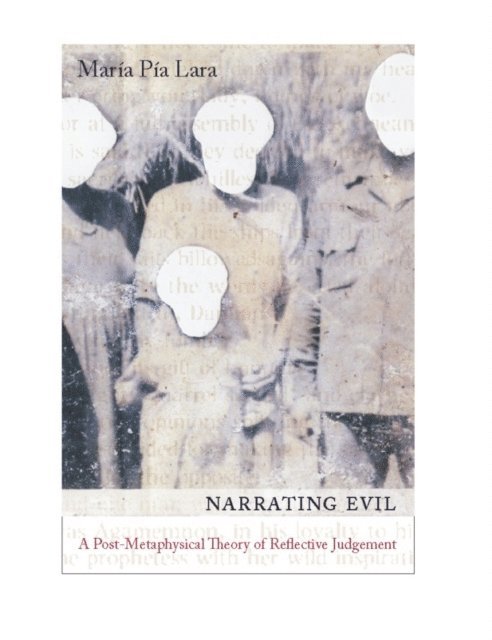
This innovative volume will be welcomed by moral and political philosophers, social scientists, and anyone who reflects seriously on the twentieth century's heavy burden of war, genocide, ethnic cleansing, and other evidence of people's desire to harm one another. Maria Pia Lara brings together a provocative set of essays that reexamine evil in the context of a 'postmetaphysical' world, a world that no longer equates natural and human evil and no longer believes in an omnipotent God. The question of how and why God permits evil events to occur is replaced by the question of how and why humans perform radically evil acts.
729 kr
Skickas inom 7-10 vardagar
In this original work, the Mexican political philosopher, Maria Pia Lara, develops a new approach to public sphere theory and a novel understanding of the history of the feminist struggle. When dominated groups create publicly-oriented social movements, she argues, they seek to frame their demands in compelling narrative forms. Through these new tales, they can become, for the first time, active subjects in their own stories. Developing this theoretical model, Lara offers new interpretations of Habermas and Arendt as well as of feminist debates about their work. Critically relating Wellmer's and Ricoeur's aesthetic ideas to public sphere theory, she also confronts the limitations of the Foucaultian tradition that informs so much post-structuralist feminism today. In making her argument, Lara examines a very wide range of women's narratives, from autobiographies of eighteenth-century salonnieres and of contemporary women activists to the novels of Jane Austen and the portrayal of women in television and film. Taking stock of contemporary feminist writings in social science, history, literature, jurisprudence and philosophy, she suggests that they can be viewed not only as empirical accounts of injustices but as cultural narratives that have transformed women's particular identities even as they have expanded universal moral claims in a revolutionary way.
294 kr
Skickas inom 5-8 vardagar
In this original work, the Mexican political philosopher, Maria Pia Lara, develops a new approach to public sphere theory and a novel understanding of the history of the feminist struggle. When dominated groups create publicly-oriented social movements, she argues, they seek to frame their demands in compelling narrative forms. Through these new tales, they can become, for the first time, active subjects in their own stories. Developing this theoretical model, Lara offers new interpretations of Habermas and Arendt as well as of feminist debates about their work. Critically relating Wellmer's and Ricoeur's aesthetic ideas to public sphere theory, she also confronts the limitations of the Foucaultian tradition that informs so much post-structuralist feminism today. In making her argument, Lara examines a very wide range of women's narratives, from autobiographies of eighteenth-century salonnieres and of contemporary women activists to the novels of Jane Austen and the portrayal of women in television and film. Taking stock of contemporary feminist writings in social science, history, literature, jurisprudence and philosophy, she suggests that they can be viewed not only as empirical accounts of injustices but as cultural narratives that have transformed women's particular identities even as they have expanded universal moral claims in a revolutionary way.
387 kr
Skickas inom 7-10 vardagar
In Beyond the Public Sphere: Film and the Feminist Imaginary, the renowned philosopher and critical theorist María Pía Lara challenges the notion that the bourgeois public sphere is the most important informal institution between social and political actors and the state.Drawing on a wide range of films-including The Milk of Sorrow, Ixcanul, Wadja, The Stone of Patience, Marnie, A Streetcar Named Desire, and Talk to Her-Lara dissects cinematic images of women's struggles and their oppression. She builds on this analysis, developing a concept of the feminist social imaginary as a broader and more complex space that provides a way of thinking through the possibilities for emancipatory social transformation in response to forms of domination perpetuated by patriarchal capitalism.