Maria Sapignoli - Böcker
Visar alla böcker från författaren Maria Sapignoli. Handla med fri frakt och snabb leverans.
10 produkter
10 produkter
2 358 kr
Skickas inom 5-8 vardagar
The Oxford Handbook of Law and Anthropology is a ground-breaking collection of essays that provides an original and internationally framed conception of the historical, theoretical, and ethnographic interconnections of law and anthropology. Each of the chapters in the Handbook provides a survey of the current state of scholarly debate and an argument about the future direction of research in this dynamic and interdisciplinary field. The structure of the Handbook is animated by an overarching collective narrative about how law and anthropology have and should relate to each other as intersecting domains of inquiry that address such fundamental questions as dispute resolution, normative ordering, social organization, and legal, political, and social identity. The need for such a comprehensive project has become even more pressing as lawyers and anthropologists work together in an ever-increasing number of areas, including immigration and asylum processes, international justice forums, cultural heritage certification and monitoring, and the writing of new national constitutions, among many others. The Handbook takes critical stock of these various points of intersection in order to identify and conceptualize the most promising areas of innovation and sociolegal relevance, as well as to acknowledge the points of tension, open questions, and areas for future development.
1 921 kr
Skickas inom 10-15 vardagar
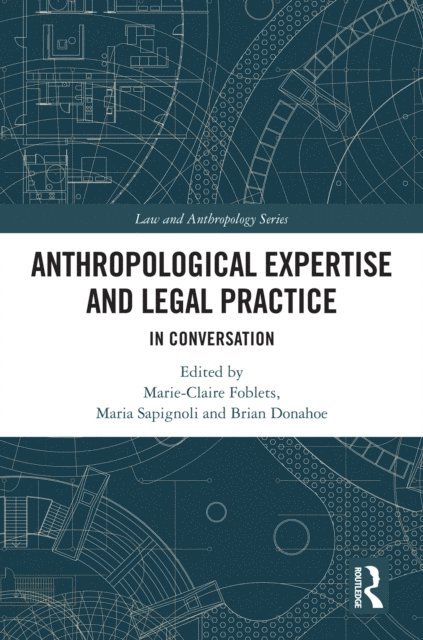
This book draws on concrete cases of collaboration between anthropologists and legal practitioners to critically assess the use of anthropological expertise in a variety of legal contexts from the point of view of the anthropologist as well as of the decision-maker or legal practitioner. The contributions, several of which are co-authored by anthropologist–legal practitioner tandems, deal with the roles of and relationships between anthropologists and legal professionals, which are often collaborative, interdisciplinary, and complementary. Such interactions go far beyond courts and litigation into areas of law that might be called ‘social justice activism’. They also entail close collaboration with the people –often subjects of violence and dispossession –with whom the anthropologists and legal practitioners are working. The aim of this collection is to draw on past experiences to come up with practical methodological suggestions for facilitating this interaction and collaboration and for enhancing the efficacy of the use of anthropological expertise in legal contexts. Explicitly designed to bridge the gap between theory and practice, and between scholarship and practical application, the book will appeal to scholars and researchers engaged in anthropology, legal anthropology, socio-legal studies, and asylum and migration law. It will also be of interest to legal practitioners and applied social scientists, who can glean valuable lessons regarding the challenges and rewards of genuine collaboration between legal practitioners and social scientists.The Open Access version of this book, available at http://www.taylorfrancis.com, has been made available under a Creative Commons [Attribution-Non Commercial-No Derivatives (CC BY-NC-ND)] 4.0 license.
580 kr
Skickas inom 10-15 vardagar
This book draws on concrete cases of collaboration between anthropologists and legal practitioners to critically assess the use of anthropological expertise in a variety of legal contexts from the point of view of the anthropologist as well as of the decision-maker or legal practitioner. The contributions, several of which are co-authored by anthropologist–legal practitioner tandems, deal with the roles of and relationships between anthropologists and legal professionals, which are often collaborative, interdisciplinary, and complementary. Such interactions go far beyond courts and litigation into areas of law that might be called ‘social justice activism’. They also entail close collaboration with the people –often subjects of violence and dispossession –with whom the anthropologists and legal practitioners are working. The aim of this collection is to draw on past experiences to come up with practical methodological suggestions for facilitating this interaction and collaboration and for enhancing the efficacy of the use of anthropological expertise in legal contexts. Explicitly designed to bridge the gap between theory and practice, and between scholarship and practical application, the book will appeal to scholars and researchers engaged in anthropology, legal anthropology, socio-legal studies, and asylum and migration law. It will also be of interest to legal practitioners and applied social scientists, who can glean valuable lessons regarding the challenges and rewards of genuine collaboration between legal practitioners and social scientists.The Open Access version of this book, available at http://www.taylorfrancis.com, has been made available under a Creative Commons [Attribution-Non Commercial-No Derivatives (CC BY-NC-ND)] 4.0 license.
States of Surveillance
Ethnographies of New Technologies in Policing and Justice
Inbunden, Engelska, 2024
1 797 kr
Skickas inom 10-15 vardagar
Recent discussions on big data surveillance and artificial intelligence in governance have opened up an opportunity to think about the role of technology in the production of the knowledge states use to govern. The contributions in this volume examine the socio-technical assemblages that underpin the surveillance carried out by criminal justice institutions – particularly the digital tools that form the engine room of modern state bureaucracies.Drawing on ethnographic research in contexts from across the globe, the contributions to this volume engage with technology’s promises of transformation, scrutinise established ways of thinking that becomeembedded through technologies, critically consider the dynamics that shape the political economy driving the expansion of security technologies, and examine how those at the margins navigate experiences of surveillance.The book is intended for an interdisciplinary academic audience interested in ethnographic approaches to the study of surveillance technologies in policing and justice. Concrete case studies provide students, practitioners, and activists from a broad range of backgrounds with nuanced entry points to the debate.The Open Access version of this book, available at http://www.taylorfrancis.com, has been made available under a Creative Commons Attribution (CC-BY) 4.0 International license.
States of Surveillance
Ethnographies of New Technologies in Policing and Justice
Häftad, Engelska, 2026
543 kr
Skickas inom 10-15 vardagar
Recent discussions on big data surveillance and artificial intelligence in governance have opened up an opportunity to think about the role of technology in the production of the knowledge states use to govern. The contributions in this volume examine the socio-technical assemblages that underpin the surveillance carried out by criminal justice institutions – particularly the digital tools that form the engine room of modern state bureaucracies.Drawing on ethnographic research in contexts from across the globe, the contributions to this volume engage with technology’s promises of transformation, scrutinise established ways of thinking that becomeembedded through technologies, critically consider the dynamics that shape the political economy driving the expansion of security technologies, and examine how those at the margins navigate experiences of surveillance.The book is intended for an interdisciplinary academic audience interested in ethnographic approaches to the study of surveillance technologies in policing and justice. Concrete case studies provide students, practitioners, and activists from a broad range of backgrounds with nuanced entry points to the debate.The Open Access version of this book, available at http://www.taylorfrancis.com, has been made available under a Creative Commons Attribution (CC-BY) 4.0 International license.
1 327 kr
Skickas inom 7-10 vardagar
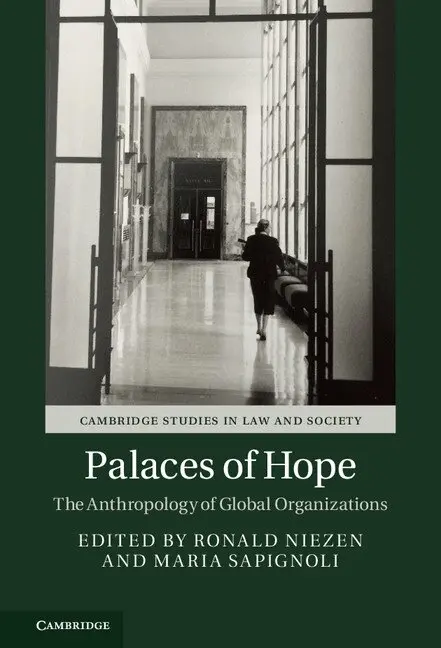
This volume assembles in one place the work of scholars who are making key contributions to a new approach to the United Nations, and to global organizations and international law more generally. Anthropology has in recent years taken on global organizations as a legitimate source of its subject matter. The research that is being done in this field gives a human face to these world-reforming institutions. Palaces of Hope demonstrates that these institutions are not monolithic or uniform, even though loosely connected by a common organizational network. They vary above all in their powers and forms of public engagement. Yet there are common threads that run through the studies included here: the actions of global institutions in practice, everyday forms of hope and their frustration, and the will to improve confronted with the realities of nationalism, neoliberalism, and the structures of international power.
867 kr
Skickas inom 7-10 vardagar
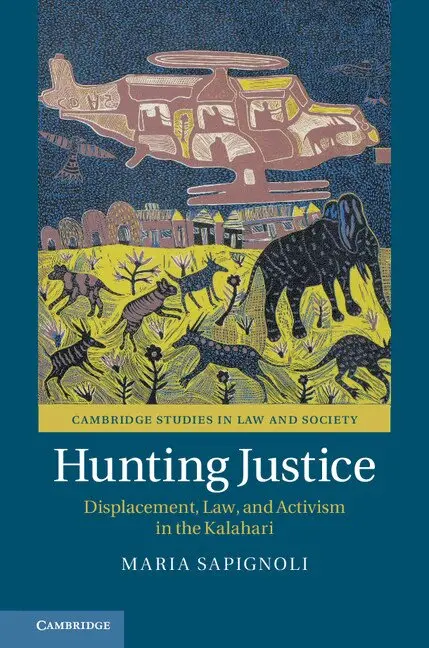
This book presents a long-term study of the activist campaign that contested the Botswana government's much-publicized removal of the San and Bakgalagadi people from the Central Kalahari Game Reserve. Sapignoli's multiple points of observation and analysis range from rural Botswana to the nation's High Court, and a variety of United Nations agencies in their Headquarters, focusing on rights claimants and officials from NGOs, states and the United Nations as they acted on the grievances of those who had been displaced. In offering a comprehensive discussion of the San people and their claims-making through formal institutions, this book maintains a consistent focus on the increased recourse to law and the everyday experience of those who are asserting their rights in response to the encroachments of the state and the opportunities inherent in new indigenous advocacy networks.
394 kr
Skickas inom 7-10 vardagar
This volume assembles in one place the work of scholars who are making key contributions to a new approach to the United Nations, and to global organizations and international law more generally. Anthropology has in recent years taken on global organizations as a legitimate source of its subject matter. The research that is being done in this field gives a human face to these world-reforming institutions. Palaces of Hope demonstrates that these institutions are not monolithic or uniform, even though loosely connected by a common organizational network. They vary above all in their powers and forms of public engagement. Yet there are common threads that run through the studies included here: the actions of global institutions in practice, everyday forms of hope and their frustration, and the will to improve confronted with the realities of nationalism, neoliberalism, and the structures of international power.
467 kr
Skickas inom 7-10 vardagar
This book presents a long-term study of the activist campaign that contested the Botswana government's much-publicized removal of the San and Bakgalagadi people from the Central Kalahari Game Reserve. Sapignoli's multiple points of observation and analysis range from rural Botswana to the nation's High Court, and a variety of United Nations agencies in their Headquarters, focusing on rights claimants and officials from NGOs, states and the United Nations as they acted on the grievances of those who had been displaced. In offering a comprehensive discussion of the San people and their claims-making through formal institutions, this book maintains a consistent focus on the increased recourse to law and the everyday experience of those who are asserting their rights in response to the encroachments of the state and the opportunities inherent in new indigenous advocacy networks.
588 kr
Skickas inom 7-10 vardagar
This book presents a critical review of the ethics of conservation-related resettlement. We examine what has become known as the” parks versus people” debate, also known as the “new conservation debate,” which has pitted indigenous and other local people against nation states and social scientists against ecologists and conservationists for the past several decades. Aiming to promote biodiversity conservation and habitat preservation, some biologists, park planners, and conservation organizations have recommended that indigenous and other people should be removed from protected areas.Local people, for their part, have argued that residents of the areas that were turned into protected areas, national parks, game reserves and monuments had managed them in productive ways for generations and that they should have the right to remain there and to use natural resources as long as they do so sustainably. This position is often supported by indigenous rights organizations and social scientists, especially anthropologists. There are also some conservation-oriented NGOs that have policies involving a more human rights-oriented approach aimed at poverty alleviation, sustainable development, and social justice.The book discusses biodiversity conservation, indigenous peoples (those who are ethnic minorities and who are often marginalized politically), and protected areas, those categories of land set aside by nation-states that have various kinds of rules about land use and residence. The focus initially is on case studies from protected areas in the United States including Yellowstone National Park, Yosemite National Park, and Glacier National Park and on national monuments and historical parks where resettlement took place. We then consider issues of coercive conservation in southern Africa, including Hwange National Park (Zimbabwe), the Central Kalahari Game Reserve (Botswana), Etosha National Park, and Bwabwata National Park (Namibia), andKgalagadi Transfrontier Park (South Africa and Botswana). All of these cases involved involuntary resettlement at the hands of the governments.In the book we consider some of the social impacts of conservation-forced resettlement (CfR), many of which tend to be negative. After that, we assess some of the strategies employed by indigenous peoples in their efforts to recover rights of access to protected areas and the cultural and natural resources that they contain. Examples are drawn from cases in Asia, Africa, and South America. Conclusions are provided regarding the ethics of conservation-related resettlement and some of the best practices that could be followed, particularly with regard to indigenous peoples.