Marianna Bolla - Böcker
Visar alla böcker från författaren Marianna Bolla. Handla med fri frakt och snabb leverans.
3 produkter
3 produkter
2 103 kr
Skickas inom 10-15 vardagar
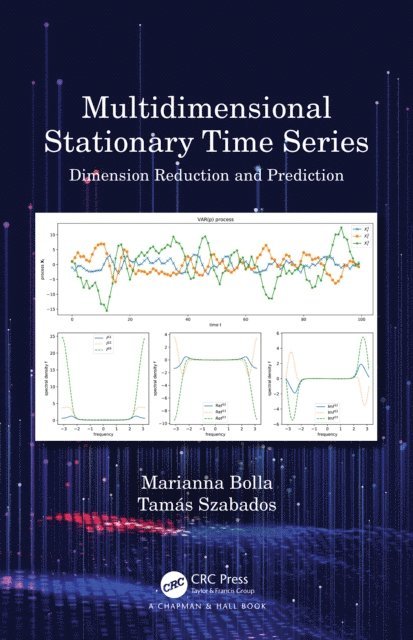
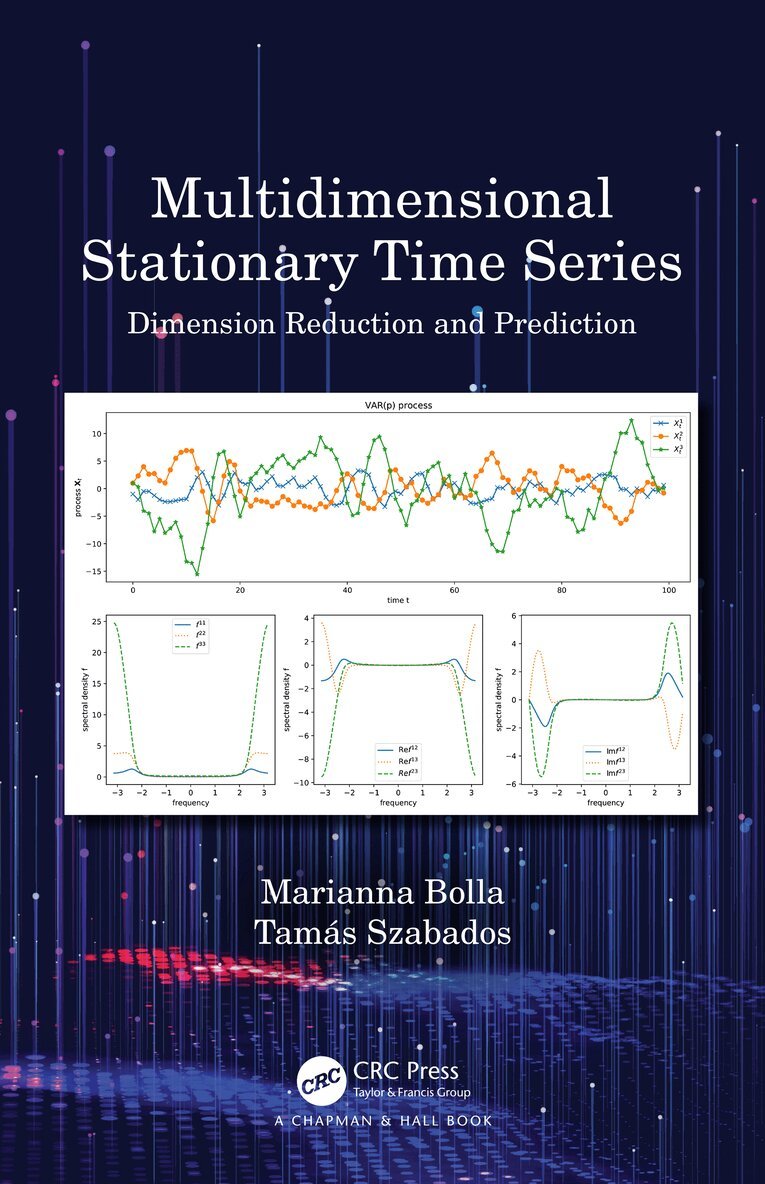
This book gives a brief survey of the theory of multidimensional (multivariate), weakly stationary time series, with emphasis on dimension reduction and prediction. Understanding the covered material requires a certain mathematical maturity, a degree of knowledge in probability theory, linear algebra, and also in real, complex and functional analysis. For this, the cited literature and the Appendix contain all necessary material. The main tools of the book include harmonic analysis, some abstract algebra, and state space methods: linear time-invariant filters, factorization of rational spectral densities, and methods that reduce the rank of the spectral density matrix.Serves to find analogies between classical results (Cramer, Wold, Kolmogorov, Wiener, Kálmán, Rozanov) and up-to-date methods for dimension reduction in multidimensional time seriesProvides a unified treatment for time and frequency domain inferences by using machinery of complex and harmonic analysis, spectral and Smith--McMillan decompositions. Establishes analogies between the time and frequency domain notions and calculationsDiscusses the Wold's decomposition and the Kolmogorov's classification together, by distinguishing between different types of singularities. Understanding the remote past helps us to characterize the ideal situation where there is a regular part at present. Examples and constructions are also givenEstablishes a common outline structure for the state space models, prediction, and innovation algorithms with unified notions and principles, which is applicable to real-life high frequency time seriesIt is an ideal companion for graduate students studying the theory of multivariate time series and researchers working in this field.
670 kr
Skickas inom 10-15 vardagar
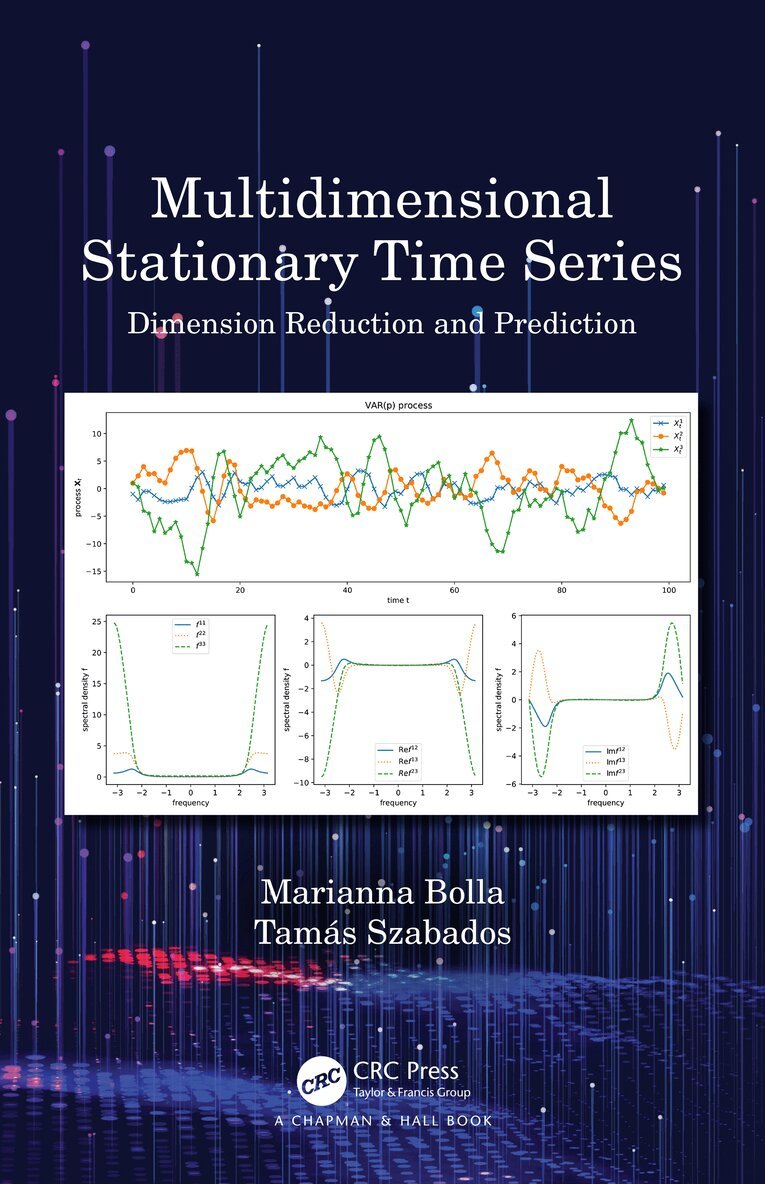
This book gives a brief survey of the theory of multidimensional (multivariate), weakly stationary time series, with emphasis on dimension reduction and prediction. Understanding the covered material requires a certain mathematical maturity, a degree of knowledge in probability theory, linear algebra, and also in real, complex and functional analysis. For this, the cited literature and the Appendix contain all necessary material. The main tools of the book include harmonic analysis, some abstract algebra, and state space methods: linear time-invariant filters, factorization of rational spectral densities, and methods that reduce the rank of the spectral density matrix.Serves to find analogies between classical results (Cramer, Wold, Kolmogorov, Wiener, Kálmán, Rozanov) and up-to-date methods for dimension reduction in multidimensional time seriesProvides a unified treatment for time and frequency domain inferences by using machinery of complex and harmonic analysis, spectral and Smith--McMillan decompositions. Establishes analogies between the time and frequency domain notions and calculationsDiscusses the Wold's decomposition and the Kolmogorov's classification together, by distinguishing between different types of singularities. Understanding the remote past helps us to characterize the ideal situation where there is a regular part at present. Examples and constructions are also givenEstablishes a common outline structure for the state space models, prediction, and innovation algorithms with unified notions and principles, which is applicable to real-life high frequency time seriesIt is an ideal companion for graduate students studying the theory of multivariate time series and researchers working in this field.
Spectral Clustering and Biclustering
Learning Large Graphs and Contingency Tables
Inbunden, Engelska, 2013
882 kr
Skickas inom 7-10 vardagar
Explores regular structures in graphs and contingency tables by spectral theory and statistical methodsThis book bridges the gap between graph theory and statistics by giving answers to the demanding questions which arise when statisticians are confronted with large weighted graphs or rectangular arrays. Classical and modern statistical methods applicable to biological, social, communication networks, or microarrays are presented together with the theoretical background and proofs.This book is suitable for a one-semester course for graduate students in data mining, multivariate statistics, or applied graph theory; but by skipping the proofs, the algorithms can also be used by specialists who just want to retrieve information from their data when analysing communication, social, or biological networks.Spectral Clustering and Biclustering: Provides a unified treatment for edge-weighted graphs and contingency tables via methods of multivariate statistical analysis (factoring, clustering, and biclustering).Uses spectral embedding and relaxation to estimate multiway cuts of edge-weighted graphs and bicuts of contingency tables.Goes beyond the expanders by describing the structure of dense graphs with a small spectral gap via the structural eigenvalues and eigen-subspaces of the normalized modularity matrix.Treats graphs like statistical data by combining methods of graph theory and statistics.Establishes a common outline structure for the contents of each algorithm, applicable to networks and microarrays, with unified notions and principles.