Marie-Louise Bemelmans-Videc - Böcker
Visar alla böcker från författaren Marie-Louise Bemelmans-Videc. Handla med fri frakt och snabb leverans.
4 produkter
4 produkter
2 096 kr
Skickas inom 10-15 vardagar
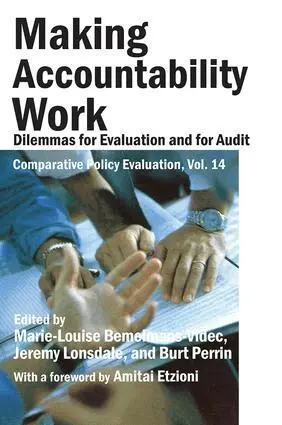
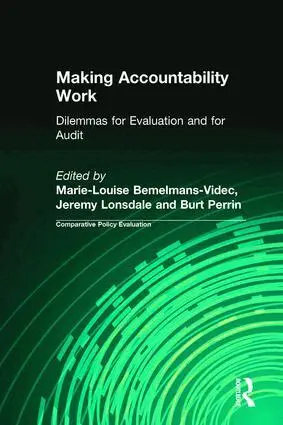
Like honesty and clean water, ""accountability"" is invariably seen as a good thing. Conversely, the absence of accountability is associated with most of the greatest abuses in human history. Accountability is thus closely linked with the exercise of power and the legitimacy of policies and those pursuing them. This book looks at the role of evaluation and of audit as key elements in democratic accountability processes. The contributors explore the apparent paradox of there being more accountability-related activities today than ever before, at the same time as much public debate laments what is seen as a lack of actual accountability. Such a situation raises a number of questions: Is there a need for different approaches to establishing accountability or can current arrangements be modified to make them more effective? Are present practices part of the problem and are they preventing a mature debate about performance improvement taking place? How can systems awash with performance information ensure that at least some of it makes sense to a wide range of potential users? How is it that greater accountability and transparency can so quickly have become associated with concerns about perverse incentives and be seen by some as a costly burden? The volume includes detailed case studies and synthesizes up-to-date research evidence drawn from very different governmental systems, ending with practical advice for those involved in the accountability processes. In doing so, it attempts to address both conceptual ambiguities about the notion of ""accountability"" and the practical uncertainties over its implications for democratic government. This book is aimed at serious people who think about trends in the use of evaluation and audit in seeking to hold governments accountable for their actions and performance.
667 kr
Skickas inom 10-15 vardagar
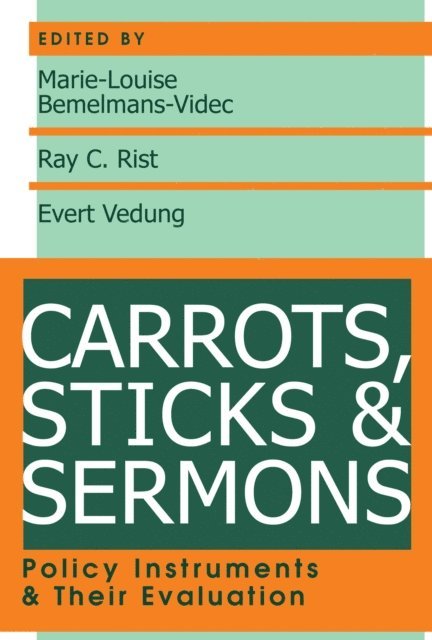
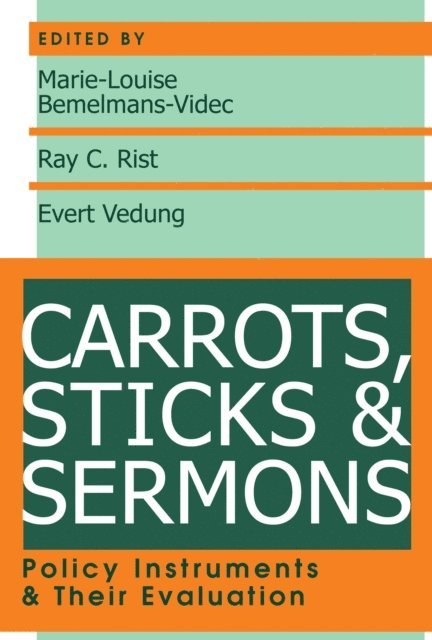
The literature on policy strategies, instruments, and styles is impressive. Still, a complex variety of theoretical and conceptual approaches and analytical tools hamper a good overview. Carrots, Sticks, and Sermons proposes such a framework for the field and clearly shows how public policy instruments are classified, packaged, and chosen, while highlighting the role evaluation plays in the instruments-choice process.Carrots, Sticks, and Sermons offers a comprehensive analysis of categories and typologies of policy instruments. It classifies sticks, carrots, and sermons - or, more specifically, regulation, economic means, and information. Readers are offered a comparative perspective of evaluation practice in foreign contexts. Special attention is paid to the examples of Sweden, the Netherlands, Belgium, England, Canada, the United States, and the Republic of Korea. As such, this volume crosses language barriers that stand in the way of dispersing research results among the international community of theoreticians and practitioners. As nations become increasingly interdependent, problems of implementation and evaluation of policy choices will become issues of increasing gravity.Carrots, Sticks, and Sermons provides insights into the traditional and current practice of policy and program evaluation in various contexts. The book's theory of comparative public policy will produce understanding and guidance in designing better policies. It will be of wide interest to those in the fields of public policy, particularly policy design, policy implementation, policy evaluation, comparative politics, and economics.
2 307 kr
Skickas inom 10-15 vardagar
The literature on policy strategies, instruments, and styles is impressive. Still, a complex variety of theoretical and conceptual approaches and analytical tools hamper a good overview. Carrots, Sticks, and Sermons proposes such a framework for the field and clearly shows how public policy instruments are classified, packaged, and chosen, while highlighting the role evaluation plays in the instruments-choice process.Carrots, Sticks, and Sermons offers a comprehensive analysis of categories and typologies of policy instruments. It classifies sticks, carrots, and sermons - or, more specifically, regulation, economic means, and information. Readers are offered a comparative perspective of evaluation practice in foreign contexts. Special attention is paid to the examples of Sweden, the Netherlands, Belgium, England, Canada, the United States, and the Republic of Korea. As such, this volume crosses language barriers that stand in the way of dispersing research results among the international community of theoreticians and practitioners. As nations become increasingly interdependent, problems of implementation and evaluation of policy choices will become issues of increasing gravity.Carrots, Sticks, and Sermons provides insights into the traditional and current practice of policy and program evaluation in various contexts. The book's theory of comparative public policy will produce understanding and guidance in designing better policies. It will be of wide interest to those in the fields of public policy, particularly policy design, policy implementation, policy evaluation, comparative politics, and economics.
494 kr
Skickas inom 10-15 vardagar
Like honesty and clean water, ""accountability"" is invariably seen as a good thing. Conversely, the absence of accountability is associated with most of the greatest abuses in human history. Accountability is thus closely linked with the exercise of power and the legitimacy of policies and those pursuing them. This book looks at the role of evaluation and of audit as key elements in democratic accountability processes. The contributors explore the apparent paradox of there being more accountability-related activities today than ever before, at the same time as much public debate laments what is seen as a lack of actual accountability. Such a situation raises a number of questions: Is there a need for different approaches to establishing accountability or can current arrangements be modified to make them more effective? Are present practices part of the problem and are they preventing a mature debate about performance improvement taking place? How can systems awash with performance information ensure that at least some of it makes sense to a wide range of potential users? How is it that greater accountability and transparency can so quickly have become associated with concerns about perverse incentives and be seen by some as a costly burden? The volume includes detailed case studies and synthesizes up-to-date research evidence drawn from very different governmental systems, ending with practical advice for those involved in the accountability processes. In doing so, it attempts to address both conceptual ambiguities about the notion of ""accountability"" and the practical uncertainties over its implications for democratic government. This book is aimed at serious people who think about trends in the use of evaluation and audit in seeking to hold governments accountable for their actions and performance.