Marina Frasca-Spada - Böcker
Visar alla böcker från författaren Marina Frasca-Spada. Handla med fri frakt och snabb leverans.
4 produkter
4 produkter
1 932 kr
Skickas inom 5-8 vardagar
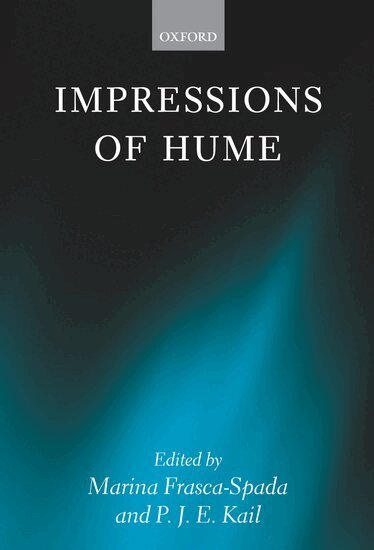
Impressions of Hume presents new essays from leading scholars in different philosophical, historiographical, and literary traditions to which Hume made defining contributions. Hume has made a variety of impressions on these different areas; his writings, philosophical and otherwise, may indeed be read in a number of different ways. For example, they can be taken as transparent vehicles for philosophical intuitions, problems, and arguments that are still at the centre of philosophical reflection today. On the other hand, there are readings which are interested in locating Hume's views against the background of concerns, debates and discussions of Hume's own time. And this is not all. Hume's texts may be read as highly sophisticated literary-cum-philosophical creations: in such cases, the reader's attention tends to be directed at issues of genre and persuasive strategies rather than on argument. Or they may be regarded as moments in the construction of the ideology of modernity, and as contributions to the legitimation of a given social order. As the true classics that they are, Hume's works are typical 'open texts', which present their readers of all provenances with a bounty of materials and inspirations. It is the editors' conviction that the borders between these approaches are far from neat; and that as much cross-fertilization as possible is to be promoted. Impressions of Hume amply demonstrates the rewards of such an approach.
1 192 kr
Skickas inom 7-10 vardagar
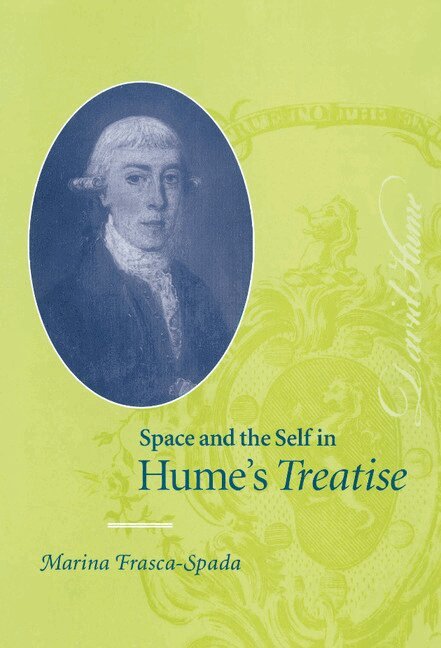
Hume's discussion of the idea of space in his Treatise on Human Nature is fundamental to an understanding of his treatment of such central issues as the existence of external objects, the unity of the self, the relation between certainty and belief, and abstract ideas. Marina Frasca-Spada's rich and original study examines this difficult part of Hume's philosophical writings and connects it to eighteenth-century works in natural philosophy, mathematics and literature. Focusing on Hume's discussions of the infinite divisibility of extension, the origin of the idea of space, geometry, and the notion of a vacuum, she shows that the central questions of Hume's 'science of human nature' - what does the 'science of human nature' reveal about the mind and its operations? what is experience? - underlie all of these discussions. Her analysis points the way to a reassessment of the central current interpretative problems in Hume studies.
726 kr
Skickas inom 7-10 vardagar
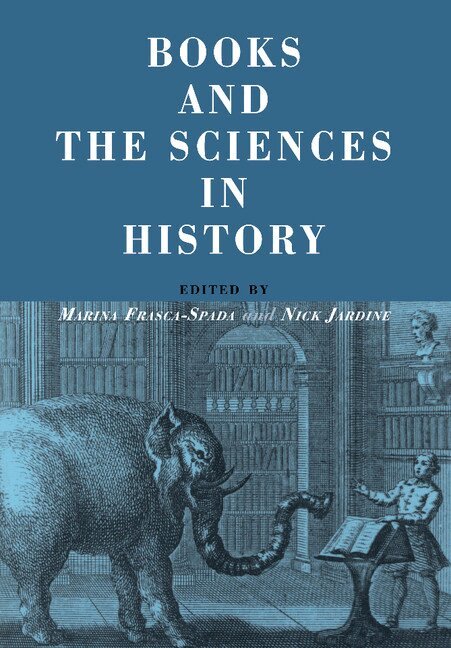
The history of the sciences and the history of the book are complementary, and there has been much recent innovative research in the intersection of these lively fields. This accessibly-written, well-illustrated volume, published in 2000, was the first systematic general work to do justice to the fruits of recent scholarship. The twenty specially-commissioned chapters, by an international cast of distinguished scholars, cover the period from the Carolingian renaissance of learning to the mid nineteenth-century consolidation of science. They examine all aspects of the authorship, production, distribution, and reception of manuscripts, books and journals in the various sciences. An editorial introduction surveys the many profitable interactions of the history of the sciences with the history of books. Two afterwords highlight the relevances of this wide-ranging survey to the study of the development of scientific disciplines and to the predicaments of scientific communication in the electronic age.
521 kr
Skickas inom 7-10 vardagar
Hume's discussion of the idea of space in his Treatise on Human Nature is fundamental to an understanding of his treatment of such central issues as the existence of external objects, the unity of the self, the relation between certainty and belief, and abstract ideas. Marina Frasca-Spada's rich and original study examines this difficult part of Hume's philosophical writings and connects it to eighteenth-century works in natural philosophy, mathematics and literature. Focusing on Hume's discussions of the infinite divisibility of extension, the origin of the idea of space, geometry, and the notion of a vacuum, she shows that the central questions of Hume's 'science of human nature' - what does the 'science of human nature' reveal about the mind and its operations? what is experience? - underlie all of these discussions. Her analysis points the way to a reassessment of the central current interpretative problems in Hume studies.