Mario Diaz Nava - Böcker
Visar alla böcker från författaren Mario Diaz Nava. Handla med fri frakt och snabb leverans.
2 produkter
2 produkter
1 431 kr
Skickas inom 10-15 vardagar
The advances in industrial edge artificial intelligence (AI) are transforming the way industrial equipment and machines interact with the real world, with other machines and humans during manufacturing processes. These advances allow Industrial Internet of Things (IIoT) and edge devices to make decisions during the manufacturing processes using sensors and actuators.Digital transformation is reshaping the manufacturing industry, and industrial edge AI aims to combine the potential advantages of edge computing (low latency times, reduced bandwidth, distributed architecture, improved trustworthiness, etc.) with the benefits of AI (intelligent processing, predictive solutions, classification, reasoning, etc.).The industrial environments allow the deployment of highly distributed intelligent industrial applications in remote sites that require reliable connectivity over wireless and cellular connections. Intelligent connectivity combines IIoT, wireless/cellular and AI technologies to support new autonomous industrial applications by enabling AI capabilities at the edge and allowing manufacturing companies to improve operational efficiency and reduce risks and costs for industrial applications.There are several critical issues to consider when introducing AI to industrial IoT applications considering training AI models at the edge, the deployment of the AI-trained inferencing models on the target edge hardware platforms, and the benchmarking of solutions compared to other implementations.Next-generation trustworthy industrial AI systems offer dependability in terms of their design, transparency, explainability, verifiability, and standardised industrial solutions can be implemented in various applications across different industrial sectors.New AI techniques such as embedded machine learning (ML) and deep learning (DL), capture edge data, employ AI models, and deploy these in hardware target edge devices, from ultra-low-power microcontrollers to embedded devices, gateways, and on-premises servers for industrial applications. These techniques reduce latency, increase scalability, reliability, and resilience; and optimise wireless connectivity, greatly expanding the capabilities of the IIoT.This book provides an overview of the latest research results and activities in industrial AI technologies and applications, based on the innovative research, developments and ideas generated by the ECSEL JU AI4DI, ANDANTE and TEMPO projects.The authors describe industrial AI's challenges, the approaches adopted, and the main industrial systems and applications to give the reader extensive insight into the technical nature of this field. The chapters provide insightful material on industrial AI technologies and applications.This book is a valuable resource for researchers, post-graduate students, practitioners, and technoloyg developers interested in gaining insight into industrial edge AI, the IIoT, embedded machine and deep learning, new technologies, and solutions to advance intelligent processing at the edge.The Open Access version of this book, available at http://www.taylorfrancis.com, has been made available under a Creative Commons Attribution-Non-Commercial (CC-BY-NC) 4.0 International License.
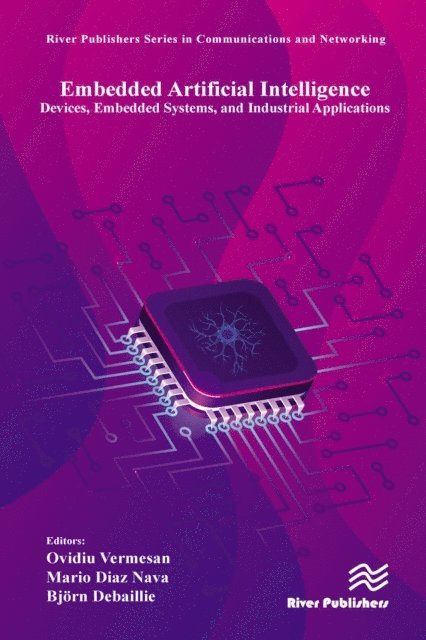
Embedded Artificial Intelligence
Devices, Embedded Systems, and Industrial Applications
Inbunden, Engelska, 2023
1 322 kr
Skickas inom 10-15 vardagar
Recent technological developments in sensors, edge computing, connectivity, and artificial intelligence (AI) technologies have accelerated the integration of data analysis based on embedded AI capabilities into resource-constrained, energy-efficient hardware devices for processing information at the network edge.Embedded AI combines embedded machine learning (ML) and deep learning (DL) based on neural networks (NN) architectures such as convolutional NN (CNN), or spiking neural network (SNN) and algorithms on edge devices and implements edge computing capabilities that enable data processing and analysis without optimised connectivity and integration, allowing users to access data from various sources.Embedded AI efficiently implements edge computing and AI processes on resource-constrained devices to mitigate downtime and service latency, and it successfully merges AI processes as a pivotal component in edge computing and embedded system devices. Embedded AI also enables users to reduce costs, communication, and processing time by assembling data and by supporting user requirements without the need for continuous interaction with physical locations.This book provides an overview of the latest research results and activities in industrial embedded AI technologies and applications, based on close cooperation between three large-scale ECSEL JU projects, AI4DI, ANDANTE, and TEMPO. The book’s content targets researchers, designers, developers, academics, post-graduate students and practitioners seeking recent research on embedded AI. It combines the latest developments in embedded AI, addressing methodologies, tools, and techniques to offer insight into technological trends and their use across different industries.