Mark Elvin - Böcker
Visar alla böcker från författaren Mark Elvin. Handla med fri frakt och snabb leverans.
6 produkter
6 produkter
218 kr
Skickas inom 7-10 vardagar
This landmark account of China’s environmental history, written by an internationally pre-eminent China specialist, "should stand for decades to come as a unique statement on motives, processes, perceptions and consequences of environmental change in China.” (Jennifer L. Mnookin, American Scientist)This is the first environmental history of China during the three thousand years for which there are written records. It is also a treasure trove of literary, political, aesthetic, scientific, and religious sources, which allow the reader direct access to the views and feelings of the Chinese people toward their environment and their landscape.Elvin chronicles the spread of the Chinese style of farming that eliminated the habitat of the elephants that populated the country alongside much of its original wildlife; the destruction of most of the forests; the impact of war on the environmental transformation of the landscape; and the re-engineering of the countryside through water-control systems, some of gigantic size. He documents the histories of three contrasting localities within China to show how ecological dynamics defined the lives of the inhabitants. And he shows that China in the eighteenth century, on the eve of the modern era, was probably more environmentally degraded than northwestern Europe around this time.Indispensable for its new perspective on long-term Chinese history and its explanation of the roots of China’s present-day environmental crisis, this book opens a door into the Chinese past.
1 906 kr
Skickas inom 7-10 vardagar
This collection of essays was the first relatively comprehensive survey of the environmental history of China. Written by some of the world's leading Western and Chinese experts, Sediments of Time crystallises a new and distinct field of scholarship that studies what happens when human social systems interact with the rest of the natural world. This book shows how deforestation, land-reclamation, settlement, and water-control, when mixed with an ever-changing climate, shape a distinct and often precarious environment. Pioneering essays explore new methodologies of historical environmental research, comparative perspectives setting China in the context of the West and Japan, and the impact of the early modern ecological transformation on the spread of diseases such as cholera and tuberculosis. This is an indispensable book for anyone who wants to understand either the foundations of modern China, or the deeper origins of many of China's most daunting contemporary challenges.
1 037 kr
Skickas inom 7-10 vardagar
A Stanford University Press classic.
378 kr
Skickas inom 10-15 vardagar
A satisfactory comprehensive history of the social and economic development of pre-modern China, the largest country in the world in terms of population, and with a documentary record covering three millennia, is still far from possible. The present work is only an attempt to disengage the major themes that seem to be of relevance to our understanding of China today. In particular, this volume studies three questions. Why did the Chinese Empire stay together when the Roman Empire, and every other empire of antiquity of the middle ages, ultimately collapsed? What were the causes of the medieval revolution which made the Chinese economy after about 1100 the most advanced in the world? And why did China after about 1350 fail to maintain her earlier pace of technological advance while still, in many respects, advancing economically? The three sections of the book deal with these problems in turn but the division of a subject matter is to some extent only one of convenience. These topics are so interrelated that, in the last analysis, none of them can be considered in isolation from the others.
1 686 kr
Skickas inom 7-10 vardagar
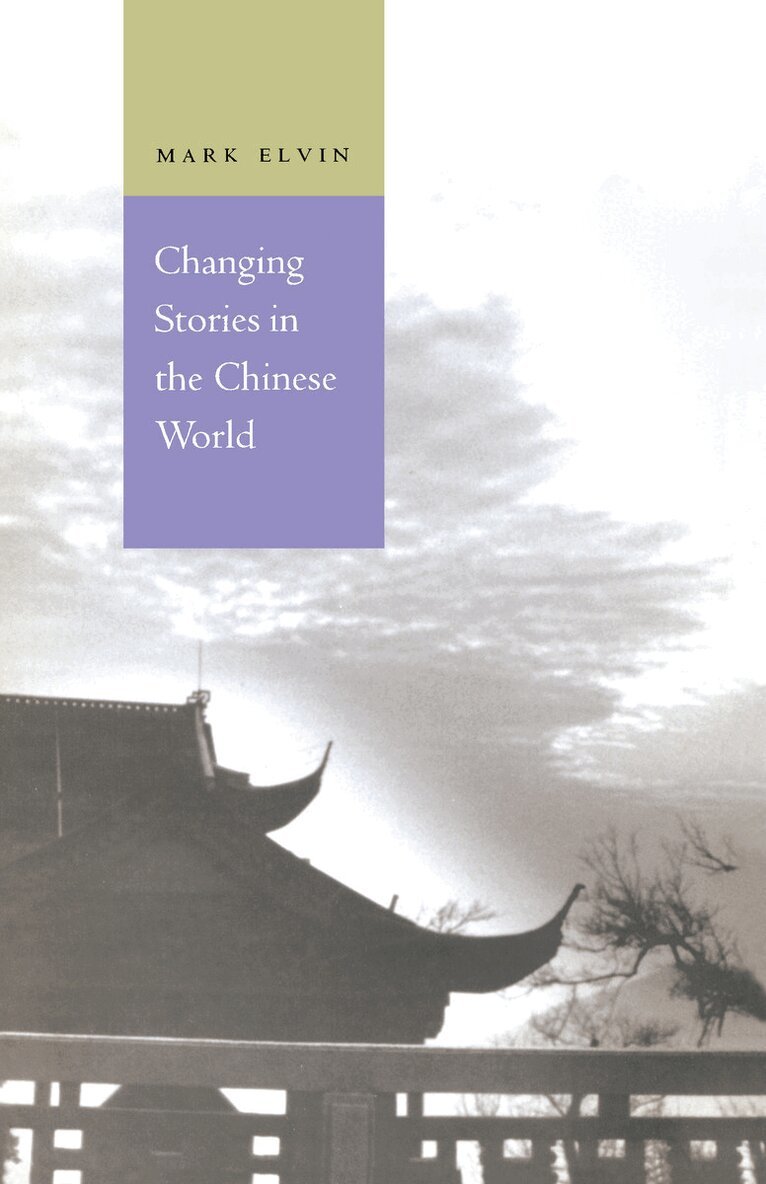
This book is an innovative attempt to convey something of how it has felt since the early nineteenth century to be Chinese. It is based on the assumption that people live their lives in stories, or as if they themselves were in stories—stories that are largely a social inheritance but are also in some measure self-created or at least continually adapted, edited, or extended.The author describes and interprets some of the most important stories through which the Chinese have lived their lives in the last two hundred years and their understanding of them. He shows how largely forgotten works of popular literature, novels and poems in particular, can admit the reader to a number of different emotional worlds. Together they suggest that there is no such thing as the Chinese story, let alone mind, but rather a historical palimpsest of extraordinary and often internally contradictory complexity.The book begins with an examination of Li Ruzhen's Destinies of the Flowers in the Mirror, which reveals a microcosm of the educated Chinese world predating major Western influences. Balancing this emphasis on the elite are the poems collected by Zhang Yingchang in Our Dynasty's Bell of Poesy, which portray the universe of peasants, women, artisans, soldiers, and prisoners. A bestseller of the 1930's, Tides in the Human Sea, shows the 'crisis of absurdity' that arises when feelings no longer coincide with inherited patterns of behavior as modernization begins to take hold. Hao Ran's Children of the Western Sands, a popular Communist work of the early 1970's, allows us to be drawn into at least a momentary empathy with the idealism of the Maoist faithful.Almost as different as can be imagined is The Bastard, by Sima Zhongyuan, one of Taiwan's most widely read writers. Its characters interpret the Communist revolution in terms derived from traditional Chinese religion, as a deserved punishment inflicted on the Chinese for the filthy impropriety of their sexual conduct.The final work considered is a book of essays, A Commonplace Fellow, by Yuan Ze'nan, a Chinese-American writer who has reached the point where his Chineseness has all but vanished, and who is consciously exploring its disappearance.
416 kr
Skickas inom 7-10 vardagar
This book is an innovative attempt to convey something of how it has felt since the early nineteenth century to be Chinese. It is based on the assumption that people live their lives in stories, or as if they themselves were in stories—stories that are largely a social inheritance but are also in some measure self-created or at least continually adapted, edited, or extended.The author describes and interprets some of the most important stories through which the Chinese have lived their lives in the last two hundred years and their understanding of them. He shows how largely forgotten works of popular literature, novels and poems in particular, can admit the reader to a number of different emotional worlds. Together they suggest that there is no such thing as the Chinese story, let alone mind, but rather a historical palimpsest of extraordinary and often internally contradictory complexity.The book begins with an examination of Li Ruzhen's Destinies of the Flowers in the Mirror, which reveals a microcosm of the educated Chinese world predating major Western influences. Balancing this emphasis on the elite are the poems collected by Zhang Yingchang in Our Dynasty's Bell of Poesy, which portray the universe of peasants, women, artisans, soldiers, and prisoners. A bestseller of the 1930's, Tides in the Human Sea, shows the 'crisis of absurdity' that arises when feelings no longer coincide with inherited patterns of behavior as modernization begins to take hold. Hao Ran's Children of the Western Sands, a popular Communist work of the early 1970's, allows us to be drawn into at least a momentary empathy with the idealism of the Maoist faithful.Almost as different as can be imagined is The Bastard, by Sima Zhongyuan, one of Taiwan's most widely read writers. Its characters interpret the Communist revolution in terms derived from traditional Chinese religion, as a deserved punishment inflicted on the Chinese for the filthy impropriety of their sexual conduct.The final work considered is a book of essays, A Commonplace Fellow, by Yuan Ze'nan, a Chinese-American writer who has reached the point where his Chineseness has all but vanished, and who is consciously exploring its disappearance.