Mark H. A. Davis - Böcker
Visar alla böcker från författaren Mark H. A. Davis. Handla med fri frakt och snabb leverans.
5 produkter
5 produkter
129 kr
Skickas inom 5-8 vardagar
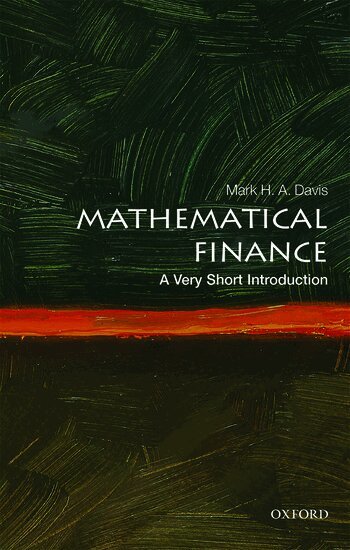
In recent years the finance industry has mushroomed to become an important part of modern economies, and many science and engineering graduates have joined the industry as quantitative analysts, with mathematical and computational skills that are needed to solve complex problems of asset valuation and risk management. An important parallel story exists of scientific endeavour. Between 1965-1995, insightful ideas in economics about asset valuation were turned into a mathematical 'theory of arbitrage', an enterprise whose first achievement was the famous 1973 Black-Scholes formula, followed by extensive investigations using all the resources of modern analysis and probability. The growth of the finance industry proceeded hand-in-hand with these developments. Now new challenges arise to deal with the fallout from the 2008 financial crisis and to take advantage of new technology, which has revolutionized the practice of trading. This Very Short Introduction introduces readers with no previous background in this area to arbitrage theory and why it works the way it does. Illuminating pricing theory, Mark Davis explains its applications to interest rates, credit trading, fund management and risk management. He concludes with a survey of the most pressing issues in mathematical finance today.ABOUT THE SERIES: The Very Short Introductions series from Oxford University Press contains hundreds of titles in almost every subject area. These pocket-sized books are the perfect way to get ahead in a new subject quickly. Our expert authors combine facts, analysis, perspective, new ideas, and enthusiasm to make interesting and challenging topics highly readable.
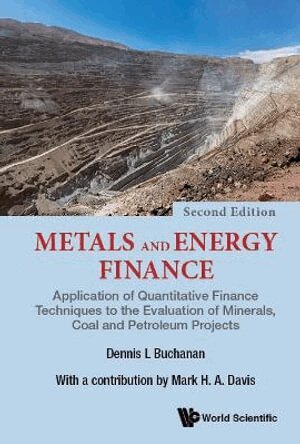
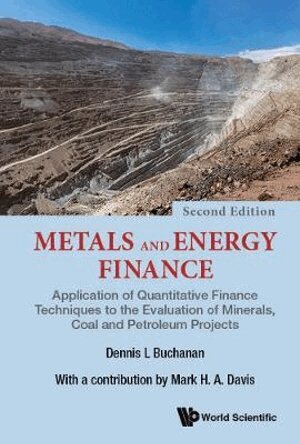
Metals And Energy Finance: Application Of Quantitative Finance Techniques To The Evaluation Of Minerals, Coal And Petroleum Projects
Inbunden, Engelska, 2018
1 546 kr
Skickas inom 3-6 vardagar
"Dennis Buchanan’s text clearly shows how an understanding of the complementary disciplines of geoscience, conventional engineering and advanced financial engineering is essential to making the right decisions concerning how to appraise a resource or project and how to structure the funding of natural resources assets in order to mitigate technical and financial risk and to maximise value for owners. Crucially, the book also looks at how other sources of capital, such as limited recourse lenders, appraise metals and energy assets. Such an understanding is essential to optimising the capital structure and valuation of natural resources assets … The advanced methodologies revealed in Dennis Buchanan’s book will have great value to those working in the technical and financial functions, or to those spanning both functions, of the natural resources industry. "Mineral EconomicsGiven the design component it involves, financial engineering should be considered equal to conventional engineering. By adopting this complementary approach, financial models can be used to identify how and why timing is critical in optimizing return on investment and to demonstrate how financial engineering can enhance returns to investors. Metals and Energy Finance capitalizes on this approach, and identifies and examines the investment opportunities offered across the extractive industry's cycle, from exploration through evaluation, pre-production development, development and production. The textbook also addresses the similarities of a range of natural resource projects, whether minerals or petroleum, while at the same time identifying their key differences.This new edition has been comprehensively revised with a new chapter on Quantitative Finance and three additional case studies. Contemporary themes in the revised edition include the current focus on the transition from open pit to underground mining as well as the role of real option valuations applied to marginal projects that may have value in the future.This innovative textbook is clear and concise in its approach. Both authors have extensive experience within the academic environment at a senior level as well as track records of hands-on participation in projects within the natural resources and financial services sectors. Metals and Energy Finance will be invaluable to both professionals and graduate students working in the field of mineral and petroleum business management.
Metals And Energy Finance: Application Of Quantitative Finance Techniques To The Evaluation Of Minerals, Coal And Petroleum Projects
Häftad, Engelska, 2018
869 kr
Skickas inom 3-6 vardagar
"Dennis Buchanan’s text clearly shows how an understanding of the complementary disciplines of geoscience, conventional engineering and advanced financial engineering is essential to making the right decisions concerning how to appraise a resource or project and how to structure the funding of natural resources assets in order to mitigate technical and financial risk and to maximise value for owners. Crucially, the book also looks at how other sources of capital, such as limited recourse lenders, appraise metals and energy assets. Such an understanding is essential to optimising the capital structure and valuation of natural resources assets … The advanced methodologies revealed in Dennis Buchanan’s book will have great value to those working in the technical and financial functions, or to those spanning both functions, of the natural resources industry. "Mineral EconomicsGiven the design component it involves, financial engineering should be considered equal to conventional engineering. By adopting this complementary approach, financial models can be used to identify how and why timing is critical in optimizing return on investment and to demonstrate how financial engineering can enhance returns to investors. Metals and Energy Finance capitalizes on this approach, and identifies and examines the investment opportunities offered across the extractive industry's cycle, from exploration through evaluation, pre-production development, development and production. The textbook also addresses the similarities of a range of natural resource projects, whether minerals or petroleum, while at the same time identifying their key differences.This new edition has been comprehensively revised with a new chapter on Quantitative Finance and three additional case studies. Contemporary themes in the revised edition include the current focus on the transition from open pit to underground mining as well as the role of real option valuations applied to marginal projects that may have value in the future.This innovative textbook is clear and concise in its approach. Both authors have extensive experience within the academic environment at a senior level as well as track records of hands-on participation in projects within the natural resources and financial services sectors. Metals and Energy Finance will be invaluable to both professionals and graduate students working in the field of mineral and petroleum business management.
Del 19 - Advanced Series on Statistical Science & Applied Probability
Risk-sensitive Investment Management
Inbunden, Engelska, 2014
2 089 kr
Skickas inom 5-8 vardagar
Over the last two decades, risk-sensitive control has evolved into an innovative and successful framework for solving dynamically a wide range of practical investment management problems.This book shows how to use risk-sensitive investment management to manage portfolios against an investment benchmark, with constraints, and with assets and liabilities. It also addresses model implementation issues in parameter estimation and numerical methods. Most importantly, it shows how to integrate jump-diffusion processes which are crucial to model market crashes.With its emphasis on the interconnection between mathematical techniques and real-world problems, this book will be of interest to both academic researchers and money managers. Risk-sensitive investment management links stochastic control and portfolio management. Because of its distinct emphasis on integrating advanced theoretical concepts into practical dynamic investment management tools, this book stands out from the existing literature in fundamental ways. It goes beyond mainstream research in portfolio management in a traditional static setting. The theoretical developments build on contemporary research in stochastic control theory, but are informed throughout by the need to construct an effective and practical framework for dynamic portfolio management.This book fills a gap in the literature by connecting mathematical techniques with the real world of investment management. Readers seeking to solve key problems such as benchmarked asset management or asset and liability management will certainly find it useful.
Del 19 - Advanced Series on Statistical Science & Applied Probability
Risk-sensitive Investment Management
Häftad, Engelska, 2014
877 kr
Skickas inom 5-8 vardagar
Over the last two decades, risk-sensitive control has evolved into an innovative and successful framework for solving dynamically a wide range of practical investment management problems.This book shows how to use risk-sensitive investment management to manage portfolios against an investment benchmark, with constraints, and with assets and liabilities. It also addresses model implementation issues in parameter estimation and numerical methods. Most importantly, it shows how to integrate jump-diffusion processes which are crucial to model market crashes.With its emphasis on the interconnection between mathematical techniques and real-world problems, this book will be of interest to both academic researchers and money managers. Risk-sensitive investment management links stochastic control and portfolio management. Because of its distinct emphasis on integrating advanced theoretical concepts into practical dynamic investment management tools, this book stands out from the existing literature in fundamental ways. It goes beyond mainstream research in portfolio management in a traditional static setting. The theoretical developments build on contemporary research in stochastic control theory, but are informed throughout by the need to construct an effective and practical framework for dynamic portfolio management.This book fills a gap in the literature by connecting mathematical techniques with the real world of investment management. Readers seeking to solve key problems such as benchmarked asset management or asset and liability management will certainly find it useful.