Mark H. Moore - Böcker
Visar alla böcker från författaren Mark H. Moore. Handla med fri frakt och snabb leverans.
6 produkter
6 produkter
2 094 kr
Skickas inom 10-15 vardagar
This text provides a concise and internationalized restatement of the public value approach, an assessment of its impact to date - in theory and practice - and of its particular relevance to the challenges of public management in a time of crisis and austerity.
507 kr
Tillfälligt slut
The shooting at Columbine High School riveted national attention on violence in the nationa (TM)s schools. This dramatic example signaled an implicit and growing fear that these events would continue to occura "and even escalate in scale and severity. How do we make sense of the tragedy of a school shooting or even draw objective conclusions from these incidents? Deadly Lessons is the outcome of the National Research Councila (TM)s unique effort to glean lessons from six case studies of lethal student violence. These are powerful stories of parents and teachers and troubled youths, presenting the tragic complexity of the young shootera (TM)s social and personal circumstances in rich detail. The cases point to possible causes of violence and suggest where interventions may be most effective. Readers will come away with a better understanding of the potential threat, how violence might be prevented, and how healing might be promoted in affected communities. For each case study, Deadly Lessons relates events leading up to the violence, provides quotes from personal interviews about the incident, and explores the impact on the community.The case studies center on: * Two separate incidents in East New York in which three students were killed and a teacher was seriously wounded. * A shooting on the south side of Chicago in which one youth was killed and two wounded. * A shooting into a prayer group at a Kentucky high school in which three students were killed. * The killing of four students and a teacher and the wounding of 10 others at an Arkansas middle school. * The shooting of a popular science teacher by a teenager in Edinboro, Pennsylvania. * A suspected copycat of Columbine in which six students were wounded in Georgia * For everyone who puzzles over these terrible incidents, Deadly Lessons offers a fresh perspective on the most fundamental of questions: Why?
819 kr
Skickas inom 10-15 vardagar
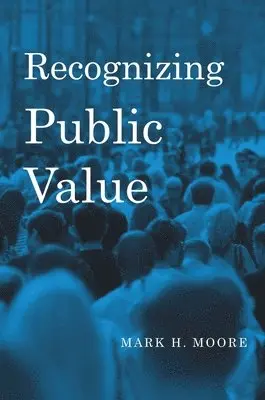
Mark H. Moore’s now classic Creating Public Value offered advice to public managers about how to create public value. But that book left a key question unresolved: how could one recognize (in an accounting sense) when public value had been created? Here, Moore closes the gap by setting forth a philosophy of performance measurement that will help public managers name, observe, and sometimes count the value they produce, whether in education, public health, safety, crime prevention, housing, or other areas. Blending case studies with theory, he argues that private sector models built on customer satisfaction and the bottom line cannot be transferred to government agencies. The Public Value Account (PVA), which Moore develops as an alternative, outlines the values that citizens want to see produced by, and reflected in, agency operations. These include the achievement of collectively defined missions, the fairness with which agencies operate, and the satisfaction of clients and other stake-holders.But strategic public managers also have to imagine and execute strategies that sustain or increase the value they create into the future. To help public managers with that task, Moore offers a Public Value Scorecard that focuses on the actions necessary to build legitimacy and support for the envisioned value, and on the innovations that have to be made in existing operational capacity.Using his scorecard, Moore evaluates the real-world management strategies of such former public managers as D.C. Mayor Anthony Williams, NYPD Commissioner William Bratton, and Commissioner of the Minnesota Department of Revenue John James.
498 kr
Skickas inom 10-15 vardagar
A seminal figure in the field of public management, Mark H. Moore presents his summation of fifteen years of research, observation, and teaching about what public sector executives should do to improve the performance of public enterprises. Useful for both practicing public executives and those who teach them, this book explicates some of the richest of several hundred cases used at Harvard’s Kennedy School of Government and illuminates their broader lessons for government managers. Moore addresses four questions that have long bedeviled public administration: What should citizens and their representatives expect and demand from public executives? What sources can public managers consult to learn what is valuable for them to produce? How should public managers cope with inconsistent and fickle political mandates? How can public managers find room to innovate?Moore’s answers respond to the well-understood difficulties of managing public enterprises in modern society by recommending specific, concrete changes in the practices of individual public managers: how they envision what is valuable to produce, how they engage their political overseers, and how they deliver services and fulfill obligations to clients. Following Moore’s cases, we witness dilemmas faced by a cross-section of public managers: William Ruckelshaus and the Environmental Protection Agency; Jerome Miller and the Department of Youth Services; Miles Mahoney and the Park Plaza Redevelopment Project; David Sencer and the swine flu scare; Lee Brown and the Houston Police Department; Harry Spence and the Boston Housing Authority. Their work, together with Moore’s analysis, reveals how public managers can achieve their true goal of producing public value.
434 kr
Skickas inom 10-15 vardagar
In Ports in a Storm a team of Harvard Kennedy School scholars focus diverse conceptual lenses on a single high-stakes management taskenhancing port security across the United States. Their aims are two: to understand how a public manager might confront that complex undertaking, and to explore the similarities, differences, and complementarities of their alternative approaches to public management.The book takes as its pivot point the singular case of U.S. Coast Guard Captain Suzanne Englebert and her leadership of efforts to secure America's ports after the September 11 attacks. The Coast Guard had always been responsible for securing America's ports and coastline. But now it was tasked with safeguarding these critical, complex, and vulnerable assets during a time of war, a job it clearly could not handle alone.Ports in a Storm considers the monumental challenge of driving rapid change in a complex system involving hundreds of private organizations and scores of government agencies with their operations intricately intertwined. The book examines Englebert's actions from varied conceptual vantage points, sometimes critiquing questionable calls but more often celebrating her initiative, creativity, persistence, and skill.The authors use the Coast Guard episode as a testing ground for the eclectic intellectual constructs they have been developing to guide public managers. Instead of starting with theory and searching for examples that fit, they begin with the concrete and then harness scholarship to the service of better practice. And rather than mimic management principles from the business world, they tailor their approach to the very different challenges of managing in a public sector context. The volume allows readers in both the scholarly and practical worlds to see how the theories measure up.Contributors, including the two volume editors, are Robert D. Behn, John D. Donahue, Archon Fung, Stephen Goldsmith, Elaine Kamarck, Herman B. Leonard, Mark H. Moore, Malcolm K. Sparrow, Pamela Varley, and Richard Zeckhauser.
493 kr
Skickas inom 10-15 vardagar
From the preface: "History has dealt the juvenile court (and, more broadly, the juvenile justice system) a cruel blow. What began as a promising social experiment has disappointed nearly everyone... Inevitably, disillusionment has weakened the mandate of the juvenile justice system. Conflicts in philosophy, once held at bay by general enthusiasm for the enterprise, have now surfaced with great urgency. What, in fact, is the purpose of the juvenile justice system? Is it to protect the community from youth crime, or to help children grow up? Is it primarily a court dominated by concerns for justice? Or, is it more fundamentally a social service agency concerned with structuring the environments of children? Is the court an independent institution that stands apart from the community and administers justice in a fair and impartial way? Or, is the court an agent of the community in the sense that it establishes norms of conduct and draws both public and private agencies to the tasks of socializing children?"