Mark S. Cladis - Böcker
Visar alla böcker från författaren Mark S. Cladis. Handla med fri frakt och snabb leverans.
6 produkter
6 produkter
152 kr
Skickas
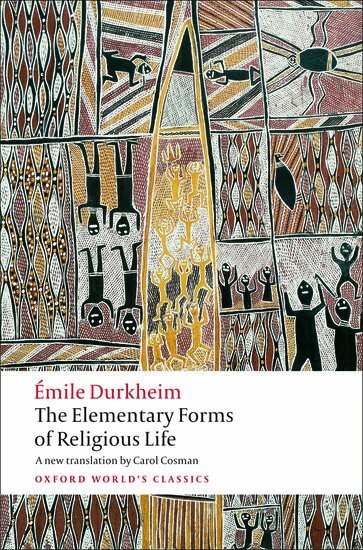
'If religion generated everything that is essential in society, this is because the idea of society is the soul of religion.'In The Elementary Forms of Religious Life (1912), Émile Durkheim set himself the task of discovering the enduring source of human social identity. He investigated what he considered to be the simplest form of documented religion - totemism among the Aborigines of Australia. Aboriginal religion was an avenue 'to yield an understanding of the religious nature of man, by showing us an essential and permanent aspect of humanity'. The need and capacity of men and women to relate socially lies at the heart of Durkheim's exploration, in which religion embodies the beliefs that shape our moral universe. The Elementary Forms has been applauded and debated by sociologists, anthropologists, ethnographers, philosophers, and theologians, and continues to speak to new generations about the origin and nature of religion and society. This new, lightly abridged edition provides an excellent introduction to Durkheim's ideas. ABOUT THE SERIES: For over 100 years Oxford World's Classics has made available the widest range of literature from around the globe. Each affordable volume reflects Oxford's commitment to scholarship, providing the most accurate text plus a wealth of other valuable features, including expert introductions by leading authorities, helpful notes to clarify the text, up-to-date bibliographies for further study, and much more.
1 095 kr
Skickas inom 5-8 vardagar
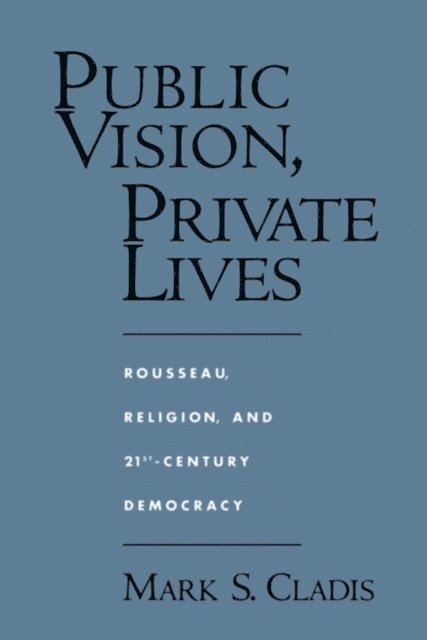
In this elegantly written book, Mark S. Cladis invites us to reflect on the nature and place of the public and private in the work of Rousseau and, more generally, in democratic society. The tension between the hopes and desires of the individual and the requirements of a shared public life were at the heart, or the knot, of Rousseau's life and thought. Cladis skillfully leads the reader on an exploration of the conflicting claims with which Rousseau wrestled - prerogatives and obligations to self, friends, family, vocation, civic life, and to humanity. At the juncture of diverse theological and secular traditions, Rousseau forged a vision of human happiness found not exclusively in the public or private, but in a complex combination of the two. Ultimately, however, Public Vision, Private Lives narrates a tragic tale. Placing Rousseau at the crossroads of Enlightenment optimism and Augustinian pessimism, Cladis elucidates Rousseau's uncomfortable, double vision. In one direction, Rousseau beheld humans able to transform their societies humanely; in the other, he perceived humans destined for immense suffering unless they dodge social involvement. At this awkward juncture, Rousseau sought to remind us of both our responsibility for ourselves and our powerlessness to radically transform ourselves. In Part I, Cladis employs the Garden-Fall myth to narrate Rousseau's rather dismal account of the human journey into social life. Yet contrary to most interpreters of Rousseau, Cladis maintains that if we categorically identify the natural with the good and the social with evil, we fail to do justice to Rousseau's provocative account of our joy and sorrow in solitude and community. Part II explores the limits and possibilities of Rousseau's three paths to partial redemption - the public path (the reformed society), the private path (the escape into solitude), and the tense, middle way between them. Throughout this study, Cladis listens closely to the religious pitch in Rousseau's voice. He convincingly shows that Rousseau, when attempting to portray the most characteristic aspects of the public and private, reached for a religious vocabulary. Honouring both love of self and love of that which is larger than the self - these twin poles, with all the tension between them - mark Rousseau's work, vision, and challenge - the challenge of 21st century democracy.
487 kr
Skickas inom 7-10 vardagar
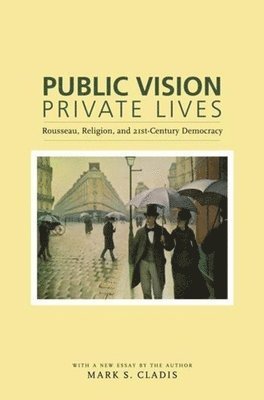
Mark S. Cladis pinpoints the origins of contemporary notions of the public and private and their relationship to religion in the work of Jean-Jacques Rousseau. His thesis cuts across many fields and issues-philosophy of religion, women's studies, democratic theory, modern European history, American culture, social justice, privacy laws, and notions of solitude and community-and wholly reconsiders the political, cultural, and legal nature of modernity in relation to religion. Turning to Rousseau's Garden, its inhabitants, the Solitaires, and the question of restoration and redemption that preoccupied much of Rousseau's thought, Cladis examines how Rousseau addressed the tension between the joys and moral obligations of social engagement and the desire for solitude. He was caught between two possibilities: active involvement in the creation of an enlightened and humane society or extrication from social entanglements in favor of cultivating a spiritual interior life. Yet Rousseau did not view this conflict as a desperate division. Rather, for him it was a moral struggle to be endured by those who had fallen from the Garden.For this edition Cladis has added a substantive introduction that discusses the role of religion in contemporary democratic societies, particularly in American public life. Cladis proposes four models of thinking about religion in public and champions what he calls spiritual democracy-a dynamic, culturally specific, and progressive democracy. Cladis argues that spiritual democracy refers not only to a society's legal codes and principles but also to its democratic culture and symbols and its daily practices and institutions. It encompasses the nation's character, diverse identities, and a distinctivel exchange between the nation's public vision and citizens' complex, private lives.
1 387 kr
Skickas inom 7-10 vardagar
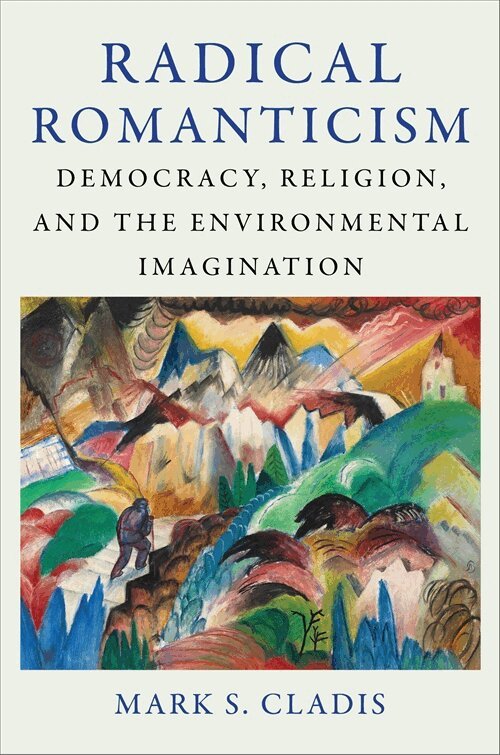
Romanticism is often reduced to nostalgic pastoralism and solitary contemplation of the sublime. But a radical strand of Romantic writers and thinkers offered sweeping political, ecological, and religious critiques of capitalism, racism, settler colonialism, and environmental destruction. Interweaving canonical nineteenth-century authors with Black and Indigenous thinkers who transformed their work, this book is a bold new account of Romanticism for today’s deeply entrenched crises.Mark S. Cladis examines the progressive democratic, religious, and environmental beliefs and practices that informed European Romantic literature and its sustained legacies in North America. His interpretation interweaves diverse voices such as W. E. B. Du Bois, Zora Neale Hurston, and Leslie Marmon Silko while also revealing the progressive visions of Romantic authors such as Rousseau, William and Dorothy Wordsworth, Coleridge, Mary Shelley, Thoreau, and Margaret Fuller. Forging connections among literary and philosophical traditions while closely reading a wide range of texts, Radical Romanticism shows how storytelling is central to the pursuit of justice and flourishing for the human and the more-than-human worlds. Bringing together environmental humanities, literary theory, political theory, and religious studies, this book makes the case for a renewed radical Romanticism, offering urgent resources for a world beset by catastrophe, uncertainty, and despair.
348 kr
Skickas inom 7-10 vardagar
Romanticism is often reduced to nostalgic pastoralism and solitary contemplation of the sublime. But a radical strand of Romantic writers and thinkers offered sweeping political, ecological, and religious critiques of capitalism, racism, settler colonialism, and environmental destruction. Interweaving canonical nineteenth-century authors with Black and Indigenous thinkers who transformed their work, this book is a bold new account of Romanticism for today’s deeply entrenched crises.Mark S. Cladis examines the progressive democratic, religious, and environmental beliefs and practices that informed European Romantic literature and its sustained legacies in North America. His interpretation interweaves diverse voices such as W. E. B. Du Bois, Zora Neale Hurston, and Leslie Marmon Silko while also revealing the progressive visions of Romantic authors such as Rousseau, William and Dorothy Wordsworth, Coleridge, Mary Shelley, Thoreau, and Margaret Fuller. Forging connections among literary and philosophical traditions while closely reading a wide range of texts, Radical Romanticism shows how storytelling is central to the pursuit of justice and flourishing for the human and the more-than-human worlds. Bringing together environmental humanities, literary theory, political theory, and religious studies, this book makes the case for a renewed radical Romanticism, offering urgent resources for a world beset by catastrophe, uncertainty, and despair.
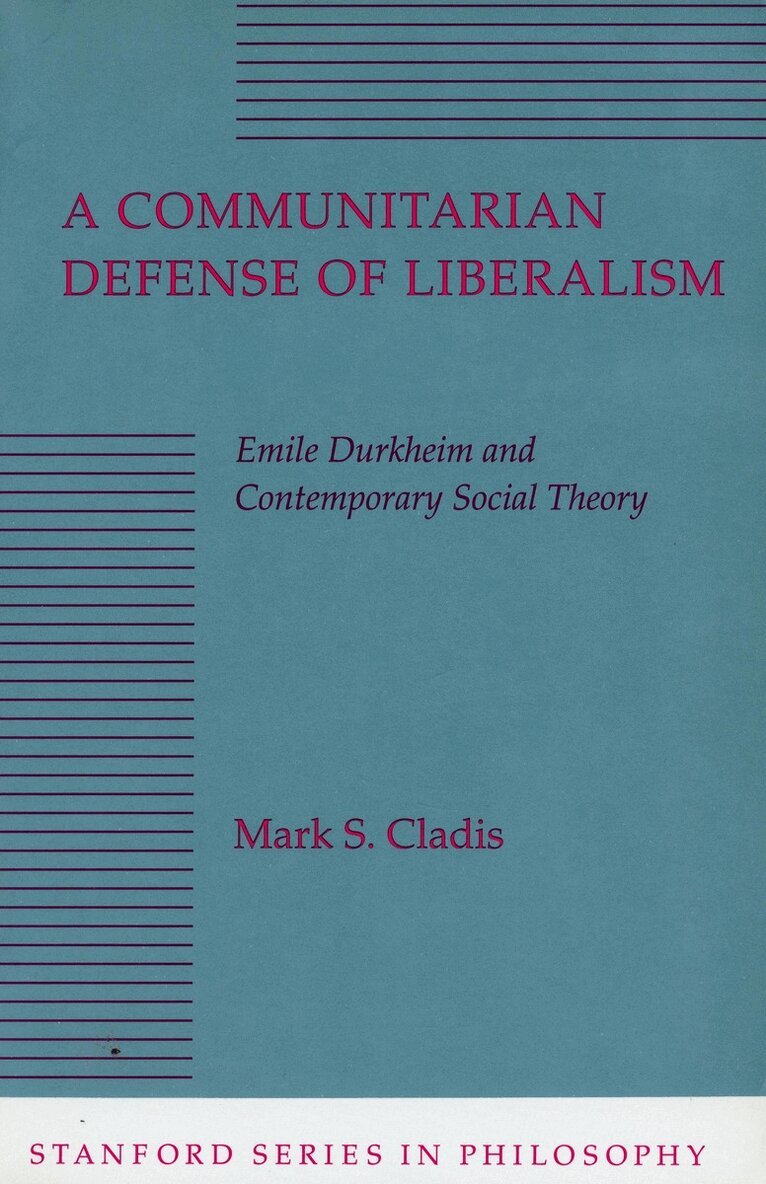
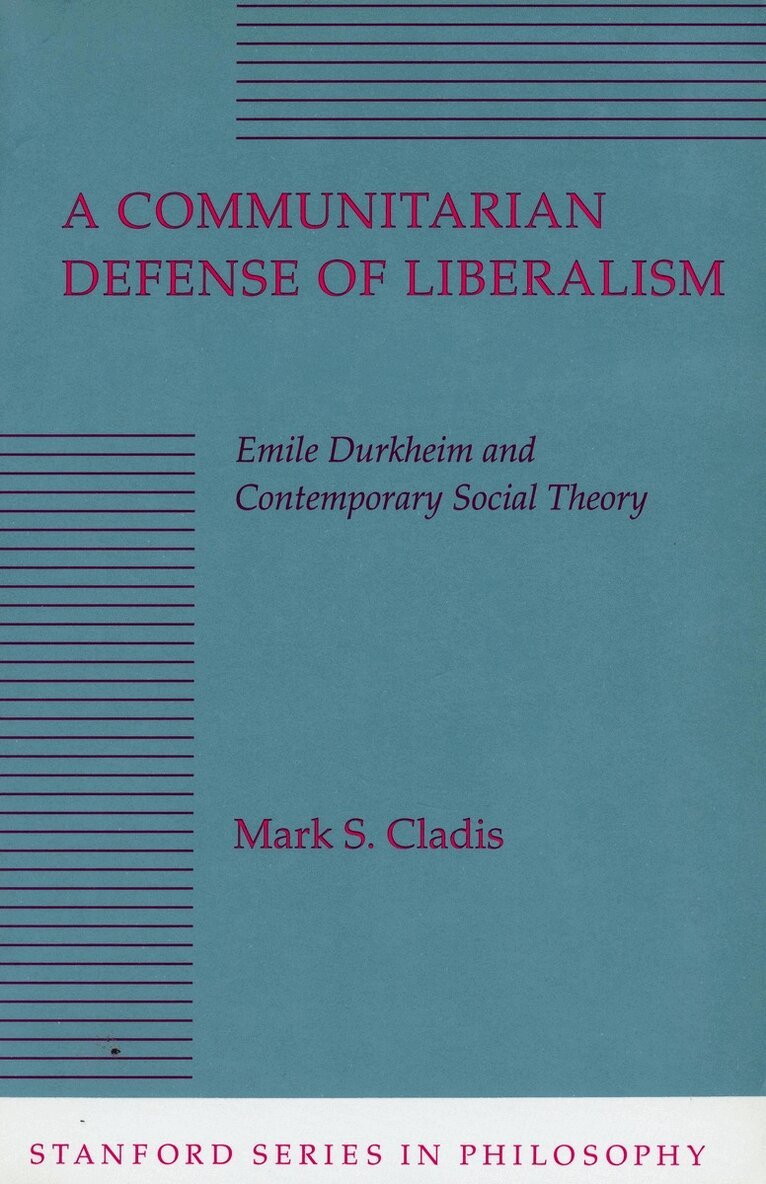
Communitarian Defense of Liberalism
Emile Durkheim and Contemporary Social Theory
Inbunden, Engelska, 1992
1 476 kr
Skickas inom 10-15 vardagar
'Community, ' 'tradition, ' 'the individual', stand out prominently in today's intellectual landscape. In social and political theory and in religious studies they figure in the ongoing debates between liberals (champions of the individual) and communitarians (champions of the common good). With these debates and their potential conflict in mind, the author has constructed a timely reading of Emile Durkheim that captures the benefits associated with both liberalism and communitarianism. The book explores fundamental issues concerning freedom, rights, authority, public moral education, the relation between the public and the private, and the role of social criticism in democracies. Isolating the merits and liabilities of both liberal and communitarian theories, the author demonstrates that we need not be in the position of having to choose between them.