Martha Fineman - Böcker
Visar alla böcker från författaren Martha Fineman. Handla med fri frakt och snabb leverans.
3 produkter
3 produkter
1 396 kr
Skickas inom 10-15 vardagar
"The essays in this volume confront the inroads that economics has made into the legal academy.... Law and Economics uses principles of neoclassical economics to develop laws and social policies that maintain if not bolster current allocations of power."—from the IntroductionThe Law and Economics school has had a significant impact on the legal and governmental landscape in the United States. It posits a perfectly rational "economic man"—homo economicus—who is unconstrained by familial and communal ties and who can and should make decisions solely in light of considerations of economic value. Feminism Confronts Homo Economicus offers a major intervention in debates about how law has come under the influence of economic principles. Drawing on the latest thinking in the fields of feminist legal theory, critical legal studies, and feminist economics, the essays critique the notion that legal and policy decisions should be made solely through the lens of economics. While the contributors question the wholesale incorporation of the neoclassical economic model into legal analysis, they do not all discard economic analysis and theory.Situated at the intersection of feminism, law, and economics, Feminism Confronts Homo Economicus will appeal to scholars and students of these disciplines as well as policy analysts and social theorists interested in family, education, labor, and welfare.
411 kr
Skickas inom 10-15 vardagar
"The essays in this volume confront the inroads that economics has made into the legal academy.... Law and Economics uses principles of neoclassical economics to develop laws and social policies that maintain if not bolster current allocations of power."—from the IntroductionThe Law and Economics school has had a significant impact on the legal and governmental landscape in the United States. It posits a perfectly rational "economic man"—homo economicus—who is unconstrained by familial and communal ties and who can and should make decisions solely in light of considerations of economic value. Feminism Confronts Homo Economicus offers a major intervention in debates about how law has come under the influence of economic principles. Drawing on the latest thinking in the fields of feminist legal theory, critical legal studies, and feminist economics, the essays critique the notion that legal and policy decisions should be made solely through the lens of economics. While the contributors question the wholesale incorporation of the neoclassical economic model into legal analysis, they do not all discard economic analysis and theory.Situated at the intersection of feminism, law, and economics, Feminism Confronts Homo Economicus will appeal to scholars and students of these disciplines as well as policy analysts and social theorists interested in family, education, labor, and welfare.
Del 13 - Series on Transitional Justice
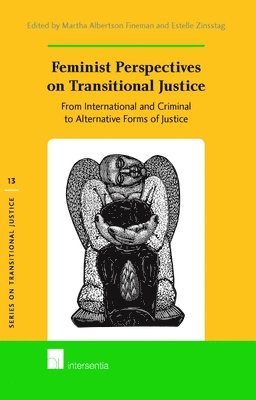
Feminist Perspectives on Transitional Justice
From International and Criminal to Alternative Forms of Justice
Inbunden, Engelska, 2013
886 kr
Tillfälligt slut
Truth-seeking mechanisms, international criminal law developments, and other forms of transitional justice have become ubiquitous in societies emerging from long years of conflict, instability and oppression and moving into a post-conflict, more peaceful era. In practice, both top-down and bottom-up approaches to transitional justice are being formally and informally developed in places such as South Africa, Liberia, Peru, Chile, the Democratic Republic of Congo, Sierra Leone, Rwanda, the former Yugoslavia, and Northern Ireland. Many studies, conferences and debates have taken place addressing these developments and providing elaboration of theories relating to transition justice generally. However, rarely have these processes been examined and critiqued through a feminist lens. The position of women, particularly their specific victimisation, typically has not been taken into account in any systematic manner. Seldom do commentators specifically consider whether the recently developed mechanisms for promoting peace and reconciliation will actually help the position of women in a society moving out of repression or conflict.This is unfortunate, since women's issues are often overlooked and post-conflict societies, because they must rebuild, are ideally poised to introduce standards that would enable and ensure the active participation of the entire population, including women, in rebuilding a more stable, fair and democratic polity. This book offers some insights into women's perspectives and feminist views on the topic of transitional justice or 'justice in transition'. Bringing feminism into the conversation allows us to expand the possibilities for a transformative justice approach after a period of conflict or insecurity, not by replacing it with feminist theory, but by broadening the scope and vision of the potential responses.