Martha Schoolman - Böcker
Visar alla böcker från författaren Martha Schoolman. Handla med fri frakt och snabb leverans.
3 produkter
3 produkter
1 330 kr
Skickas inom 10-15 vardagar
From David Brion Davis's The Problem of Slavery in the Age of Revolution to Paul Gilroy's The Black Atlantic, some of the most influential conceptualizations of the Atlantic World have taken the movements of individuals and transnational organizations working to advocate the abolition of slavery as their material basis. This unique, interdisciplinary collection of essays provides diverse new approaches to examining the abolitionist Atlantic. With contributions from an international roster of historians, literary scholars, and specialists in the history of art, this book provides case studies in the connections between abolitionism and material spatial practice in literature, theory, history and memory.This volume covers a wide range of topics and themes, including the circum-Atlantic itineraries of abolitionist artists and activists; precise locations such as Paris and Chatham, Ontario where abolitionists congregated to speculate over the future of, and hatch emigration plans to, sites in Africa, Latin America and the Caribbean; and the reimagining of abolitionist places in twentieth and twenty-first century literature and public art. This book was originally published as a special issue of Atlantic Studies.
295 kr
Skickas inom 7-10 vardagar
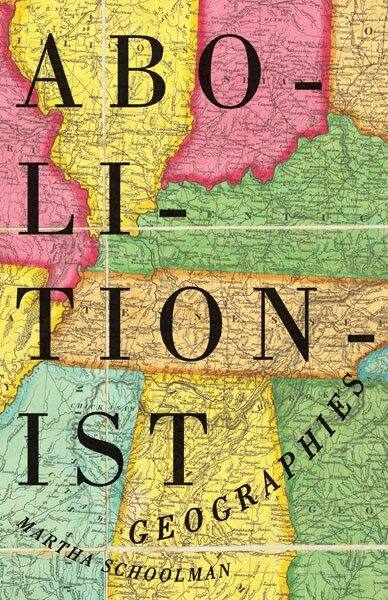
Traditional narratives of the period leading up to the Civil War are invariably framed in geographical terms. The sectional descriptors of the North, South, and West, like the wartime categories of Union, Confederacy, and border states, mean little without reference to a map of the United States. In Abolitionist Geographies, Martha Schoolman contends that antislavery writers consistently refused those standard terms. Through the idiom Schoolman names “abolitionist geography,” these writers instead expressed their dissenting views about the westward extension of slavery, the intensification of the internal slave trade, and the passage of the Fugitive Slave Law by appealing to other anachronistic, partial, or entirely fictional north–south and east–west axes. Abolitionism’s West, for instance, rarely reached beyond the Mississippi River, but its East looked to Britain for ideological inspiration, its North habitually traversed the Canadian border, and its South often spanned the geopolitical divide between the United States and the British Caribbean.Schoolman traces this geography of dissent through the work of Martin Delany, Ralph Waldo Emerson, William Wells Brown, and Harriet Beecher Stowe, among others. Her book explores new relationships between New England transcendentalism and the British West Indies; African-American cosmopolitanism, Britain, and Haiti; sentimental fiction, Ohio, and Liberia; John Brown’s Appalachia and circum-Caribbean marronage. These connections allow us to see clearly for the first time abolitionist literature’s explicit and intentional investment in geography as an idiom of political critique, by turns liberal and radical, practical and utopian.
592 kr
Skickas inom 10-15 vardagar
From David Brion Davis's The Problem of Slavery in the Age of Revolution to Paul Gilroy's The Black Atlantic, some of the most influential conceptualizations of the Atlantic World have taken the movements of individuals and transnational organizations working to advocate the abolition of slavery as their material basis. This unique, interdisciplinary collection of essays provides diverse new approaches to examining the abolitionist Atlantic. With contributions from an international roster of historians, literary scholars, and specialists in the history of art, this book provides case studies in the connections between abolitionism and material spatial practice in literature, theory, history and memory.This volume covers a wide range of topics and themes, including the circum-Atlantic itineraries of abolitionist artists and activists; precise locations such as Paris and Chatham, Ontario where abolitionists congregated to speculate over the future of, and hatch emigration plans to, sites in Africa, Latin America and the Caribbean; and the reimagining of abolitionist places in twentieth and twenty-first century literature and public art. This book was originally published as a special issue of Atlantic Studies.