Martin Mevius - Böcker
Visar alla böcker från författaren Martin Mevius. Handla med fri frakt och snabb leverans.
3 produkter
3 produkter
Agents of Moscow
The Hungarian Communist Party and the Origins of Socialist Patriotism 1941-1953
Inbunden, Engelska, 2005
2 797 kr
Skickas inom 5-8 vardagar
After 1945, state patriotism of the communist regimes in Eastern Europe was characterized by the widespread use of national symbols. In communist Hungary the party (MKP) widely celebrated national holidays, national heroes, erected national statues, and employed national street names. This 'socialist patriotism' had its origin in the 'national line' of the Comintern, established on Soviet instructions following the German invasion of the Soviet Union. At that time Stalin called the parties of the Comintern to oppose the Germans by issuing the call for national liberation.This policy continued after 1945 when, as an aid in the struggle for power, the MKP presented itself as both the 'heir to the traditions of the nations' and the 'only true representative of the interest of the Hungarian people'. Paradoxically however, the Soviet origins of the national line were also one of the main obstacles to its success as the MKP could not put forward national demands if these conflicted with Soviet interests. Martin Mevius' pioneering study reveals that what had started as a tactical measure in 1941 had become the self-image of party and state in 1953 and that the ultimate loyalty to the Soviet Union worked to the detriment of the national party - the MKP never rid itself of the label 'agents of Moscow'.
2 181 kr
Skickas inom 10-15 vardagar
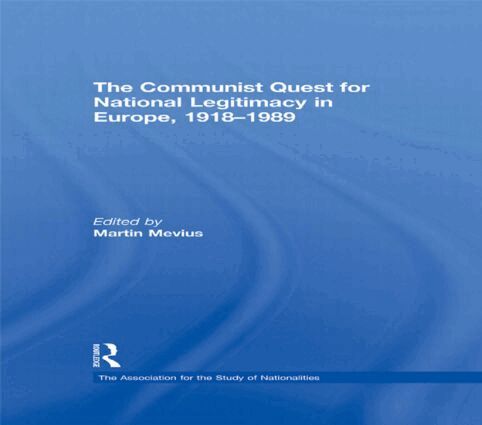
There are two popular myths concerning the relationship between communism and nationalism. The first is that nationalism and communism are wholly antagonistic and mutually exclusive. The second is the assertion that in communist Eastern Europe nationalism was oppressed before 1989, to emerge triumphant after the Berlin Wall came down. Reality was different. Certainly from 1945 onwards, communist parties presented themselves as heirs to national traditions and guardians of national interests. The communist states of Central and Eastern Europe constructed "socialist patriotism," a form of loyalty to their own state of workers and peasants. Up to 1989, communists in Eastern Europe sang the national anthem, and waved the national flag next to the red banner. The use of national images was not the exception, but the rule. From Cuba to Korea, all communist parties attempted to gain national legitimacy. This was not incidental or a deviation from Marxist orthodoxy, but ingrained in the theory and practice of the communist movement since its inception.The study of communist national legitimacy is an exciting new field. This book presents examples of communist attempts to co-opt nationalism from both sides of the iron curtain and lays bare the striking similarities between such diverse cases as the socialist patriotism of the Bulgarian Communist Party and the national line of the Portuguese communists, between Romanian communist nation building and the national ideology of the Spanish Communist Party.This book was published as a special issue of Nationalities Papers.
693 kr
Skickas inom 10-15 vardagar
There are two popular myths concerning the relationship between communism and nationalism. The first is that nationalism and communism are wholly antagonistic and mutually exclusive. The second is the assertion that in communist Eastern Europe nationalism was oppressed before 1989, to emerge triumphant after the Berlin Wall came down. Reality was different. Certainly from 1945 onwards, communist parties presented themselves as heirs to national traditions and guardians of national interests. The communist states of Central and Eastern Europe constructed "socialist patriotism," a form of loyalty to their own state of workers and peasants. Up to 1989, communists in Eastern Europe sang the national anthem, and waved the national flag next to the red banner. The use of national images was not the exception, but the rule. From Cuba to Korea, all communist parties attempted to gain national legitimacy. This was not incidental or a deviation from Marxist orthodoxy, but ingrained in the theory and practice of the communist movement since its inception.The study of communist national legitimacy is an exciting new field. This book presents examples of communist attempts to co-opt nationalism from both sides of the iron curtain and lays bare the striking similarities between such diverse cases as the socialist patriotism of the Bulgarian Communist Party and the national line of the Portuguese communists, between Romanian communist nation building and the national ideology of the Spanish Communist Party.This book was published as a special issue of Nationalities Papers.