Martina Morris - Böcker
Visar alla böcker från författaren Martina Morris. Handla med fri frakt och snabb leverans.
5 produkter
5 produkter
2 931 kr
Skickas inom 5-8 vardagar
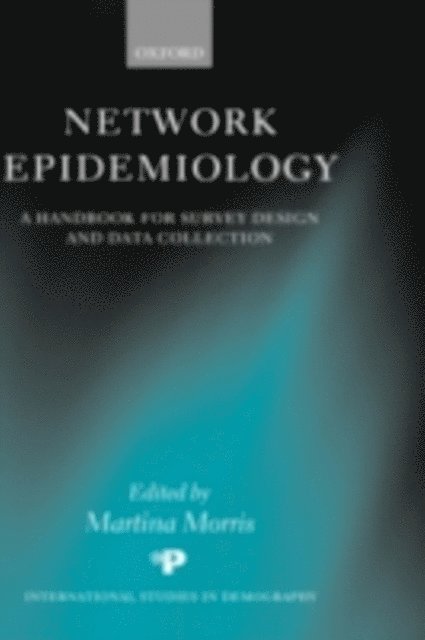
Over the past two decades, the epidemic of HIV/AIDS has challenged the public health community to fundamentally rethink the framework for preventing infectious diseases. While much progress has been made on the biomedical front in treatments for HIV infection, prevention still relies on behaviour change. This book documents and explains the remarkable breakthroughs in behavioural research design that have emerged to confront this new challenge: the study of partnership networks.Traditionally, public health research focused on the "knowledge, attitudes, and practices (KAP)" of individuals, an approach designed for understanding health-related behaviour like seat-belt wearing and cigarette smoking. For HIV and other sexually transmitted infections, however, there are at least two people involved in transmission. This may not seem like a big difference, but in fact it changes everything. First, it means that your risk depends on your partners -- and on their partners, and their partners: it depends on your position in the network of partnerships. Consider, for example, the rise of infections among monogamous women. Second, it means that individuals are not free to simply change their behaviour -- condom use, or abstinence, needs to be negotiated with a partner. both the epidemiology of risk and constraints to behaviour are therefore a function of the partnership network. And our ability to design effective prevention strategies depends on our ability to measure and summarize that network. Using the traditional research designs, you would not see this network at all -- you would only see the unconnected nodes. They key to solving this problem lies in Network Analysis, before now a relatively obscure subfield in Sociology.For empirical studies of networks to become feasible, however, many problems had to be solved. This book documents the rapid progress that has been made. It brings together eight pioneering studies that have sought to map the networks that spread infection around the world. Each chapter reviews the questions that drove the study, the changes in methodology that were needed to implement the network survey, the mistakes and successes encountered, and the central findings that the network design made possible. An introduction provides an overview of network survey design, a glossary provides a summary of network terminology, and example questionnaires from each study provide a template for further research. This is a unique and valuable resource for the international public health research community.
535 kr
Skickas inom 10-15 vardagar
In social science research, differences among groups or changes over time are a common focus of study. While means and variances are typically the basis for statistical methods used in this research, the underlying social theory often implies properties of distributions that are not well captured by these summary measures. Examples include the current controversies regarding growing inequality in earnings, racial diferences in test scores, socio-economic correlates of birth outcomes, and the impact of smoking on survival and health. The distributional differences that animate the debates in these fields are complex. They comprise the usual mean-shifts and changes in variance, but also more subtle comparisons of changes in the upper and lower tails of distributions. Survey and census data on such attributes contain a wealth of distributional information, but traditional methods of data analysis leave much of this information untapped. In this monograph, we present methods for full comparative distributional analysis.The methods are based on the relative distribution, a nonparametric complete summary of the information required for scale--invariant comparisons between two distributions. The relative distribution provides a general integrated framework for analysis. It offers a graphical component that simplifies exploratory data analysis and display, a statistically valid basis for the development of hypothesis-driven summary measures, and the potential for decomposition that enables one to examine complex hypotheses regarding the origins of distributional changes within and between groups. The monograph is written for data analysts and those interested in measurement, and it can serve as a textbook for a course on distributional methods. The presentation is application oriented,
180 kr
Skickas inom 5-8 vardagar
538 kr
Skickas inom 10-15 vardagar
In social science research, differences among groups or changes over time are a common focus of study. While means and variances are typically the basis for statistical methods used in this research, the underlying social theory often implies properties of distributions that are not well captured by these summary measures. Examples include the current controversies regarding growing inequality in earnings, racial diferences in test scores, socio-economic correlates of birth outcomes, and the impact of smoking on survival and health. The distributional differences that animate the debates in these fields are complex. They comprise the usual mean-shifts and changes in variance, but also more subtle comparisons of changes in the upper and lower tails of distributions. Survey and census data on such attributes contain a wealth of distributional information, but traditional methods of data analysis leave much of this information untapped. In this monograph, we present methods for full comparative distributional analysis. The methods are based on the relative distribution, a nonparametric complete summary of the information required for scale--invariant comparisons between two distributions. The relative distribution provides a general integrated framework for analysis. It offers a graphical component that simplifies exploratory data analysis and display, a statistically valid basis for the development of hypothesis-driven summary measures, and the potential for decomposition that enables one to examine complex hypotheses regarding the origins of distributional changes within and between groups. The monograph is written for data analysts and those interested in measurement, and it can serve as a textbook for a course on distributional methods. The presentation is application oriented,
138 kr
Skickas inom 5-8 vardagar