Martyn Thomas - Böcker
Visar alla böcker från författaren Martyn Thomas. Handla med fri frakt och snabb leverans.
4 produkter
4 produkter
558 kr
Tillfälligt slut
The focus of Software for Dependable Systems is a set of fundamental principles that underlie software system dependability and that suggest a different approach to the development and assessment of dependable software. Unfortunately, it is difficult to assess the dependability of software. The field of software engineering suffers from a pervasive lack of evidence about the incidence and severity of software failures; about the dependability of existing software systems; about the efficacy of existing and proposed development methods; about the benefits of certification schemes; and so on. There are many anecdotal reports, which-although often useful for indicating areas of concern or highlighting promising avenues of research-do little to establish a sound and complete basis for making policy decisions regarding dependability. The committee regards claims of extraordinary dependability that are sometimes made on this basis for the most critical of systems as unsubstantiated, and perhaps irresponsible.This difficulty regarding the lack of evidence for system dependability leads to two conclusions: (1) that better evidence is needed, so that approaches aimed at improving the dependability of software can be objectively assessed, and (2) that, for now, the pursuit of dependability in software systems should focus on the construction and evaluation of evidence. The committee also recognized the importance of adopting the practices that are already known and used by the best developers; this report gives a sample of such practices. Some of these (such as systematic configuration management and automated regression testing) are relatively easy to adopt; others (such as constructing hazard analyses and threat models, exploiting formal notations when appropriate, and applying static analysis to code) will require new training for many developers. However valuable, though, these practices are in themselves no silver bullet, and new techniques and methods will be required in order to build future software systems to the level of dependability that will be required.
204 kr
Skickas
Shortlisted for the Sunday Times Rugby Book of the Year 2023World in their Hands recounts the remarkable events that led to a group of friends from south-west London staging the inaugural Women’s Rugby World Cup in 1991. The tournament was held just 13 years after teams from University College London and King’s contested a match that catalysed the growth of the women’s game in the UK, and the organisers overcame myriad obstacles before, during and after the World Cup. Those challenges, which included ingrained misogyny, motherhood, a recession, the Gulf War and the collapse of the Soviet Union, provide a fitting framing device for a book that celebrates female achievement in the face of adversity.Although ostensibly a story about women’s rugby, this is a tale that has rare crossover appeal. It is not only the account of a group of inspirational women who took on the institutional misogyny that existed in rugby clubs across the globe to put on a first ever Women’s Rugby World Cup. It is also the compelling and relatable tale of how those women, their peers and others in the generations before them, reshaped the idea of what it means to be a woman, finding acceptance and friendship on boggy rugby pitches. At the time, with the men’s game tying itself up in knots about professionalism and apartheid, these women were a breath of fresh air. Three decades on, their achievements deserve to be highlighted to a wider audience.
540 kr
Skickas inom 10-15 vardagar
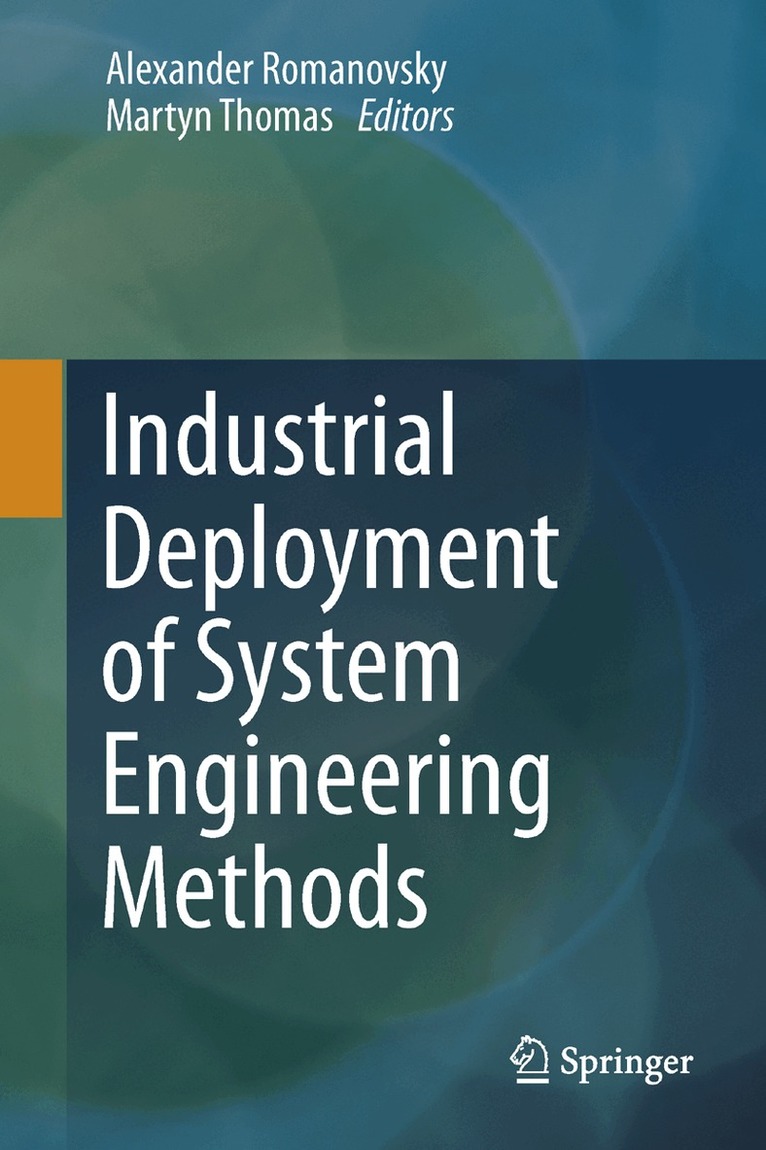
A formal method is not the main engine of a development process, its contribution is to improve system dependability by motivating formalisation where useful. This book summarizes the results of the DEPLOY research project on engineering methods for dependable systems through the industrial deployment of formal methods in software development. The applications considered were in automotive, aerospace, railway, and enterprise information systems, and microprocessor design. The project introduced a formal method, Event-B, into several industrial organisations and built on the lessons learned to provide an ecosystem of better tools, documentation and support to help others to select and introduce rigorous systems engineering methods. The contributing authors report on these projects and the lessons learned. For the academic and research partners and the tool vendors, the project identified improvements required in the methods and supporting tools, while the industrial partners learned about the value of formal methods in general. A particular feature of the book is the frank assessment of the managerial and organisational challenges, the weaknesses in some current methods and supporting tools, and the ways in which they can be successfully overcome. The book will be of value to academic researchers, systems and software engineers developing critical systems, industrial managers, policymakers, and regulators.
540 kr
Skickas inom 10-15 vardagar
A formal method is not the main engine of a development process, its contribution is to improve system dependability by motivating formalisation where useful. This book summarizes the results of the DEPLOY research project on engineering methods for dependable systems through the industrial deployment of formal methods in software development. The applications considered were in automotive, aerospace, railway, and enterprise information systems, and microprocessor design. The project introduced a formal method, Event-B, into several industrial organisations and built on the lessons learned to provide an ecosystem of better tools, documentation and support to help others to select and introduce rigorous systems engineering methods. The contributing authors report on these projects and the lessons learned. For the academic and research partners and the tool vendors, the project identified improvements required in the methods and supporting tools, while the industrial partners learned about the value of formal methods in general. A particular feature of the book is the frank assessment of the managerial and organisational challenges, the weaknesses in some current methods and supporting tools, and the ways in which they can be successfully overcome. The book will be of value to academic researchers, systems and software engineers developing critical systems, industrial managers, policymakers, and regulators.