Division on Engineering and Physical Sciences – författare
Visar alla böcker från författaren Division on Engineering and Physical Sciences. Handla med fri frakt och snabb leverans.
2274 produkter
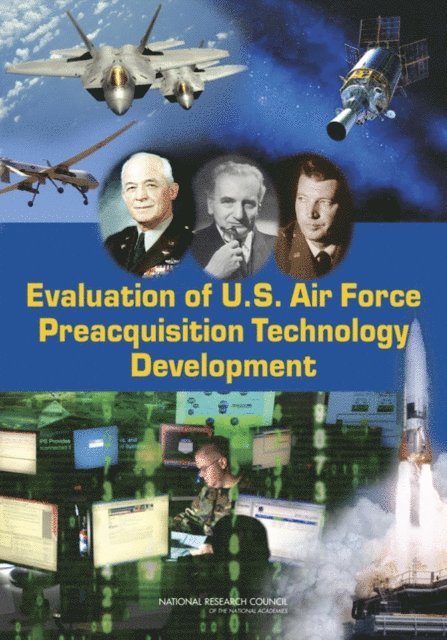
Evaluation of U.S. Air Force Preacquisition Technology Development
Av Committee on Evaluation of U.S. Air Force Preacquisition Technology Development, Air Force Studies Board m. fl.
E-bok, 2011
627 kr
Lägg i varukorg
From the days of biplanes and open cockpits, the air forces of the United States have relied on the mastery of technology. From design to operation, a project can stretch to 20 years and more, with continuous increases in cost. Much of the delay and cost growth afflicting modern United States Air …
Directions in Engineering Research
An Assessment of Opportunities and Needs
Av National Research Council, Division on Engineering and Physical Sciences m. fl.
Häftad, 1987
3185 kr
Lägg i varukorg
Surveying the dynamic field of engineering research, Directions in Engineering Research first presents an overview of the status of engineering research today. It then examines research and needs in a variety of areas: bioengineering; construction and structural design; energy, mineralogy, and the …
Nuclear Weapons Complex
Management for Health, Safety, and the Environment
Av National Research Council, Division on Engineering and Physical Sciences m. fl.
Häftad, 1989
2925 kr
Lägg i varukorg
In this volume, the National Research Council examines problems arising throughout government-owned, contractor-operated facilities in the United States engaged in activities to build nuclear weapons. The book draws conclusions about and makes recommendations for the health and safety of the …
Eruption of Nevado Del Ruiz Volcano Colombia, South America, November 13, 1985
Av National Research Council, Division on Engineering and Physical Sciences m. fl.
Häftad, 1991
1275 kr
Lägg i varukorg
On November 13, 1985, catastrophic mudflows swept down the slopes of the erupting Nevado del Ruiz volcano, destroying structures in their paths. Various estimates of deaths ranged as high as 24,000 residents. Though the nature and extent of risk posed by the mudflows to local communities were well …
Commercialization of New Materials for a Global Economy
Av National Research Council, Division on Engineering and Physical Sciences m. fl.
Häftad, 1993
632 kr
Lägg i varukorg
Materials are important in the pursuit of virtually every human endeavor. Advances in materials are applied not only in advanced technological systems such as spacecraft, jet engines, computers, and telecommunications but also in a world of more familiar applications from automobiles to floor …
Alternative Technologies for the Destruction of Chemical Agents and Munitions
Av National Research Council, Division on Engineering and Physical Sciences m. fl.
Häftad, 1993
1777 kr
Lägg i varukorg
The U.S. Army Chemical Stockpile Disposal Program was established with the goal of destroying the nation's stockpile of lethal unitary chemical weapons. Since 1990 the U.S. Army has been testing a baseline incineration technology on Johnston Island in the southern Pacific Ocean. Under the planned …
Practical Lessons from the Loma Prieta Earthquake
Av National Research Council, Division on Engineering and Physical Sciences m. fl.
Häftad, 1994
2150 kr
Lägg i varukorg
The Loma Prieta earthquake struck the San Francisco area on October 17, 1989, causing 63 deaths and $10 billion worth of damage. This book reviews existing research on the Loma Prieta quake and draws from it practical lessons that could be applied to other earthquake-prone areas of the country. The …
Measuring and Improving Infrastructure Performance
Av National Research Council, Division on Engineering and Physical Sciences m. fl.
Häftad, 1995
1322 kr
Lägg i varukorg
The nation's physical infrastructure facilitates movement of people and goods; provides safe water; provides energy when and where needed; removes wastes; enables rapid communications; and generally supports our economy and quality of life. Developing a framework for guiding attempts at measuring …
Charting a Course into the Digital Era
Guidance for NOAA's Nautical Charting Mission
Av National Research Council, Division on Engineering and Physical Sciences m. fl.
Häftad, 1994
1310 kr
Lägg i varukorg
A number of trends and forces are converging to require change in the National Oceanic and Atmospheric Administration's (NOAA) nautical charting mission. The most salient among these are changes in customer requirements, with a growing demand for customized and digital nautical information …
Safety in the Underground Construction and Operation of the Exploratory Studies Facility at Yucca Mountain
Av National Research Council, Division on Engineering and Physical Sciences m. fl.
Häftad, 1995
1297 kr
Lägg i varukorg
Yucca Mountain, located on the Nevada Test Site, is being considered as a potential repository site for spent nuclear fuel and high-level radioactive waste. To determine the suitability of Yucca Mountain as a repository, the Department of Energy constructed an underground Exploratory Studies …
Statistical Software Engineering
Av National Research Council, Division on Engineering and Physical Sciences m. fl.
Häftad, 1996
1341 kr
Lägg i varukorg
This book identifies challenges and opportunities in the development and implementation of software that contain significant statistical content. While emphasizing the relevance of using rigorous statistical and probabilistic techniques in software engineering contexts, it presents opportunities …
Assessment of Hydrologic and Hydrometeorological Operations and Services
Av National Research Council, Division on Engineering and Physical Sciences m. fl.
Häftad, 1996
1346 kr
Lägg i varukorg
Floods are by far the most devastating of all weather-related hazards in the United States. The National Weather Service (NWS) is charged by Congress to provide river and flood forecasts and warnings to the public to protect life and property and to promote the nation's economic and environmental …
Post-Cold War Conflict Deterrence
Av National Research Council, Division on Engineering and Physical Sciences m. fl.
Häftad, 1997
1559 kr
Lägg i varukorg
Deterrence as a strategic concept evolved during the Cold War. During that period, deterrence strategy was aimed mainly at preventing aggression against the United States and its close allies by the hostile Communist power centers--the Union of Soviet Socialist Republics (USSR) and its allies, …
Massive Data Sets
Proceedings of a Workshop
Av National Research Council, Division on Engineering and Physical Sciences m. fl.
Häftad, 1997
1502 kr
Lägg i varukorg
Mars Sample Return
Issues and Recommendations
Av National Research Council, Division on Engineering and Physical Sciences m. fl.
Häftad, 1997
1346 kr
Lägg i varukorg
The Space Studies Board of the National Research Council (NRC) serves as the primary adviser to the National Aeronautics and Space Administration (NASA) on planetary protection policy, the purpose of which is to preserve conditions for future biological and organic exploration of planets and other …
New Science Strategy for Space Astronomy and Astrophysics
Av National Research Council, Division on Engineering and Physical Sciences m. fl.
Häftad, 1997
1205 kr
Lägg i varukorg
Future Materials Science Research on the International Space Station
Av National Research Council, Division on Engineering and Physical Sciences m. fl.
Häftad, 1997
1376 kr
Lägg i varukorg
Review and Evaluation of the Air Force Hypersonic Technology Program
Av National Research Council, Division on Engineering and Physical Sciences m. fl.
Häftad, 1998
1303 kr
Lägg i varukorg
This study was undertaken in response to a request by the U.S. Air Force that the National Research Council (NRC) examine whether the technologies that underlie the concept of a hypersonic, air-launched, air-breathing, hydrocarbon-fueled missile with speeds up to Mach 81 can be demonstrated in time …
Applying Advanced Information Systems to Ports and Waterways Management
Av Division on Engineering and Physical Sciences, Commission on Engineering and Technical Systems m. fl.
Häftad, 1999
2172 kr
Lägg i varukorg
The future safety of maritime transportation in the United States-a major factor in the nation's international trade and economic well-being-will depend heavily on the quality of port and waterways information systems. Many U.S. ports and waterways lack adequate information services, although …
Industrial Technology Assessments
An Evaluation of the Research Program of the Office of Industrial Technologies
Av National Research Council, Division on Engineering and Physical Sciences m. fl.
Häftad, 1999
1205 kr
Lägg i varukorg
In 1993, the U.S. Department of Energy (DOE) Office of Industrial Technology (OIT) established a group of seven industries designated as Industries of the Future (IOF). These industries were selected for their high energy use and large waste generation. The original IOF included the aluminum, …
Gravitational Physics
Exploring the Structure of Space and Time
Av National Research Council, Division on Engineering and Physical Sciences m. fl.
Häftad, 1999
1425 kr
Lägg i varukorg
Gravitational Physics assesses the achievements of the field over the past decade in both theory and experiment, identifies the most promising opportunities for research in the next decade, and describes the resources necessary to realize those opportunities. A major theme running through the …
Partnership for Advancing Technology in Housing
Year 2000 Progress Assessment of the PATH Program
Av National Research Council, Division on Engineering and Physical Sciences m. fl.
Häftad, 2001
729 kr
Lägg i varukorg
In response to HUD's request, the NRC assembled a panel of experts, the Committee for Oversight and Assessment of the Partnership for Advancing Technology in Housing, under the auspices of the Board on Infrastructure and the Constructed Environment. Over an initial term of three years, the …
Nontechnical Strategies to Reduce Children's Exposure to Inappropriate Material on the Internet
Summary of a Workshop
Av Institute of Medicine, National Research Council m. fl.
Häftad, 2001
587 kr
Lägg i varukorg
In response to a mandate from Congress in conjunction with the Protection of Children from Sexual Predators Act of 1998, the Computer Science and Telecommunications Board and the Board on Children, Youth, and Families of the National Research Council and the Institute of Medicine established a …
Review of the U.S. Department of Defense Air, Space, and Supporting Information Systems Science and Technology Program
Av National Research Council, Division on Engineering and Physical Sciences m. fl.
Häftad, 2001
729 kr
Lägg i varukorg
Since the mid-1940s, when Vannevar Bush and Theodore von Karman wrote Science, the Endless Frontier and Toward New Horizons, respectively, there has been a consensus that strong Department of Defense support of science and technology (S&T) is important to the security of the United States. During …
Drought Management and Its Impact on Public Water Systems
Report on a Colloquium Sponsored by the Water Science and Technology Board
Av National Research Council, Division on Engineering and Physical Sciences m. fl.
Häftad, 1986
1816 kr
Lägg i varukorg
Based on a colloquium sponsored by the Water Science and Technology Board, this book addresses the need for research toward the problems of water management during drought episodes. It covers such topics as the causes and occurrence of drought, drought management options, acceptable risks for …
Engineering Education and Practice in the United States
Foundations of Our Techno-Economic Future
Av National Research Council, Division on Engineering and Physical Sciences m. fl.
Häftad, 1985
1816 kr
Lägg i varukorg
Both sides of the engineering equation--education and utilization--are studied in this unique volume. A brief discussion of the development of engineering in the United States is followed by an examination of the status of engineering today. A specially developed flow diagram, which defines all …
Signs of Life
A Report Based on the April 2000 Workshop on Life Detection Techniques
Av National Research Council, Division on Earth and Life Studies m. fl.
Häftad, 2002
497 kr
Lägg i varukorg
A workshop to assess the science and technology of life detection techniques was organized by the Committee on the Origins and Evolution of Life (COEL) of the Board on Life Sciences (BLS) and the Space Studies Board (SSB). Topics discussed in the workshop included the search for extraterrestrial …
Materials Science and Engineering in a Post-Pandemic World: A DoD Perspective
Proceedings of a Workshop
Av National Materials and Manufacturing Board, Division on Engineering and Physical Sciences m. fl.
E-bok, 2022
572 kr
Lägg i varukorg
Advances in materials science and engineering play a crucial role in supporting the U.S. economy and national security. To maintain its leading edge in the field, the United States relies on a rich and diverse innovation ecosystem encompassing industry, academic institutions, and government …
Transfer of Pollution Prevention Technologies
Av National Research Council, Division on Engineering and Physical Sciences m. fl.
Häftad, 2002
508 kr
Lägg i varukorg
The activities of the Department of Defense (DOD) and its contractors in manufacturing, testing, maintaining, and disposing of military equipment make up a significant portion of the industrial processes conducted in the United States. As is the case with the commercial industries, some of these …
Modeling and Simulation in Manufacturing and Defense Acquisition
Pathways to Success
Av National Research Council, Division on Engineering and Physical Sciences m. fl.
Häftad, 2002
954 kr
Lägg i varukorg
The Committee on Modeling and Simulation Enhancements for 21st Century Manufacturing and Acquisition was formed by the NRC in response to a request from the Defense Modeling and Simulation Office (DMSO) of DOD. The committee was asked to (1) investigate next-generation evolutionary and …