Mary Morrissey – författare
Visar alla böcker från författaren Mary Morrissey. Handla med fri frakt och snabb leverans.
3 produkter
3 produkter
3 373 kr
Skickas inom 5-8 vardagar
The open-air pulpit in Paul's Churchyard in the City of London, known as Paul's Cross, is one of the most important vehicles of popular public persuasion employed by government from the outset of the Henrician Reformation in the early 1530s until the opening salvos of the Civil War when the pulpit was demolished. Paul's Cross became especially prominent as the public face of government when Thomas Cromwell orchestrated propaganda for the Henrician reformation in the early 1530s. Here too, after the accession of Edward VI, Hugh Latimer preached his 'Sermon on the Ploughers', one of the most celebrated sermons of the English Reformation. While Edmund Bonner, Bishop of London sat here listening to a sermon in 1553, a riot broke out. In November 1559, John Jewel preached his celebrated 'Challenge Sermon' here, arguably the most influential of all sermons delivered at Paul's Cross throughout the Tudor era. Near the end of Elizabeth's reign William Barlow mounted the pulpit to pronounce the government's response to the abortive rebellion of the Earl of Essex. Barlow preached another sermon at Paul's Cross in the wake of the Gunpowder Plot in 1605. Throughout the early modern period, Paul's Cross remained continuously at the epicentre of events which radically transformed England's religious and political identities. And throughout this transformation, animated as it was by a popular 'culture of persuasion' which Paul's Cross itself came to exemplify, the pulpit contributed enormously to the emergence of a new public arena of discourse. Many of these sermons preached at Paul's Cross have been lost; yet a considerable number have survived both in manuscript and in early printed editions. This edition makes available a selection of Paul's Cross sermons representative of this rich period in the maturation of England's popular culture of persuasion.
2 268 kr
Skickas inom 7-10 vardagar
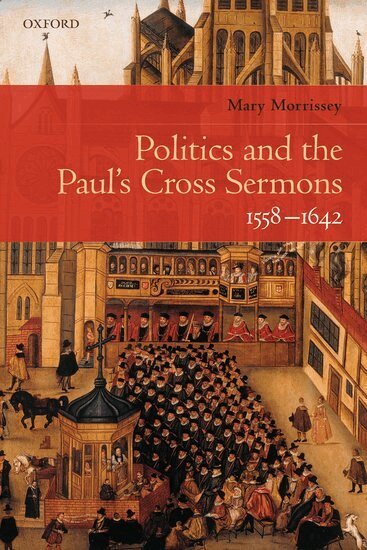
Scholars do not contest that English Reformation culture centred on 'the word preached'; that before the advent of newsbooks, sermons were the primary means available for shaping public opinion; or that the sermons of men like Lancelot Andrewes and John Donne were valued as literary works of the highest order. Throughout the Reformation period, England's most important public pulpit was Paul's Cross, which stood in the churchyard of St Paul's Cathedral in London. Politics and the Paul's Cross Sermons, 1558-1642 provides a detailed history of the Paul's Cross sermons from the reign of Elizabeth I until the destruction of the pulpit under Charles I. It explains the arrangement for the sermons' delivery and the tensions between the different authorities (the royal government, the bishops of London, and the Corporation of London) who controlled them. The increasing role that the Paul's Cross sermons played in London's civic culture after the Reformation is discussed, and an account is given of the narrowing of the sermons' audience in the years preceding the English Civil War. The book explores early modern English homiletics, so that preachers' adaptation of sermon genres to suit sermons on religious controversies or on political anniversaries (such as 5 November) can be described. The relationship between the different textual forms in which sermons are preserved is also considered.
239 kr
Tillfälligt slut
Upgrade your mind to upgrade your life.What if you could accomplish your five-year plan in a matter of months? If that sounds impossible, you're not thinking bravely. Yet.In this transformational guide to changing your life for good, personal development expert and best-selling author Mary Morrissey shows you how to move from stasis to action-by changing the stories you tell yourself. Drawing from advancements in science, timeless principles from wisdom traditions, and her personal stories and insights, Morrissey gives you the tools to overcome "common-hour thinking"-the fact-based, linear way of processing reality that measures what is possible by what resources you believe are available to you-and replace it with the powerful alternative that is brave thinking.Where common-hour thinking is limiting and uncreative, brave thinking is expansive and imaginative, not limited by time or circumstance or even the past. Brave thinkers know that before something can exist in the real world, it must first exist in your mind. Then, it must be grounded in decisive action. If you want results in life that are different from the ones you currently have, you need a different operating system for your mind. It's time to install brave thinking, and start living the life you want.