Masanao Aoki – författare
Visar alla böcker från författaren Masanao Aoki. Handla med fri frakt och snabb leverans.
16 produkter
Optimization of Stochastic Systems
Topics in Discrete-time Systems
Av Masanao Aoki
E-bok, 1967
905 kr
Lägg i varukorg
Optimization of Stochastic Systems is an outgrowth of class notes of a graduate level seminar on optimization of stochastic systems. Most of the material in the book was taught for the first time during the 1965 Spring Semester while the author was visiting the Department of Electrical Engineering, …
New Trends In Dynamic Systems Theory And Economics
Av Masanao Aoki
E-bok, 1979
717 kr
Lägg i varukorg
New Trends in Dynamic System Theory and Economics contains selected papers presented at a two-week seminar on New Trends in Dynamic System Theory and Economics held at the International Center for Mechanical Sciences in Udine, Italy, on September 12-23, 1977. Contributors discuss recent trends in …
Dynamic Analysis Of Open Economies
Av Masanao Aoki
E-bok, 2014
717 kr
Lägg i varukorg
Dynamic Analysis of Open Economies focuses on the dynamic behavior of open economies in general, and dynamic interactions among several interconnected economies in particular. The emphasis is on the techniques of dynamic analysis and on the dynamic responses of models of open economies. This book …
Applications of Computer Aided Time Series Modeling
Av Masanao Aoki, Arthur M. Havenner
Häftad, 1996
1096 kr
Lägg i varukorg
This book consists of three parts: Part One is composed of two introductory chapters. The first chapter provides an instrumental varible interpretation of the state space time series algorithm originally proposed by Aoki (1983), and gives an introductory account for incorporating exogenous signals …
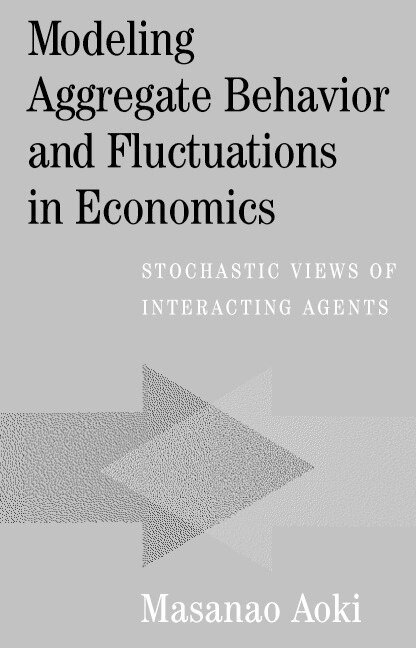
Modeling Aggregate Behavior and Fluctuations in Economics
Stochastic Views of Interacting Agents
Av Masanao Aoki
Häftad, 2004
720 kr
Lägg i varukorg
This book has two components: stochastic dynamics and stochastic random combinatorial analysis. The first discusses evolving patterns of interactions of a large but finite number of agents of several types. Changes of agent types or their choices or decisions over time are formulated as jump Markov …
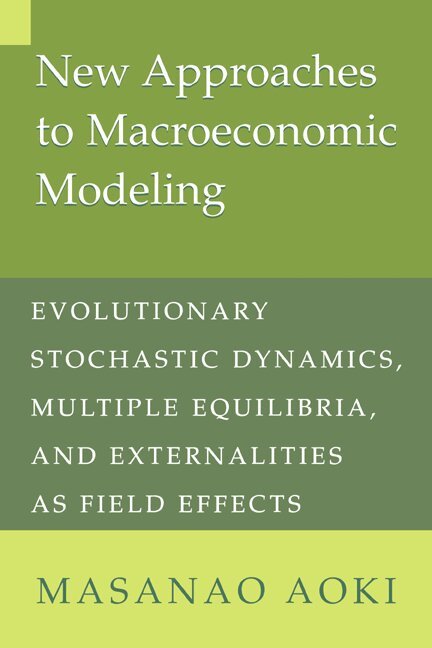
New Approaches to Macroeconomic Modeling
Evolutionary Stochastic Dynamics, Multiple Equilibria, and Externalities as Field Effects
Av Masanao Aoki
Häftad, 1998
754 kr
Lägg i varukorg
This book contributes substantively to state-of-the-art macroeconomic modeling by providing a method for modeling large collections of heterogeneous agents subject to non-pairwise externality called field effects, i.e. feedback of aggregate effects on individual agents or agents using …
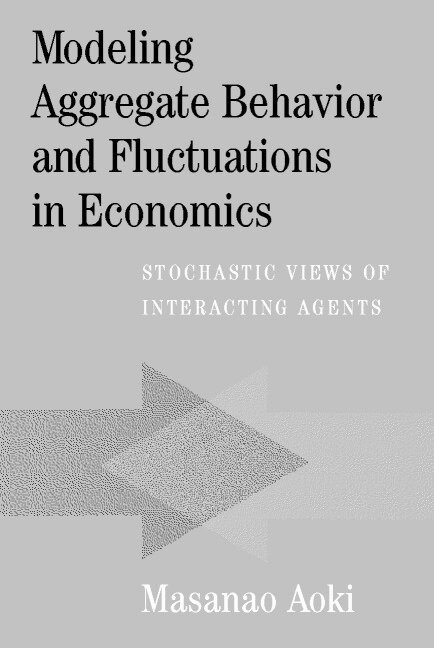
Modeling Aggregate Behavior and Fluctuations in Economics
Stochastic Views of Interacting Agents
Av Masanao Aoki
Inbunden, 2001
1844 kr
Lägg i varukorg
This book has two components: stochastic dynamics and stochastic random combinatorial analysis. The first discusses evolving patterns of interactions of a large but finite number of agents of several types. Changes of agent types or their choices or decisions over time are formulated as jump Markov …
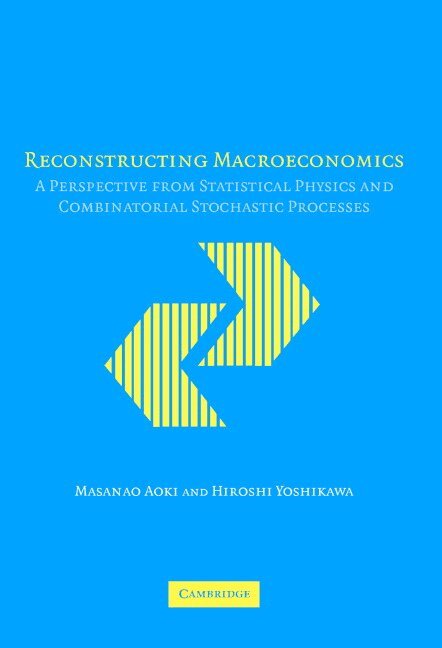
Reconstructing Macroeconomics
A Perspective from Statistical Physics and Combinatorial Stochastic Processes
Av Masanao Aoki, Hiroshi Yoshikawa
Inbunden, 2006
2029 kr
Lägg i varukorg
In this book, the authors treat macroeconomic models as composed of large numbers of micro-units or agents of several types and explicitly discuss stochastic dynamic and combinatorial aspects of interactions among them. In mainstream macroeconomics sound microfoundations for macroeconomics have …
Reconstructing Macroeconomics
A Perspective from Statistical Physics and Combinatorial Stochastic Processes
Av Masanao Aoki, Hiroshi Yoshikawa m. fl.
Häftad, 2011
754 kr
Lägg i varukorg
In this book, the authors treat macroeconomic models as composed of large numbers of micro-units or agents of several types and explicitly discuss stochastic dynamic and combinatorial aspects of interactions among them. In mainstream macroeconomics sound microfoundations for macroeconomics have …
Applications of Computer Aided Time Series Modeling
Av Arthur M. Havenner, Masanao Aoki
E-bok, 2012
1459 kr
Lägg i varukorg
This book consists of three parts: Part One is composed of two introductory chapters. The first chapter provides an instrumental varible interpretation of the state space time series algorithm originally proposed by Aoki (1983), and gives an introductory account for incorporating exogenous signals …
Optimization of Stochastic Systems
Topics in Discrete-Time Systems
Av Masanao Aoki, Richard Bellman
E-bok, 2016
807 kr
Lägg i varukorg
Optimization of Stochastic Systems
Notes on Economic Time Series Analysis: System Theoretic Perspectives
Av Masanao Aoki
Häftad, 1983
552 kr
Lägg i varukorg
In seminars and graduate level courses I have had several opportunities to discuss modeling and analysis of time series with economists and economic graduate students during the past several years. These experiences made me aware of a gap between what economic graduate students are taught about …
State Space Modeling of Time Series
Av Masanao Aoki
Häftad, 1990
552 kr
Lägg i varukorg
In this book, the author adopts a state space approach to time series modeling to provide a new, computer-oriented method for building models for vector-valued time series. This second edition has been completely reorganized and rewritten. Background material leading up to the two types of …
Notes on Economic Time Series Analysis: System Theoretic Perspectives
Av Masanao Aoki
E-bok, 2012
734 kr
Lägg i varukorg
In seminars and graduate level courses I have had several opportunities to discuss modeling and analysis of time series with economists and economic graduate students during the past several years. These experiences made me aware of a gap between what economic graduate students are taught about …
State Space Modeling of Time Series
Av Masanao Aoki
E-bok, 2013
718 kr
Lägg i varukorg
In this book, the author adopts a state space approach to time series modeling to provide a new, computer-oriented method for building models for vector-valued time series. This second edition has been completely reorganized and rewritten. Background material leading up to the two types of …
State Space Modeling of Time Series
Av Masanao Aoki
E-bok, 2013
1209 kr
Lägg i varukorg
model''s predictive capability? These are some of the questions that need to be answered in proposing any time series model construction method. This book addresses these questions in Part II. Briefly, the covariance matrices between past data and future realizations of time series are used to …