E-bok, Engelska, 2013
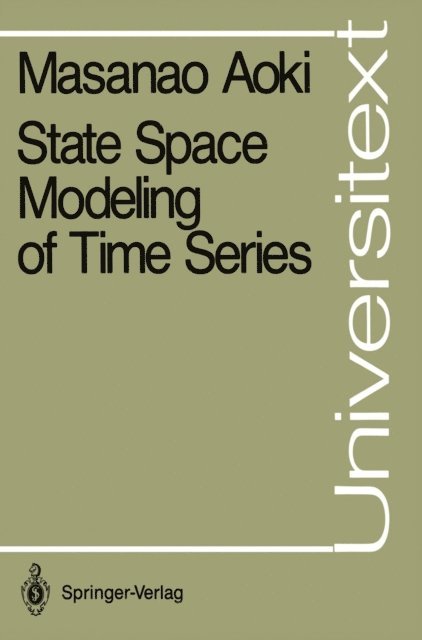
State Space Modeling of Time Series
Av Masanao Aoki
1209 kr
Läs direkt i Bokus Reader – eller ladda ned till din enhet (PDF kräver ofta zoom och scroll på små skärmar).
Beskrivning
model''s predictive capability? These are some of the questions that need to be answered in proposing any time series model construction method. This book addresses these questions in Part II. Briefly, the covariance matrices between past data and future realizations of time series are used to build a matrix called the Hankel matrix. Information needed for constructing models is extracted from the Hankel matrix. For example, its numerically determined rank will be the di mension of the state model. Thus the model dimension is determined by the data, after balancing several sources of error for such model construction. The covariance matrix of the model forecasting error vector is determined by solving a certain matrix Riccati equation. This matrix is also the covariance matrix of the innovation process which drives the model in generating model forecasts. In these model construction steps, a particular model representation, here referred to as balanced, is used extensively. This mode of model representation facilitates error analysis, such as assessing the error of using a lower dimensional model than that indicated by the rank of the Hankel matrix. The well-known Akaike''s canonical correlation method for model construc tion is similar to the one used in this book. There are some important differ ences, however. Akaike uses the normalized Hankel matrix to extract canonical vectors, while the method used in this book does not normalize the Hankel ma trix.
Produktinformation
- Utgivningsdatum: 2013-03-09
- Språk: Engelska
- Filformat: PDF
- Kopieringsskydd: LCP
- ISBN: 9783642969850
- Förlag: Springer Berlin Heidelberg
Utforska kategorier
Betyg & recensioner
0 recensioner
Inga recensioner tillgängliga.