• Fri frakt över 249 kr
  • •
  • Snabba leveranser
  • •
  • Billiga böcker
Kundservice

Du är på sajten för privatpersoner.

Företag, bibliotek eller offentlig verksamhet?

Du handlar på classic.bokus.com, där alla dina funktioner finns intakta.
Till classic.bokus.com
Bokus logotyp. Gå till startsidan.
  • Erbjudanden
  • Nyheter
  • Student
  • Topplistor
  • Barn & ungdom
  • Bokus Play
  • E-böcker
  • Pocketböcker
  • Spel & pussel

10% rabatt på allt med kod: NYSTART10 →

Sidfot

Mina sidor

    Hjälp

    • Kundservice
    • Vanliga frågor och svar
    • Frakt och leverans
    • Retur vid ångerrätt
    • Reklamera vara
    • Betalning
    • Köpvillkor
    • Allmänna villkor
    • Information om webbplatsens tillgänglighet

    Om Bokus

    • Om oss
    • Pressrum
    • För studenter
    • För företag
    • För bibliotek och offentlig verksamhet
    • För leverantörer
    • Hållbarhet

    Populärt

    • Aktuella erbjudanden
    • Presentkort
    • Studentlitteratur
    • Nya böcker
    • Topplistor
    • Signerade böcker
    • Engelska böcker

    Inspiration

    • Boktips
    • BookTok
    • Populära bokserier
    • Barnbokskaraktärer
    • Populära författare
    Logotyp för Bokus
    Följ oss på Facebook (extern länk)Följ oss på Instagram (extern länk)Följ oss på YouTube (extern länk)Följ oss på TikTok (extern länk)
    bokus @ CookiesAnpassa cookiesIntegritetspolicyKöpvillkor
    Till Citymail hemsida (extern länk)Till Budbee hemsida (extern länk)Till Postnord hemsida (extern länk)Till Schenker hemsida (extern länk)Till Early Bird hemsida (extern länk)Till Walleys hemsida (extern länk)
    1. Ekonomi och Ledarskap
    2. Nationalekonomi
    3. Mikroekonomi

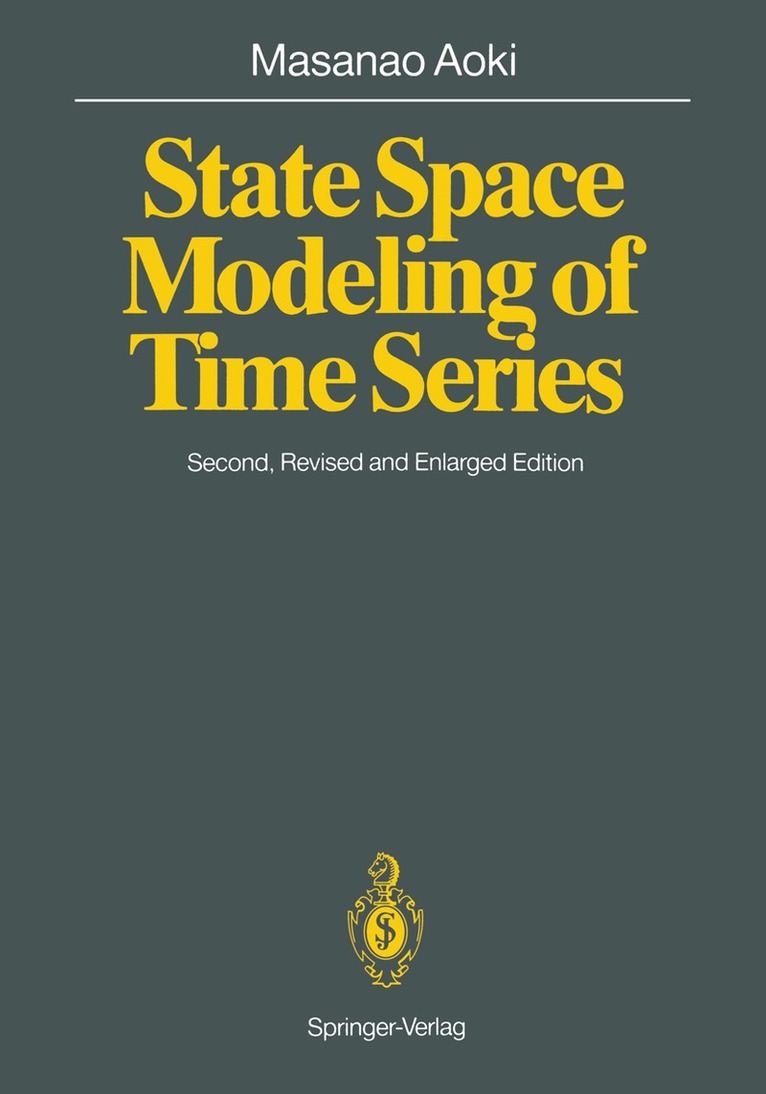
    State Space Modeling of Time Series

    AvMasanao Aoki

    Häftad, Engelska, 1990

    Del i serien Universitext

    547 kr

    Beställningsvara. Skickas inom 10-15 vardagar. Fri frakt över 249 kr.

    Fler format och utgåvor

    E-bok

    712 kr

    E-bok

    1 170 kr

    Beskrivning

    In this book, the author adopts a state space approach to time series modeling to provide a new, computer-oriented method for building models for vector-valued time series. This second edition has been completely reorganized and rewritten. Background material leading up to the two types of estimators of the state space models is collected and presented coherently in four consecutive chapters. New, fuller descriptions are given of state space models for autoregressive models commonly used in the econometric and statistical literature. Backward innovation models are newly introduced in this edition in addition to the forward innovation models, and both are used to construct instrumental variable estimators for the model matrices. Further new items in this edition include statistical properties of the two types of estimators, more details on multiplier analysis and identification of structural models using estimated models, incorporation of exogenous signals and choice of model size. A whole new chapter is devoted to modeling of integrated, nearly integrated and co-integrated time series.

    Produktinformation

    • Utgivningsdatum:1990-08-01
    • Mått:170 x 242 x 19 mm
    • Vikt:597 g
    • Format:Häftad
    • Språk:Engelska
    • Serie:Universitext
    • Antal sidor:323
    • Upplaga:2
    • Förlag:Springer-Verlag Berlin and Heidelberg GmbH & Co. KG
    • ISBN:9783540528708

    Utforska kategorier

    • Mikroekonomi inom Ekonomi och Ledarskap
    • Systemvetenskap och AI inom Data och IT
    • Matematisk statistik inom Naturvetenskap och teknik

    Innehållsförteckning

    • 1. Introduction.- 2. The Notion of State.- 3. Data Generating Processes.- 3.1 Statistical Data Descriptions.- 3.2 Spectral Factorization.- 3.3 Decomposition of Time Series.- 3.4 Minimum-Phase Transfer Function Representation.- 4. State Space and ARMA Models.- 4.1 State Space Models.- 4.2 Conversion to State Space Representation.- 4.3 Conversion of State Space Models into ARMA Models.- 5. Properties of State Space Models.- 5.1 Observability.- 5.2 Orthogonal Projections.- 6. Hankel Matrix and Singular Value Decomposition.- 6.1 The Hankel Matrix.- 6.2 Singular Value Decomposition.- 6.3 Balanced Realization of State Space Model.- 6.4 Examples with Exact Covariance Matrices.- 6.5 Hankel Norm of a Transfer Function.- 6.6 Singular Value Decomposition in the z-Domain.- 7. Innovation Models, Riccati Equations, and Multiplier Analysis.- 7.1 Innovation Models.- 7.2 Solving Riccati Equations.- 7.3 Likelihood Functions.- 7.4 Dynamic Multiplier Analysis and Structural Model Identification.- 7.5 Out-of-Sample Forecasts.- 8. State Vectors and Optimality Measures.- 8.1 Canonical Variates.- 8.2 Prediction Error.- 8.3 Singular Values and Canonical Correlation Coefficients.- 9. Estimation of System Matrices.- 9.1 Two Classes of Estimators of System Matrices.- 9.2 Properties of Balanced Models.- 9.3 Examples with Exact Covariance Matrices.- 9.4 Numerical Examples.- 9.5 Monte Carlo Experiments.- 9.6 Model Selection.- 9.7 Incorporating Exogenous Variables.- 10. Approximate Models and Error Analysis.- 10.1 Structural Sensitivity.- 10.2 Error Norms.- 10.3 Asymptotic Error Covariance Matrices of Estimators.- 10.4 Other Statistical Aspects.- 11. Integrated Time Series.- 11.1 The Beveridge and Nelson Decomposition.- 11.2 State Space Decomposition.- 11.3 Contents of Random Walk Components.- 11.4 Cointegration, Error Correction, and Dynamic Aggregation.- 11.5 Two-Step Modeling Procedure.- 11.6 Dynamic Structure of Seasonal Components.- 11.7 Large Sample Properties.- 11.8 Drifts or Linear Deterministic Trends?.- 11.9 Regime Shifts.- 11.10 Nearly Integrated Processes.- 12. Numerical Examples.- 12.1 West Germany.- 12.2 United Kingdom.- 12.3 The United States of America.- 12.4 The US and West German Real GNP Interaction.- 12.5 The US and West German Real GNP and Unemployment Rate.- 12.6 The US and Japan Real GNP Interaction.- 12.7 The USA, West Germany, and Japan Real GNP Interaction.- 12.8 Further Examples.- Appendices.- A.1 Geometry of Weakly Stationary Stochastic Sequences.- A.2 The z-Transform.- A.3 Discrete and Continuous Time System Correspondences.- A.4 Some Useful Relations for Matrix Quadratic Forms.- A.5 Computation of Sample Covariance Matrices.- A.6 Properties of Symplectic Matrices.- A.7 Common Factors in ARMA Models.- A.8 Singular Value Decomposition Theorem.- A.9 Hankel Matrices.- A. 10 Spectral Factorization.- A.11 Time Series from Intertemporal Optimization.- A. 12 Time Series from Rational Expectations Models.- A. 13 Data Sources.- References.