

Inbunden, Engelska, 1982
652 kr
Skickas inom 10-15 vardagar
652 kr
Skickas inom 10-15 vardagar
1 395 kr
Läs direkt efter köp
722 kr
Läs direkt efter köp
The purpose of this book is to analyse and interpret the present state of biculturalism in Canada. It examines the way in which English-speaking and French-speaking Canadians behave toward each other as parts of the same national whole, and the way in which the ideas of one group have been affected by those of the other. The underlying assumption of these studies is that these two groups constitute the foundation of the Canadian nation, and that the behaviour of each can only be understood in the context of its relationship with the other. The basic question raised in these studies is whether there has been communication, adjustment, and co-operation between the two cultural groups, or misunderstanding, friction, and conflict. Inevitability, since Canada has been created on the basis of compromises, the answers do not fall neatly into either category, but partly under both. This book is intended to shed some light on the questions “what is Canada?” and “How much have English-speaking Canadians and French-speaking Canadians contributed to the Canadian whole?”
Contributors include: G.V. Ferguson, Jean-C. Falardeau, Watson Kirkconnell, Louis-M. Regis, F.R. Scott, Louis Baudouin, Nathan Keyfitz, Jacques Henripin, Phillippe Gargiue, J.H. Dales, Albert Faucher, P.-E. Trudeau, Norman Ward, Gerard Pelletier, Stuart Jamieson, G.F.G. Stanley, Leopold Lamontagne, Rene Baudry, Hugh Thorburn, George F. Theirault.
L’objet de ce volume est d’étudier la coexistence de deux groupes culturels dominants dans le Canada d’aujourd’hui et, plu précisément, d’observer la manière dont les Canadiens anglais et les Canadiens français se comportent les uns envers les autres en tant qu’éléments d’une même ensemble national, et la manière dont les attitudes et les idéologies des deux groupes se sont réciproquement influences. Le postulat sur lequel reposent ces essais est que ces deux groupes constituent la substance de la nation canadienne. D’autre part, on ne peut comprendre les comportements de chacun que si on les perçoit dans la perspective des relations d’un groupe avec l’autre. La préoccupation principale a été de déterminer jusqu’à quel point, dans l’histoire récente de la coexistence canadienne, il y a eu communication, adaptions réciproque, coopération, ou inversement, mésentente, friction, conflit, entre les deux groupes. Comme le canada a été le résultat d’incessants compris, le jugement ne peut pas être nettement trance. La réalité canadienne a un caractère antinomique. En définitive, les deux questions fondamentales que nous tentons d’éclairer sont les suivantes : « Qu’est-ce que le Canada? » - « Dans quelle mesure les Canadiens anglais et les Canadiens français ont-ils respectivement contribue a l’édification d’un Canada commun? »
Collaborateurs : G.V. Ferguson, Jean-C. Falardeau, Watson Kirkconnell, Louis-M. Regis, F.R. Scott, Louis Baudouin, Nathan Keyfitz, Jacques Henripin, Phillippe Gargiue, J.H. Dales, Albert Faucher, P.-E. Trudeau, Norman Ward, Gerard Pelletier, Stuart Jamieson, G.F.G. Stanley, Leopold Lamontagne, Rene Baudry, Hugh Thorburn, George F. Theirault.
510 kr
Läs direkt efter köp
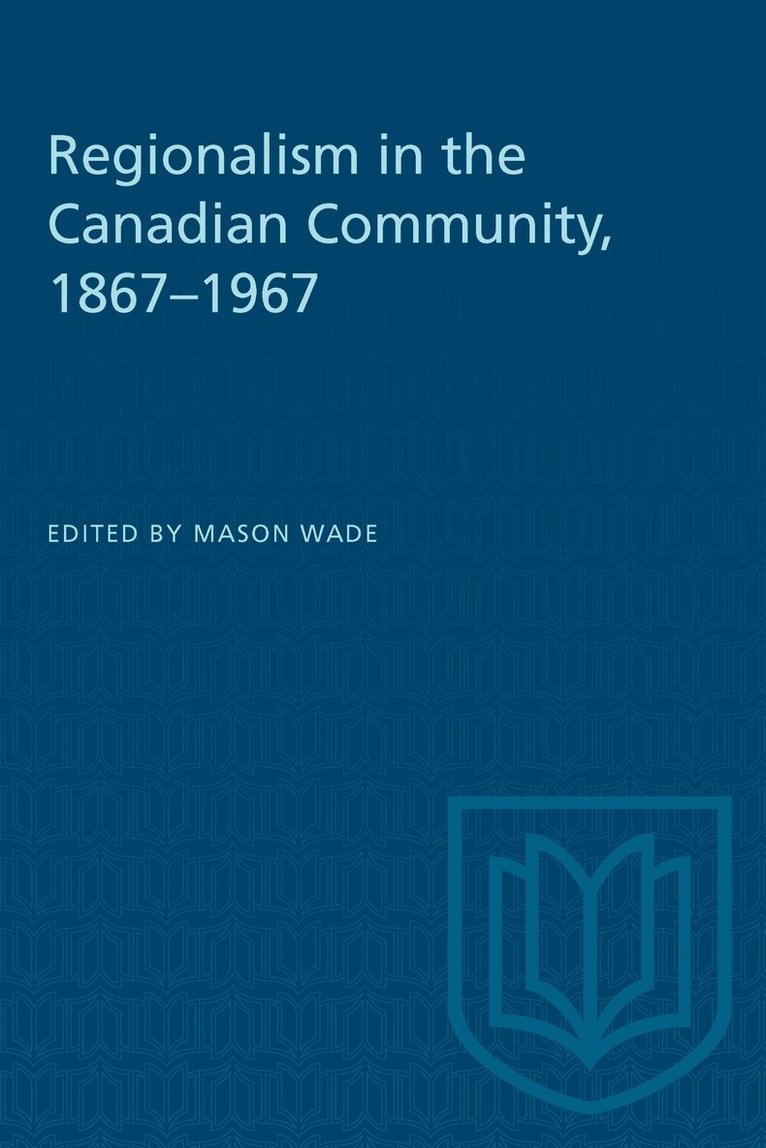
Problems of regionalism have not received much attention from historians, who have been primarily concerned with central Canada. To increase the knowledge of this neglected area of study five seminars were held in the summer of 1967 under the auspices of the Canadian Historical Association and the Association of Universities and Colleges in Canada with the help of a grant from the Centennial Commission. The five seminars, held at the universities of Saskatchewan, Victoria, Laval, Laurentian, and Memorial, discussed the same topic: Canadian regionalism since confederation. This volume includes the papers presented by twenty-one Canadian and American scholars. The papers deal with ideas and facts which in the past have not received much attention, and they provide clear evidence that there are more than the traditional two versions (English and French) of Canadian history. The wide range of opinion on basic Canadian problems will interest both the scholar and the general reader.
562 kr
Skickas inom 5-8 vardagar
410 kr
Skickas inom 5-8 vardagar