Mathias Frisch – författare
Visar alla böcker från författaren Mathias Frisch. Handla med fri frakt och snabb leverans.
7 produkter
Inconsistency, Asymmetry, and Non-Locality
A Philosophical Investigation of Classical Electrodynamics
Inbunden, 2005
1683 kr
Lägg i varukorg
Mathias Frisch provides the first sustained philosophical discussion of conceptual problems in classical particle-field theories. Part of the book focuses on the problem of a satisfactory equation of motion for charged particles interacting with electromagnetic fields. As Frisch shows, the standard …
Inconsistency, Asymmetry, and Non-Locality
A Philosophical Investigation of Classical Electrodynamics
E-bok, 2005
1082 kr
Lägg i varukorg
Mathias Frisch provides the first sustained philosophical discussion of conceptual problems in classical particle-field theories. Part of the book focuses on the problem of a satisfactory equation of motion for charged particles interacting with electromagnetic fields. As Frisch shows, the standard …
Inconsistency, Asymmetry, and Non-Locality
A Philosophical Investigation of Classical Electrodynamics
E-bok, 2005
1082 kr
Lägg i varukorg
Mathias Frisch provides the first sustained philosophical discussion of conceptual problems in classical particle-field theories. Part of the book focuses on the problem of a satisfactory equation of motion for charged particles interacting with electromagnetic fields. As Frisch shows, the standard …
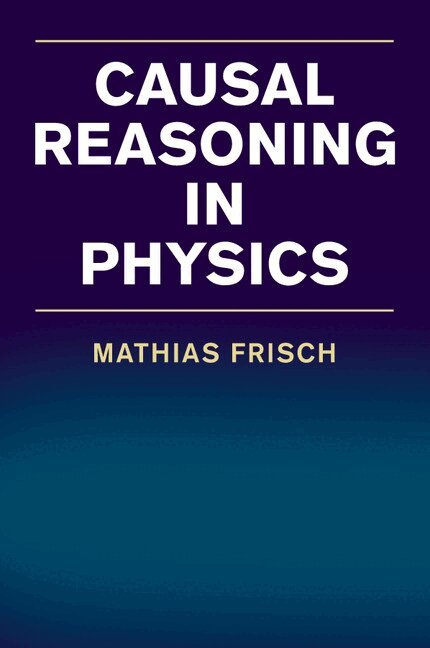
Causal Reasoning in Physics
Inbunden, 2014
1593 kr
Lägg i varukorg
Much has been written on the role of causal notions and causal reasoning in the so-called 'special sciences' and in common sense. But does causal reasoning also play a role in physics? Mathias Frisch argues that, contrary to what influential philosophical arguments purport to show, the answer is …
Causal Reasoning in Physics
Häftad, 2017
569 kr
Lägg i varukorg
Much has been written on the role of causal notions and causal reasoning in the so-called 'special sciences' and in common sense. But does causal reasoning also play a role in physics? Mathias Frisch argues that, contrary to what influential philosophical arguments purport to show, the answer is …
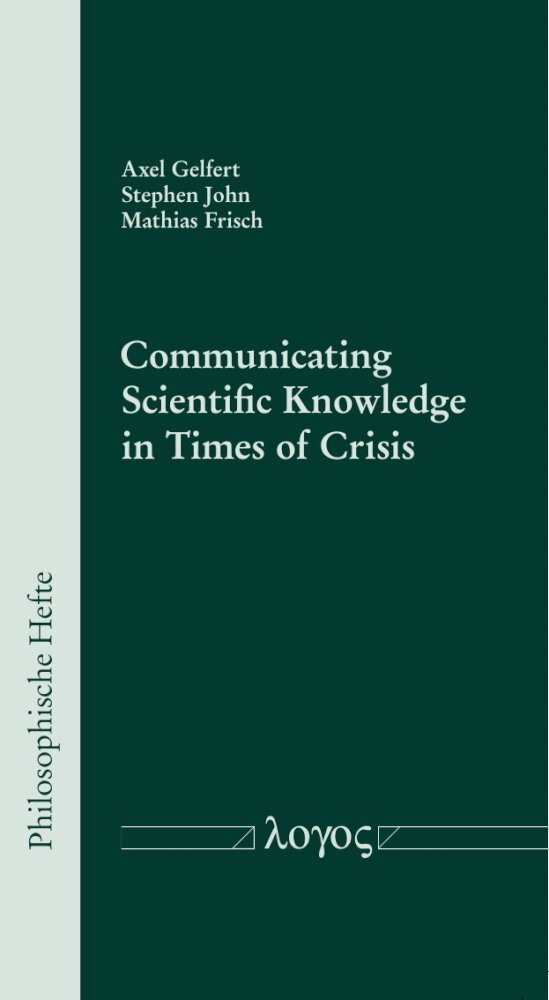
Communicating Scientific Knowledge in Times of Crisis
Av Axel Gelfert, Stephen John m. fl.
Häftad, 2025
479 kr
Lägg i varukorg
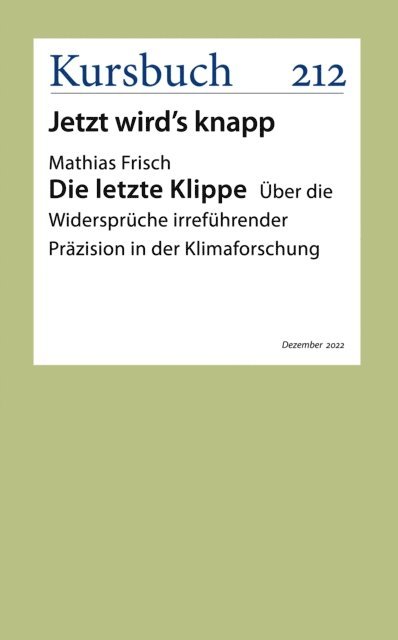
Die letzte Klippe
Über die Widersprüche irreführender Präzision in der Klimaforschung
E-bok, 2022
15 kr
Lägg i varukorg
Das Kursbuch 212 beschäftigt sich mit der Frage, wie der Umgang mit knappen Gütern beziehungsweise mit Knappheit vor sich geht. In dem Beitrag von Mathias Frisch geht es um die im Hinblick aufs Klima wirklich knapp werdenden Zeit. Er zeigt, dass man dabei nicht zu knapp kalkulieren sollte. Wer die …