Matthew Craven - Böcker
Visar alla böcker från författaren Matthew Craven. Handla med fri frakt och snabb leverans.
8 produkter
8 produkter
The Decolonization of International Law
State Succession and the Law of Treaties
Inbunden, Engelska, 2007
1 817 kr
Skickas inom 5-8 vardagar
The issue of state succession continues to be a vital and complex focal point for public international lawyers, yet it has remained strangely resistant to effective articulation. The formative period in this respect was that of decolonization which marked for many the time when international law came of age and when the promises of the UN Charter would be realized in an international community of sovereign peoples. Throughout the 1990s a series of territorial adjustments placed succession once again at the centre of international legal practice, in new contexts that went beyond the traditional model of decolonization: the disintegration of the Soviet Union, Yugoslavia, and Czechoslovakia, and the unifications of Germany and Yemen brought to light the fundamentally unresolved character of issues within the law of succession.Why have attempts to codify the practice of succession met with so little success? Why has succession remained so problematic a feature of international law? This book argues that the answers to these questions lie in the political backdrop of decolonization and self-determination, and that the tensions and ambiguities that run throughout the law of succession can only be understood by looking at the historical relationship between discourses on state succession, decolonization, and imperialism within the framework of international law.
The Decolonization of International Law
State Succession and the Law of Treaties
Häftad, Engelska, 2009
692 kr
Skickas inom 7-10 vardagar
The issue of state succession continues to be a vital and complex focal point for public international lawyers, yet it has remained strangely resistant to effective articulation. The formative period in this respect was that of decolonization which marked for many the time when international law 'came of age' and when the promises of the UN Charter would be realized in an international community of sovereign peoples. Throughout the 1990s a series of territorial adjustments placed succession once again at the centre of international legal practice, in new contexts that went beyond the traditional model of decolonization: the disintegration of the Soviet Union, Yugoslavia, and Czechoslovakia, and the unifications of Germany and Yemen brought to light the fundamentally unresolved character of issues within the law of succession. Why have attempts to codify the practice of succession met with so little success? Why has succession remained so problematic a feature of international law? This book argues that the answers to these questions lie in the political backdrop of decolonization and self-determination, and that the tensions and ambiguities that run throughout the law of succession can only be understood by looking at the relationship between discourses on state succession, decolonization, and imperialism within the framework of international law.
2 000 kr
Skickas inom 7-10 vardagar
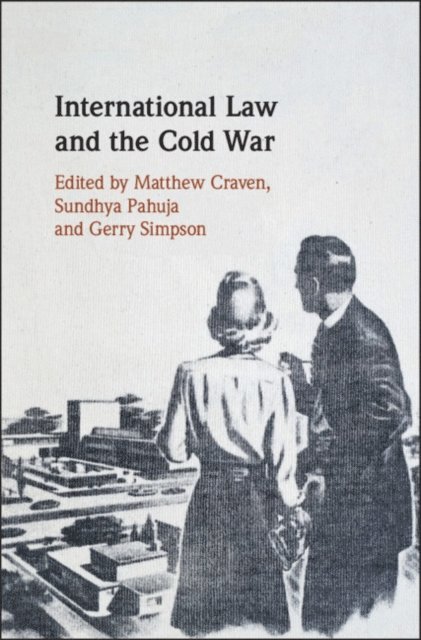
International Law and the Cold War is the first book dedicated to examining the relationship between the Cold War and International Law. The authors adopt a variety of creative approaches - in relation to events and fields such as nuclear war, environmental protection, the Suez crisis and the Lumumba assassination - in order to demonstrate the many ways in which international law acted upon the Cold War and in turn show how contemporary international law is an inheritance of the Cold War. Their innovative research traces the connections between the Cold War and contemporary legal constructions of the nation-state, the environment, the third world, and the refugee; and between law, technology, science, history, literature, art, and politics.
672 kr
Skickas inom 7-10 vardagar
International Law and the Cold War is the first book dedicated to examining the relationship between the Cold War and International Law. The authors adopt a variety of creative approaches - in relation to events and fields such as nuclear war, environmental protection, the Suez crisis and the Lumumba assassination - in order to demonstrate the many ways in which international law acted upon the Cold War and in turn show how contemporary international law is an inheritance of the Cold War. Their innovative research traces the connections between the Cold War and contemporary legal constructions of the nation-state, the environment, the third world, and the refugee; and between law, technology, science, history, literature, art, and politics.
Del 200 - Cambridge Studies in International and Comparative Law
Rival Legalities
International Laws of the Cold War
Häftad, Engelska, 2026
594 kr
Kommande
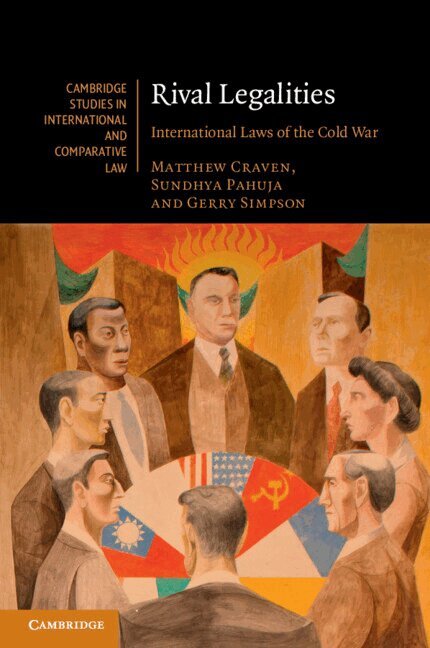
This book offers a wholly new way of thinking about the ideas, struggles and practices that constituted the "historical" Cold War. It challenges dominant myths about the history of the Cold War, arguing that far from being consumed by their ideological rivalry, the US and the Soviet Union were engaged in a conjoint project of world ordering. This idea of a unified Amero-Soviet project brings into view the many ways in which the Cold War was continuous with the imperialisms it displaced. Against this unity though, a rich plurality of law and legal forms emerged, and practices of South-South and South-North solidarity were forged which have since been obscured. The book makes visible the patterns drawn by the aftermath of this 'Cold War' legal order and seeks to both recuperate the imaginative resources that were made available at the time, and provide a corrective to contemporary prognostications that the 'rule-based order' may be nearing its end.
Del 200 - Cambridge Studies in International and Comparative Law
Rival Legalities
International Laws of the Cold War
Inbunden, Engelska, 2026
1 612 kr
Kommande
This book offers a wholly new way of thinking about the ideas, struggles and practices that constituted the "historical" Cold War. It challenges dominant myths about the history of the Cold War, arguing that far from being consumed by their ideological rivalry, the US and the Soviet Union were engaged in a conjoint project of world ordering. This idea of a unified Amero-Soviet project brings into view the many ways in which the Cold War was continuous with the imperialisms it displaced. Against this unity though, a rich plurality of law and legal forms emerged, and practices of South-South and South-North solidarity were forged which have since been obscured. The book makes visible the patterns drawn by the aftermath of this 'Cold War' legal order and seeks to both recuperate the imaginative resources that were made available at the time, and provide a corrective to contemporary prognostications that the 'rule-based order' may be nearing its end.
476 kr
Tillfälligt slut
Utilizing found images from textbooks along with his own geometric patterns, Matthew Craven’s collages and illustrations seek to create a new handmade universe, juxtaposing imagery from different cultures and time periods to celebrate commonalities. Photographs of archaeological remains and the natural world are overlaid on colorful tiled backgrounds drawn on the back of vintage movie posters, to create a hypnotic and mesmerizing vernacular of symbols and designs. Featuring an introduction by LACMA curator Leslie Jones, Primer, is the first publication of Craven’s art and a reconfiguration of traditional historical narratives inspired by obsessive formations.
686 kr
Skickas inom 5-8 vardagar
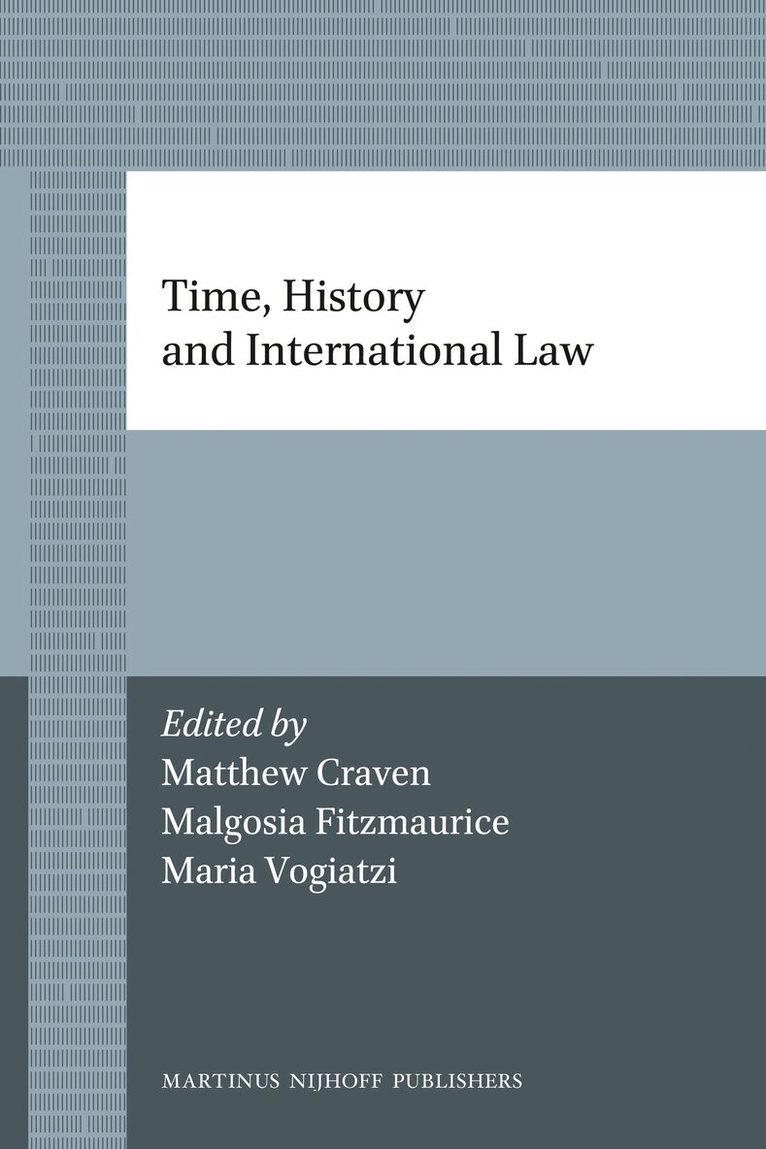
This book examines theoretical and practical issues concerning the relationship between international law, time and history. Problems relating to time and history are ever-present in the work of international lawyers, whether understood in terms of the role of historic practice in the doctrine of sources, the application of the principle of inter-temporal law in dispute settlement, or in gaining a coherent insight into the role that was played by international law in past events. But very little has been written about the various different ways in which international lawyers approach or understand the past, and it is with a view to exploring the dynamics of that engagement that this book has been compiled. In its broadest sense, it is possible to identify at least three different ways in which the relationship between international law and (its) history may be conceived. The first is that of a history of international law written in narrative form, and mapped out in terms of a teleology of origins, development, progress or renewal. The second is that of history in international law and of the role history plays in arguments about law itself (for example in the construction of customary international law). The third way of understanding that relationship is in terms of international law in history: of understanding how international law has been engaged in the creation of a history that in some senses stands outside the history of international law itself. The essays in this collection make clear that each type of engagement with history and international law interweaves various different types of historical narrative, pointing to the typically multi-layered nature of international lawyers’ engagement with the past and its importance in shaping the present and future of international law. Originally published in hardcover