Matthew H. Sommer – författare
Visar alla böcker från författaren Matthew H. Sommer. Handla med fri frakt och snabb leverans.
4 produkter
4 produkter
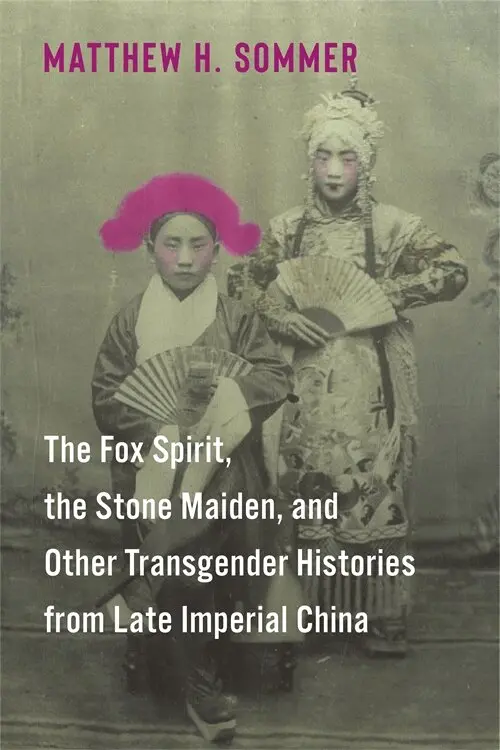
The Fox Spirit, the Stone Maiden, and Other Transgender Histories from Late Imperial China
Inbunden, Engelska, 2024
1 147 kr
Skickas inom 7-10 vardagar
Winner, 2025 John K. Fairbank Prize in East Asian history since 1800, American Historical AssociationCo-winner, 2025 John Boswell Prize, LGBTQ+ History AssociationWinner, 2025 Peter Gonville Stein Book Award, American Society for Legal HistoryFinalist, 2025 Lambda Literary Award for LGBTQ+ StudiesWinner, 2025 Choice Outstanding Academic TitleIn imperial China, people moved away from the gender they were assigned at birth in different ways and for many reasons. Eunuchs, boy actresses, and clergy left behind normative gender roles defined by family and procreation. “Stone maidens”—women deemed physically incapable of vaginal intercourse—might depart from families or marriages to become Buddhist or Daoist nuns. Anatomical males who presented as women sometimes took a conventionally female occupation such as midwife, faith healer, or even medium to a fox spirit. Yet they were often punished harshly for the crime of “masquerading in women’s attire,” suspected of sexual predation, even when they had lived peacefully in their communities for many years.Exploring these histories and many more, this book is a groundbreaking study of transgender lives and practices in late imperial China. Through close readings of court cases, as well as Ming and Qing fiction and nineteenth-century newspaper accounts, Matthew H. Sommer examines the social, legal, and cultural histories of gender crossing. He considers a range of transgender experiences, illuminating how certain forms of gender transgression were sanctioned in particular social contexts and penalized in others. Sommer scrutinizes the ways Qing legal authorities and literati writers represented and understood gender-nonconforming people and practices, contrasting official ideology with popular mentalities. An unprecedented account of China’s transgender histories, this book also sheds new light on a range of themes in Ming and Qing law, religion, medicine, literature, and culture.
The Fox Spirit, the Stone Maiden, and Other Transgender Histories from Late Imperial China
Häftad, Engelska, 2024
292 kr
Skickas inom 7-10 vardagar
Winner, 2025 John K. Fairbank Prize in East Asian history since 1800, American Historical AssociationCo-winner, 2025 John Boswell Prize, LGBTQ+ History AssociationWinner, 2025 Peter Gonville Stein Book Award, American Society for Legal HistoryFinalist, 2025 Lambda Literary Award for LGBTQ+ StudiesWinner, 2025 Choice Outstanding Academic TitleIn imperial China, people moved away from the gender they were assigned at birth in different ways and for many reasons. Eunuchs, boy actresses, and clergy left behind normative gender roles defined by family and procreation. “Stone maidens”—women deemed physically incapable of vaginal intercourse—might depart from families or marriages to become Buddhist or Daoist nuns. Anatomical males who presented as women sometimes took a conventionally female occupation such as midwife, faith healer, or even medium to a fox spirit. Yet they were often punished harshly for the crime of “masquerading in women’s attire,” suspected of sexual predation, even when they had lived peacefully in their communities for many years.Exploring these histories and many more, this book is a groundbreaking study of transgender lives and practices in late imperial China. Through close readings of court cases, as well as Ming and Qing fiction and nineteenth-century newspaper accounts, Matthew H. Sommer examines the social, legal, and cultural histories of gender crossing. He considers a range of transgender experiences, illuminating how certain forms of gender transgression were sanctioned in particular social contexts and penalized in others. Sommer scrutinizes the ways Qing legal authorities and literati writers represented and understood gender-nonconforming people and practices, contrasting official ideology with popular mentalities. An unprecedented account of China’s transgender histories, this book also sheds new light on a range of themes in Ming and Qing law, religion, medicine, literature, and culture.
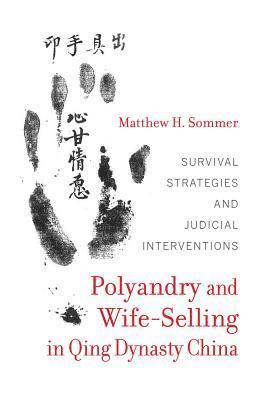
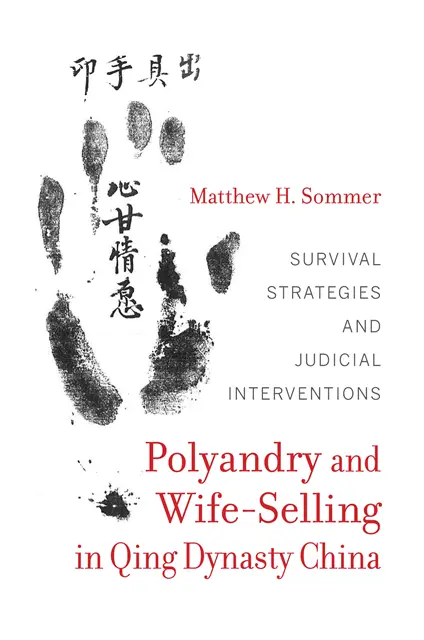
Polyandry and Wife-Selling in Qing Dynasty China
Survival Strategies and Judicial Interventions
Inbunden, Engelska, 2015
659 kr
Skickas inom 7-10 vardagar
This book is a study of polyandry, wife-selling, and a variety of related practices in China during the Qing dynasty (1644-1912). By analyzing over 1200 legal cases from local and central court archives, Matthew Sommer explores the functions played by marriage, sex, and reproduction in the survival strategies of the rural poor under conditions of overpopulation, worsening sex ratios, and shrinking farm sizes. Polyandry and wife-selling represented opposite ends of a spectrum of strategies. At one end, polyandry was a means to keep the family together by expanding it. A woman would bring in a second husband in exchange for his help supporting her family. In contrast, wife sale was a means to survive by breaking up a family: a husband would secure an emergency infusion of cash while his wife would escape poverty and secure a fresh start with another man. Even though Qing law prohibited both practices under the rubric "illicit sexual relations," Sommer shows how magistrates charged with propagating and enforcing a fundamentalist Confucian vision of female chastity tried to cope with their social reality in the face of daunting poverty.This contradiction illuminates both the pragmatism of routine adjudication and the increasingly dysfunctional nature of the dynastic state in the face of mounting social crisis. By casting a spotlight on the rural poor and the experiences of both men and women, Sommer provides an alternative to the standard paradigms of women's history that have long dominated scholarship on gender and sexuality in late imperial China.
338 kr
Skickas inom 10-15 vardagar
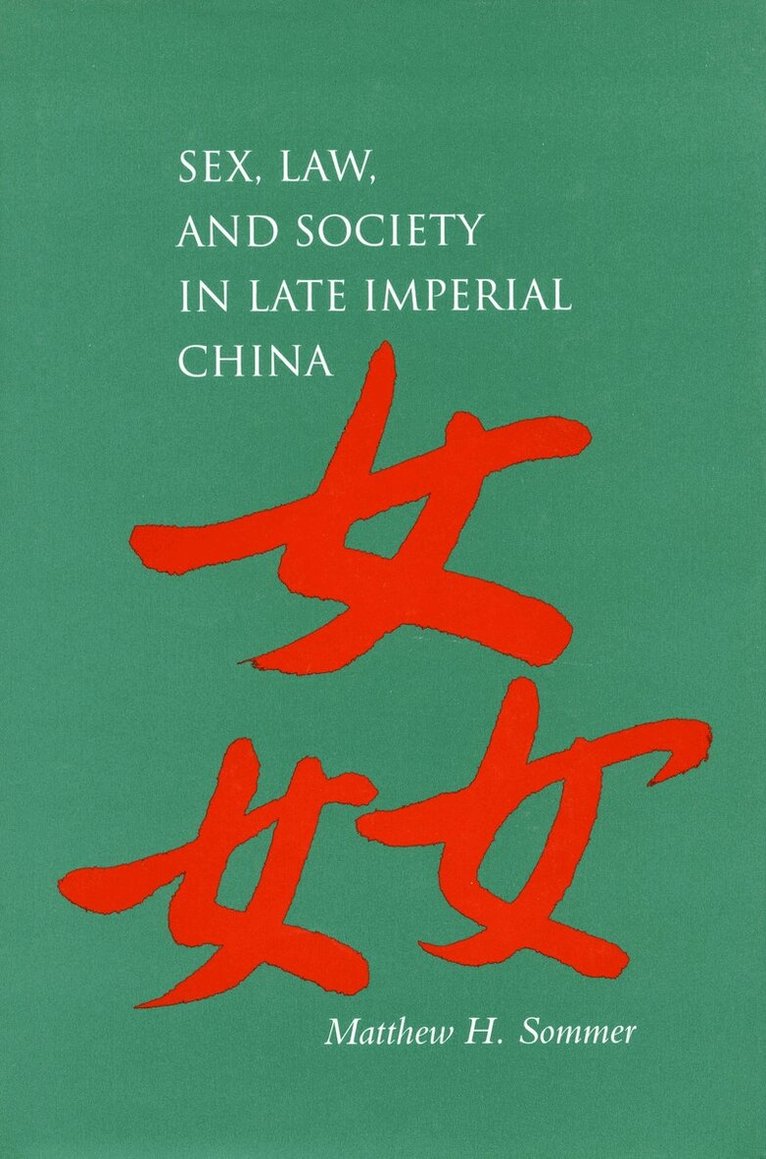
This study of the regulation of sexuality in the Qing dynasty explores the social context for sexual behavior criminalized by the state, arguing that the eighteenth century in China was a time of profound change in sexual matters. During this time, the basic organizing principle for state regulation of sexuality shifted away from status, under which members of different groups had long been held to distinct standards of familial and sexual morality. In its place, a new regime of gender mandated a uniform standard of sexual morality and criminal liability across status boundaries—all people were expected to conform to gender roles defined in terms of marriage.This shift in the regulation of sexuality, manifested in official treatment of charges of adultery, rape, sodomy, widow chastity, and prostitution, represented the imperial state's efforts to cope with disturbing social and demographic changes. Anachronistic status categories were discarded to accommodate a more fluid social structure, and the state initiated new efforts to enforce rigid gender roles and thus to shore up the peasant family against a swelling underclass of single, rogue males outside the family system. These men were demonized as sexual predators who threatened the chaste wives and daughters (and the young sons) of respectable households, and a flood of new legislation targeted them for suppression.In addition to presenting official and judicial actions regarding sexuality, the book tells the story of people excluded from accepted patterns of marriage and household who bonded with each other in unorthodox ways (combining sexual union with resource pooling and fictive kinship) to satisfy a range of human needs. This previously invisible dimension of Qing social practice is brought into sharp focus by the testimony, gleaned from local and central court archives, of such marginalized people as peasants, laborers, and beggars.