Matthew R. Kerbel - Böcker
Visar alla böcker från författaren Matthew R. Kerbel. Handla med fri frakt och snabb leverans.
2 produkter
2 produkter
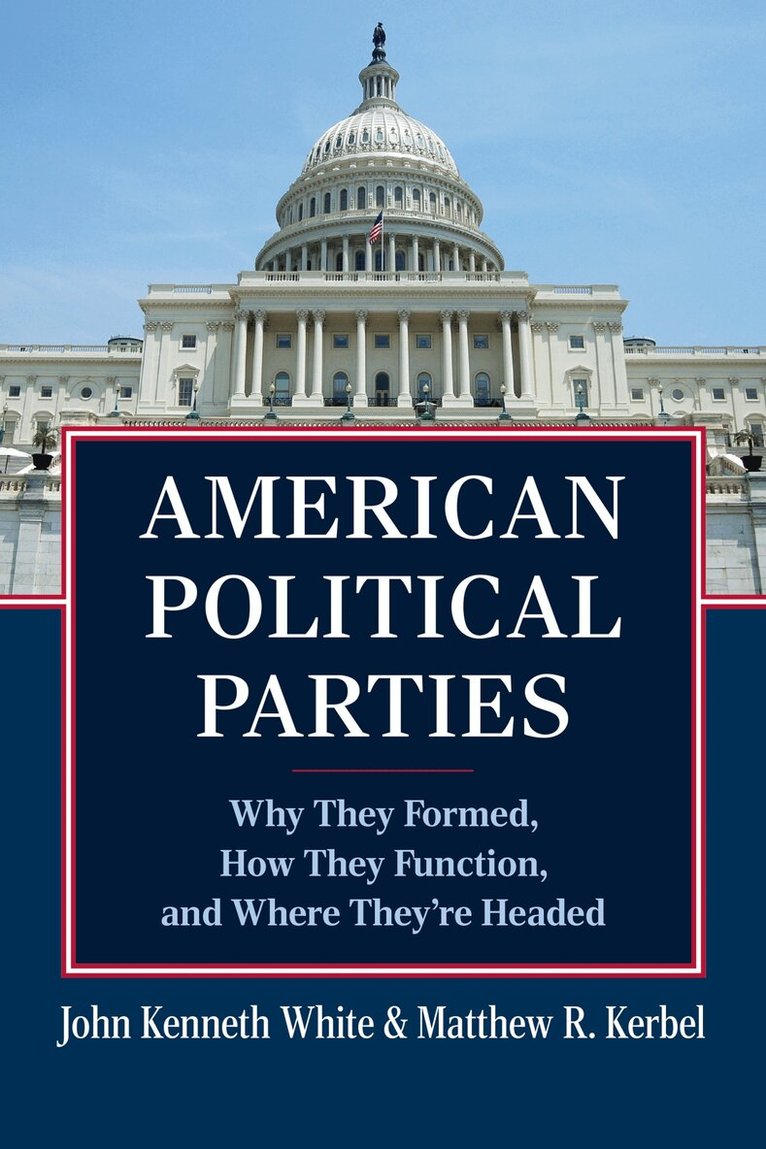
American Political Parties
Why They Formed, How They Function, and Where They're Headed
Häftad, Engelska, 2022
313 kr
Skickas inom 10-15 vardagar
American Political Parties is a core textbook on political parties in the United States that places the US party system into a framework designed around the disagreements between Alexander Hamilton and Thomas Jefferson. White and Kerbel argue that the two-party system in the United States began with a common agreement on the key values of freedom, individual rights, and equality of opportunity but that Hamilton and Jefferson disagreed—often vehemently—over how to translate these ideals into an acceptable form of governance. This text develops a unique historical perspective of US party development using the disagreements between Alexander Hamilton and Thomas Jefferson as a framework for analysis.While Hamilton wanted to marry freedom to a strong, active federal government with an energetic president who would act on behalf of all citizens, Jefferson believed that freedom should be allied to local civic virtue, with governmental responsibilities placed primarily at the local level. Today, Hamiltonian nationalism finds its home in the Democratic Party, while Republicans have espoused Jeffersonian localism since 1964. Using this historical framework, American Political Parties examines a range of topics including marketing and social media, campaign finance, reforms in the presidential nominating process, political demography, and third parties. In this new edition (previously published as Party On!), the authors describe four possible futures in the wake of the 2020 election and why Americans believed it was “the most important” election in their lifetimes.The unique history of US political parties as set forth by the disagreements between Alexander Hamilton and Thomas Jefferson is at an inflection point. Republicans have become an insurgent party fully under the control of Donald Trump while Democrats have an opportunity to create a new majority coalition. This juncture poses unique challenges to our democracy and constitutional framework, and the book describes four possible outcomes, postulating where American political parties are headed in this decade.
271 kr
Kommande
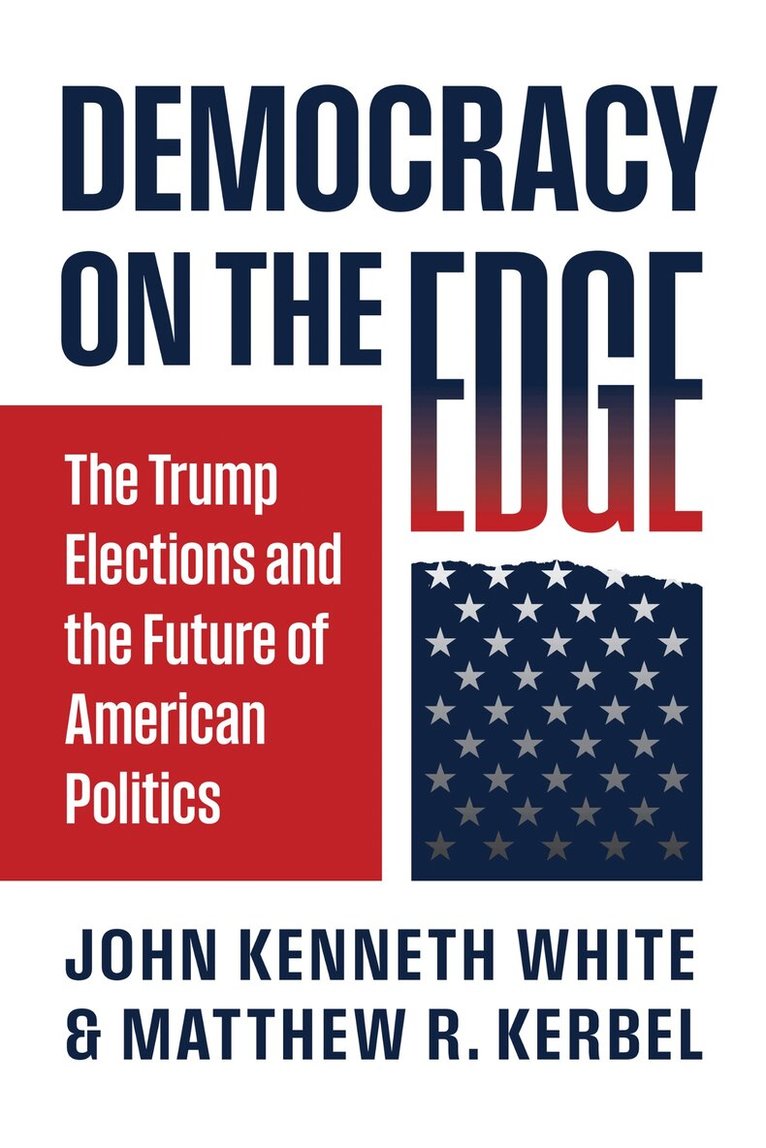
A provocative and timely examination of how the American political parties have brought us to a crossroads for democracy—and where these new paths lead for the fragile American republic.Our recent elections have been anything but normal. In Democracy on the Edge, leading political scientists John Kenneth White and Matthew R. Kerbel unravel the elections of 2020, 2022, and 2024 to show how each represented a flashpoint in the reordering of political priorities and electoral coalitions. The consequences have the potential to redefine our politics and shape our democracy for years to come. In 2020, American voters temporarily removed an authoritarian leader, only for this leader to instigate an insurrection attempt on January 6, 2021. The midterm election of 2022 broke with precedent on the basis of the public’s response to the historic overturning of Roe v. Wade and the fallout from J6, as voters rejected election deniers and MAGA candidates across the board. In 2024, however, voters could not reject this threat to democracy a third time, and Trump’s return to the White House has instead left the country at a crossroads and a moment of peril.In unpacking recent electoral cycles and placing them in broader historical context, White and Kerbel show that both major parties face unique difficulties. After Barack Obama’s election, Democrats believed they were on the cusp of securing a majority that heralded a new era of political realignment around their multiracial dominance. That majority has not yet materialized. Meanwhile, Donald Trump’s hostile takeover of the Republican Party has transformed the GOP into a party completely beholden to him, embracing election denialism, conspiracy theories, and policies that are far out of step with the country beyond his base. The efforts of Republicans and Democrats are buffeted by dramatic and unpredictable cultural and economic shifts. The generational divide between Baby Boomers and Gen X on one side and Millennials and Gen Z on the other has become a fault line of lived experiences, cultural values, financial realities, and political beliefs. This is all further complicated by chaotic realignments on lines of race and gender.And underneath it all is a political system under unprecedented pressure. Our democracy faces its most severe test since the Civil War. The aspirations contained in the Declaration of Independence and the systems built by the Constitution are no longer universally accepted. The Republican Party, led by Trump, seeks to accelerate the accumulation of presidential power and limit the Constitution’s phraseology of “We, the People” to “We, the Wealthy” or “We, the Cultural Warriors.” The final denouement of this political saga has yet to be written, but Trump’s election leaves us with the possibility of two unfamiliar outcomes—a brand of American authoritarianism or the establishment of a multicultural republic.At the close of the Constitutional Convention, Benjamin Franklin was asked by a bystander what kind of government the framers had wrought. Franklin’s famous answer was, “A republic, if you can keep it.” Keeping the republic will depend on the fallout from the last three unprecedented election cycles. Ultimately, our future is up to us.