Matti Palo - Böcker
Visar alla böcker från författaren Matti Palo. Handla med fri frakt och snabb leverans.
10 produkter
10 produkter
1 593 kr
Skickas inom 10-15 vardagar
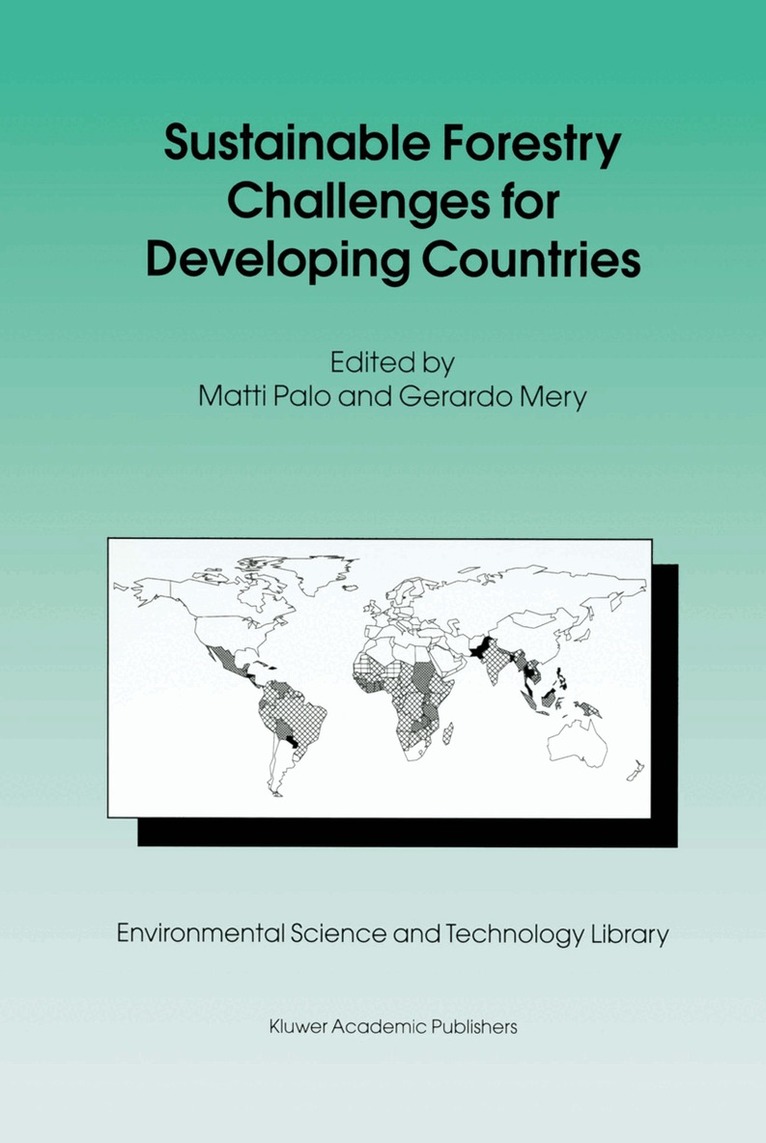
This volume addresses the acute challenges of sustainable forestry with emphasis on the developing countries. Sustainability is analyzed from its diametrically opposite deforestation point of view. A multilevel approach is adopted to take into account that the causes of deforestation occur at the local, national and international levels. Accordingly, the volume contains contributions at global, continental, national, and subnational levels. The contributions are also of a multidisciplinary character and represent issues such as forest economics and policy, forest mensurations and inventory, tropical silviculture, land use economics, environmental economics and history, as well as geography and political history. One of the aims of this volume is to present a collective analysis of deforestation and sustainability using the most up-to-date, reliable and valid empirical data. The authors have been among the first scientists in the world to have had access to the new FORIS database recently established by the FAO.
2 121 kr
Skickas inom 10-15 vardagar
This volume addresses global and regional issues concerning the world's forests, societies and the environment from an independent and non-governmental point of view. A main message is that co-operation on a global scale is not only commendable, but essential if solutions to the problems facing the world's forests are to be found. To achieve this, modern science needs to find a clearer picture of relationships between forests, human activity and the environment and of the consequences of environmental change for the ability of societies to survive. Part I, Editorial Perspectives, analyzes the ongoing globalization processes of forests, societies and the environment. Part II, Society and Environment, reviews worldwide trends with significance for the future of forests and forestry. While the trends are influenced by forest sector issues, that sector is influenced to a much larger extent by external factors - such as demography, urbanization, or technological development.Part III, Importance of Forests, looks at the value of the goods and services of forests - tangible and intangible, market and non-market - and concludes that failure to recognize their full value is one of the crucial impediments to sustainable development. In Part IV, Global Forum, scientists take up global forestry themes - deforestation, trade and the environment, climate change, biodiversity - with the aim of stimulating wider discussion. Part V, Regional Forum, looks at major themes of particular relevance to Africa, Asia-Pacific, Latin America, North America and Europe, such as farm and agroforestry, corruption and concessions, urban forestry and environmental conflicts. Part VI introduces the special theme - forest sectors in transition economies. Teams of scientists from Russia and China focus on the implications of the transition from plan to market economy, illuminating both the very different nature of the forest sector in the two countries and the different transition paths that they have adopted. In the 20th century, the entire world has been discovered.Since 1950, the contribution of forests to the economy worldwide has been perceived, while only recently have their societal and environmental benefits been globally recognized. Globalization is a demanding process requiring knowledge and information. This book offers knowledge, facts and information - but also values from diverse human and cultural perspectives - about world forests, society and environment to help us towards equity in our use of the global forest.
2 121 kr
Skickas inom 10-15 vardagar
This text addresses late 20th-century global and regional issues concerning the world's forests, societies and the environment from an independent and non-governmental point of view. A main message is that co-operation on a global scale is not only commendable, but essential if solutions to the problems facing the world's forests are to be found. To achieve this, modern science needs to find a clearer picture of relationships between forests, human activity and the environment and of the consequences of environmental change for the ability of societies to survive. Part I, Editorial Perspectives, is analyzing the ongoing globalization processes of forests, societies and the environment. Part II, Society and Environment, reviews worldwide trends with significance for the future of forests and forestry. While the trends are influenced by forest sector issues, that sector is influenced to a much larger extent by external factors - such as demography, urbanization, or technological development.Part III, Importance of Forests, looks at the value of the goods and services of forests - tangible and intangible, market and non-market - and concludes that failure to recognize their full value is one of the crucial impediments to sustainable development. In Part IV, Global Forum, scientists take up global forestry themes - deforestation, trade and the environment, climate change, biodiversity - with the aim of stimulating wider discussion. Part V, Regional Forum, looks at major themes of particular relevance to Africa, Asia-Pacific, Latin America, North America and Europe, such as farm and agroforestry, corruption and concessions, urban forestry and environmental conflicts. Part VI introduces the special theme - forest sectors in transition economies. Teams of scientists from Russia and China focus on the implications of the transition from plan to market economy, illuminating both the very different nature of the forest sector in the two countries and the different transition paths that they have adopted. In the past millennium the entire world has been discovered.In the past half century the contribution of forests to the economy worldwide has been perceived, while only recently have their societal and environmental benefits been globally recognized. Globalization is a demanding process requiring knowledge and information. This book offers knowledge, facts and information - but also values from diverse human and cultural perspectives - about world forests, society and environment to help us towards equity in our use of the global forest.
1 064 kr
Skickas inom 10-15 vardagar
This book reports one part of the findings tive, due to vested national and internation- of the research project The Forests in the al interests. South and North - Transition from Defor- This book presents a set of new research estation to Sustainable Forest Policies in findings emerging from our comprehensive Redressing Global Warming. The project research project. The book can be regard- was coordinated and partly funded by the ed as a follow-up to and elaboration of our World Institute for Development Econom- previous research published in 1996 by Kluwer Academic Publishers, Sustainable ics Research of the United Nations University (UNUIWIDER). The Finnish Forestry ChallengesforDeveloping Coun- Forest Research Institute (METLA) and the tries, edited by Matti Palo and Gerardo Institute for Applied Economic Research Mery. (IPEAIDIPES) in Brazil were among the To facilitate coordination, interaction eleven implementing institutesthat contrib- and exchange of information the project uted financially to the research. Director organized three workshops between 1994 Eustaquio J. Reis from IPEA served as the and 1996.The first and last workshops were External Project Coordinator in Rio de Ja- held in Finland and the second one in In- neiro while I acted as the External Project donesia, in cooperation with the Center for Director in Helsinki.International Forest Research (CIFOR).
1 064 kr
Skickas inom 10-15 vardagar
This book reports one part of the findings tive, due to vested national and internation- of the research project The Forests in the al interests. South and North - Transition from Defor- This book presents a set of new research estation to Sustainable Forest Policies in findings emerging from our comprehensive Redressing Global Warming. The project research project. The book can be regard- was coordinated and partly funded by the ed as a follow-up to and elaboration of our World Institute for Development Econom- previous research published in 1996 by Kluwer Academic Publishers, Sustainable ics Research of the United Nations University (UNUIWIDER). The Finnish Forestry ChallengesforDeveloping Coun- Forest Research Institute (METLA) and the tries, edited by Matti Palo and Gerardo Institute for Applied Economic Research Mery. (IPEAIDIPES) in Brazil were among the To facilitate coordination, interaction eleven implementing institutesthat contrib- and exchange of information the project uted financially to the research. Director organized three workshops between 1994 Eustaquio J. Reis from IPEA served as the and 1996.The first and last workshops were External Project Coordinator in Rio de Ja- held in Finland and the second one in In- neiro while I acted as the External Project donesia, in cooperation with the Center for Director in Helsinki.International Forest Research (CIFOR).
2 121 kr
Skickas inom 10-15 vardagar
This book offers information and insights into the potential of market and policy instruments in improving the state of the world's forests. It advocates the use of the concept of optimal mix of markets and policies as an approach to view the appropriate and operational roles of market and government in dealing with forestry issues. It does not offer a list of policy recommendations to be used as a general tool to combat the threats facing the world's forests. Obviously, the optimal mix of markets and policies must depend on the varying national and local conditions and, more specifically, on the level of development. The contents of this volume are organized in five Parts. Part I, Editorial Perspectives, briefly reviews the outline of the book and analyses the balanced use of markets and policies to support world forests towards sustainable forest management. Part II reviews changes and trends in society and environment outside the forest sector. After all, the evolution of forestry and forest industries is more dependent on these external changes than on changes internal to the sector.Two important aspects that may strongly affect the future of the forest sector are covered: the potential of wood biomass in replacing oil and the global freshwater outlook. Part III focuses on the importance of forests and is primarily aimed at those outside the forest sector. Current innovations in information technology and the fast removal of government regulations have enabled forest industry corporations to invest on a larger scale in optimal locations worldwide. The rapid expansion of forest plantations in the South is a response not only to globalization but also to the expanding conservation pressures in the North. Part IV is the global forum that introduces a few topical forest sector issues affecting the world as a whole. However, these tend to be very complex and can rarely be adequately covered from a single perspective. Therefore, discussants were invited to bring up additional points of view. Forests have great potential in the control of climate change. This is analyzed through both the increased use of wood for energy and the possible forestry investments by Northern nations in the South to cope with the requirements of the Kyoto Protocol.The interlinkages of forests and water are also highlighted. Part V is entitled Regional Forum. Its purpose is to analyze globally relevant continental issues. Interregional studies are followed by articles focusing on Latin America, Africa, Asia and the Pacific, North America, Europe, and the Russian Federation. The role of the G8 economic powers in the development of the world's forests is studied from the days of imperialism to the current Action Programme on Forests, and the implementation of the programme is followed up. A number of comparative analyses of countries are presented. The impacts of globalization on the forest sector in the Russian Far East and reforms in support of sustainable forest management in Russia are the two final themes of the book.
2 121 kr
Skickas inom 10-15 vardagar
In the 1990s the world community has arrived at a particularly in developing countries and in econo historical turning point. Global issues- the decline mies in transition. These three organizations have of biological diversity, climate change, the fate of different backgrounds and focuses, but have found forest peoples, fresh water scarcity, desertification, it relevant and rewarding to their core operations to deforestation and forest degradation - have come collaborate in WFSE activities. The intention of to dominate the public and political debate about these organizations is to continue supporting the forestry. In the economic sphere, forest industries WFSE research and developing the mutual collab have assumed global dimensions. oration. The World Forests, Society and Environment In the year 2000,WFSE took on anewchallenge, Research Program (WFSE) is a response by the re extending its research network to involve five new searchcommunity to thisglobalization. The WFSE Associate Partners: the Center for International slogan 'Globalization calls for global research' re Forestry Research (CIFOR) in Indonesia;the Cent flects both the means and the end of the program. er for Research and Higher Education on Natural The program is involved in promoting and execut Resources of Tropical America (CATIE) in Costa ing research in different parts of the world, and Rica; the International Centerfor Research inAgro through its publications and communications net Forestry (ICRAF) in Kenya; the World Forestry work, linking researchers worldwide.
Private or Socialistic Forestry?
Forest Transition in Finland vs. Deforestation in the Tropics
Inbunden, Engelska, 2012
2 121 kr
Skickas inom 10-15 vardagar
While deforestation continues at an alarming rate around the world, discussions on the range of underlying causes continue. The premise is that studying successful transitions from deforestation to sustainable forestry ex post in Finland can provide novel insights into how deforestation in the tropics might be reduced in the future. Our fundamental question here is why Finland succeeded to stop deforestation for a century ago and why not the same is feasible in the contemporary tropical countries? This book presents a novel integrated theory within which this case study on Finland and contemporary modeling of underlying causes of tropical deforestation are developed. Finland remains the world’s second largest net exporter of forest products, while maintaining the highest forest cover in Europe. A transition from deforestation to sustainable industrial forestry took place in Finland during the first part of the 20th century. The underlying causes of this transition are compared via our theory with deforestation in 74 contemporary tropical countries. Both appear similar and support our theory. The interaction of public policies and market institutions has appeared to be critical during this transition. The study’s findings suggest that private forest ownership with a continuous increase in the real value of forests and alleviation of poverty under non-corruptive conditions has been a necessary, but not a sufficient, condition for this transition. In a parallel way public policies have also proved to be a necessary, but not sufficient, condition in this transition. The conclusion is that socialistic forestry along with corruption is artificially maintaining too low values in the tropical forests. The opportunity cost of sustainable forestry remains too high and deforestation by extensification of agriculture therefore continues. The prevailing socialistic forestry with dominating public forest ownership is by purpose maintaining administratively set low stumpage prices leading to low value of forests, wide corruption and continuous forest degradation and deforestation. An effective remedy – to raise the value of forests - is found to be within forestry.
Private or Socialistic Forestry?
Forest Transition in Finland vs. Deforestation in the Tropics
Häftad, Engelska, 2014
2 121 kr
Skickas inom 10-15 vardagar
While deforestation continues at an alarming rate around the world, discussions on the range of underlying causes continue. The premise is that studying successful transitions from deforestation to sustainable forestry ex post in Finland can provide novel insights into how deforestation in the tropics might be reduced in the future. Our fundamental question here is why Finland succeeded to stop deforestation for a century ago and why not the same is feasible in the contemporary tropical countries? This book presents a novel integrated theory within which this case study on Finland and contemporary modeling of underlying causes of tropical deforestation are developed. Finland remains the world’s second largest net exporter of forest products, while maintaining the highest forest cover in Europe. A transition from deforestation to sustainable industrial forestry took place in Finland during the first part of the 20th century. The underlying causes of this transition are compared via our theory with deforestation in 74 contemporary tropical countries. Both appear similar and support our theory. The interaction of public policies and market institutions has appeared to be critical during this transition. The study’s findings suggest that private forest ownership with a continuous increase in the real value of forests and alleviation of poverty under non-corruptive conditions has been a necessary, but not a sufficient, condition for this transition. In a parallel way public policies have also proved to be a necessary, but not sufficient, condition in this transition. The conclusion is that socialistic forestry along with corruption is artificially maintaining too low values in the tropical forests. The opportunity cost of sustainable forestry remains too high and deforestation by extensification of agriculture therefore continues. The prevailing socialistic forestry with dominating public forest ownership is by purpose maintaining administratively set low stumpage prices leading to low value of forests, wide corruption and continuous forest degradation and deforestation. An effective remedy – to raise the value of forests - is found to be within forestry.
1 593 kr
Skickas inom 10-15 vardagar
This book is an outcome of a research project on "Sustainable Forestry and the Environment in Developing Countries". The project has been run by Metsantutki muslaitos METLA -the Finnish Forest Research Institute since 1987 and will be completed this year. A major output by this project has so far been a report in three volumes on "Deforestation or development in the Third World?" The purpose of our multidisciplinary research project is to generate new knowl edge about the causes of deforestation, its scenarios and consequences. More knowledge is needed for more effective, efficient and equitable public policy, both at the national and intemationallevels in supporting sustainable forestry in develop ing countries. Our project has specifically focused on 90 tropical countries as one group and on three subgroups by continents, as well as the three case study countries, the Philippines, Ethiopia and Chile. The University of Joensuu has been our active partner in the Philippine study. We have complemented the three cases by the analyzes of Brazil and Indonesia, the two largest tropical forest-owning countries. Some other interesting country studies were annexed to complement our book both by geography and expertise. The United Nations University, World Institute for Development Economics Research, UNUIWIDER in Helsinki Finland has also been partly engaged. Most of the results from its project on "The Forest in the South and North in Context of Global Warming" will, however, be published later in a separate book.